Book Notice: A New Approach to Textual Criticism: An Introduction to the Coherence-Based Genealogical Method

Published by SBL Press, and hot off the presses, is this new work on CBGM. Here’s what the SBL Press website has to say about the book:

An essential introduction for scholars and students of New Testament Greek

With the publication of the widely used twenty-eighth edition of Nestle-Aland’s Novum Testamentum Graece and the fifth edition of the United Bible Society Greek New Testament, a computer-assisted method known as the Coherence-Based Genealogical Method (CBGM) was used for the first time to determine the most valuable witnesses and establish the initial text. This book offers the first full-length, student-friendly introduction to this important new method. After setting out the method’s history, separate chapters clarify its key concepts such as genealogical coherence, textual flow diagrams, and the global stemma. Examples from across the New Testament are used to show how the method works in practice. The result is an essential introduction that will be of interest to students, translators, commentators, and anyone else who studies the Greek New Testament.

Features

  • A clear explanation of how and why the text of the Greek New Testament is changing
  • Step-by-step guidance on how to use the CBGM in textual criticism
  • Diagrams, illustrations, and glossary of key terms

And here’s the endorsement by Paul Foster:

For anybody who cares about the text of the New Testament, there will be few books published in biblical studies over the next decade that will be more important than this one. Tommy Wasserman and Peter Gurry describe some of the tectonic shifts that are currently occurring in the way that New Testament text critics are reconstructing the earliest recoverable form of the Greek text of the New Testament. With great care and clarity, the authors explain the intricacies of the Coherence-Based Genealogical Method in ways that both scholars and nonspecialists can readily understand. For anybody who wishes to know how the text of latest printed scholarly editions of the Greek New Testament has been determined and why it differs from earlier editions, this is the book to read.

Paul Foster
Professor of New Testament and Early Christianity
School of Divinity, University of Edinburgh

Screen Shot 2017-11-11 at 5.11.34 PM

Writing an introduction to the Coherence-Based Genealogical Method for the uninitiated must be akin to trying to teach the Amish how to drive a Ferrari. CBGM is a complex method that Wasserman and Gurry have simplified with a rather humane writing style, but this does not mean that those who have minimal exposure to this method will jump at the chance to understand it. They should, and Wasserman and Gurry are the right guides to gently bring them into the realm of 21st century NT textual criticism. This book is a welcome addition to the library of anyone (not just the neophyte) who wants to understand this arcane, yet foundational, discipline that has grown in intricacies and subtleties in recent years. You can get the paperback version on Amazon for less than $20.
 

Wittenberg at 500

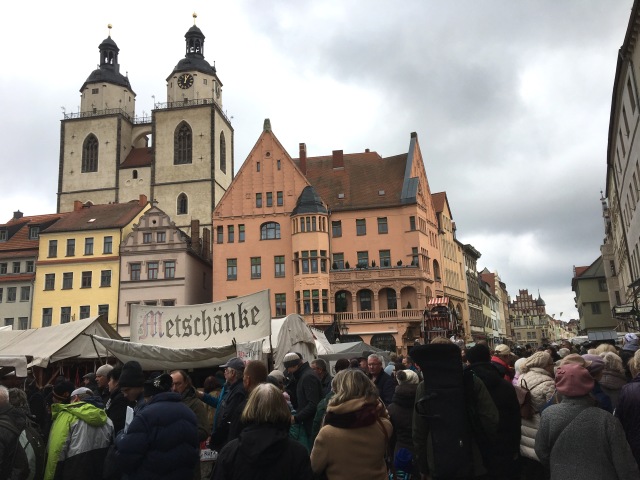
Wittenberg, Tuesday, October 31, 2017: The 500th anniversary of the Reformation in this little hamlet that was once the intellectual hub of Saxony and beyond. Reformation Day was a big event (even Angela Merkel made an appearance), and I was there with my bride. My third visit to Lutherstadt. The crowds swelled, especially close to the Schlosskirche and the town square. The day before and after, the town was virtually empty.

St Mary's church and town square_500th ann copy

How many of the celebrants really knew what the Reformation was all about? Sure, it changed western civilization, gave modern man the Bible in his own language—one that was based on the original tongues, delivered to the Renaissance a swift kick in the derriere, moved toward integrating science and religion and bringing both out of the middle ages (which were, in many ways, still the dark ages), elevated the education levels of children throughout Europe, established biblical scholarship on a new plane, inaugurated critical thinking of the Bible, added to the scientific method, built hospitals, toppled governments, granted individuals their God-ordained dignity, began to produce the wealth of nations, instigated the Protestant work ethic, and increased learning of the arts, science, history, and literature like no other period before or since has ever done.

But what did it ultimately do? It was begun by a lone Augustinian monk, standing up against the world, who articulated that salvation is free, and it comes by faith alone in Christ alone. Simul iustus et peccator (“at the same time, just and a sinner”) was the slogan based on Rom 3.23–24, and it’s still true today. The greatest good that Luther did was to remind us all of God’s grace and the redemption that we find in Christ alone. One lone monk changed the world because he had the courage of his convictions and believed that his God would not deny him. How about we change the world again—just one of us, or more (!)—and remind people of God’s grace, of the sacrifice that his own Son made on our behalf and in our stead, so that by the merit of Christ’s life and death alone—not ours—our eternal life is secured.

Schlosskirche Wittenberg_27 Oct 2017 copy

The clarion call of the Reformation is as desperately needed today as it ever was, yet after 500 years it has become muddled once again. And many evangelicals nowadays are denying the very roots of the Reformation—the imputation of Christ’s righteousness to our accounts, our Lord suffering God’s wrath in our place on the cross, salvation as a free gift (not based on our works), Scripture as our final authority, the exaltation of Christ.

Luther statue_500th anniversary copy

Sure, Luther got a lot wrong. His hot-headedness got him in trouble often, and many times unnecessarily so. But that same passion is exactly what was needed at the Diet of Worms. However, he also kept Erasmus from joining the ranks of the Reformers in spite of the priest’s own arguments with Rome. He needed a Melanchthon to temper him, to be the quiet, peaceful, intellectual force behind the Reformation. Luther’s worst offense was what he wrote about the Jews in his later years (On the Jews and Their Lies [1543]). It was ugly, un-Christian, hate speech. The Jüdensau is still in the same spot it has occupied for over 700 years—up high in the southeast corner of St. Mary’s Church—the first Protestant church—where Luther preached hundreds of times.

But let us not use Luther’s very flawed nature as an excuse to turn a deaf ear to his gospel proclamation. After all, we stand on the shoulders of giants today, but those giants more often than not had clay feet. And their very failings remind us that, of all the men and women who have ever lived, Christ alone is worthy of all honor.

Will another lone Christ-follower stand up today? Just think what one person can do if fear is not part of their vocabulary!

A Sad Home-Going for Three Saints

Autumn, for me, has been over many decades a time of adrenalin rushes, über-busyness, and frantic logistical outworkings. The cause of all this? The beginning of a new school year. This year was no exception, yet right out of the gate one biblical/theological giant after another departed this sphere for his eternal home. All died this month.

In different ways these three men all influenced me. Stanley Toussaint was a colleague at Dallas Seminary, a man who taught the Bible for forty-two years at DTS. He was one of the last of the luminaries of the 1970s (my time in the ThM program)—John Walvoord, Charles Ryrie, S. Lewis Johnson, Jr., Haddon Robinson, Harold Hoehner, Zane Hodges—who have all gone beyond the sufferings of the present time. Stan taught in the Bible Exposition Department (which is different from the Old Testament and New Testament Departments). He lectured from his Greek New Testament and had a down-home wit, pastoral heart, and penetrating insights into the text.

Stan was always cheerful in spite of having a severe limp from polio that struck him down when he was just a child. I never had the privilege of taking a course from Stan, however: I came in to DTS with plenty of English Bible and was permitted to pass on my English NT courses as long as I filled up the units with courses from the Biblical Studies Division; I loaded up on Hebrew. We agreed on much, but we also disagreed on some things. For example, he tenaciously held to Matthean priority, a position my own department chairman, Harold Hoehner, also embraced. I came to the position of Markan priority in 1987, a dozen years after following in Hoehner’s train.

Robert L. Thomas, professor of NT at Master’s Seminary, 1987–2008, also died just a few days ago. He was a professor at Talbot Seminary when I was a student at Biola University. I heard him speak in chapel a few times and learned that he would frequently invite my Greek professor, Harry Sturz, to his Greek classes to introduce students to Sturz’s perspective on NT textual criticism. Afterward, Thomas would refute Sturz’s position.

Bob and I had a few tangles over the years. In his school’s journal, he critiqued my Greek Grammar Beyond the Basics in the article, “The Principle of Single Meaning” (TMSJ 12/1 [2001] 33–47). He claimed that the book has some interesting points, but it also was “extremely dangerous.” Why? Because I had presumably imbibed Roman Catholic hermeneutics with my category of plenary genitive. Ironically, what Bob did not know was that I learned of that category of usage (though not by that name) by one of his revered theology professors, Charles Ryrie—a man who could hardly be accused of following Roman Catholic hermeneutics.

Bob also didn’t care much for ideas with theologically liberal roots, especially the historical-critical method—this in spite of responses by my colleague, Darrell Bock, and many other evangelical exegetes who argued that method and presupposition are not the same thing.

I suspect that Bob and I would probably have agreed more on many points of Reformed theology than I did with Stan Toussaint. Regardless of what one thinks of how Thomas dealt with other evangelicals, I confess that I admire the man for his faithfulness to scripture and to studying the original languages his whole life.

This past Thursday, September 21, I drove down to Houston with my good friend, Ed Komoszewski, to the funeral of another good friend, Nabeel Qureshi. Nabeel was diagnosed with stomach cancer in August 2016 and succumbed to the disease on Saturday, September 16. He leaves behind his wife, Michelle, and their young daughter, Ayah. Nabeel came to faith in Christ dramatically through the instrumentality of his college roommate David Wood and through visions of Christ, about a dozen years ago. He became a champion for the gospel. His first book, Seeking Allah, Finding Jesus, has been a huge success, selling hundreds of thousands of copies. Nabeel died too soon. He was only 34.
Screen Shot 2017-09-24 at 12.41.36 PM.png

Nabeel and I had our differences, too. He didn’t care much for Calvinism especially. We would have vigorous, passionate discussions about God’s sovereignty and mankind’s responsibility/free will, but these never harmed our friendship.

His interest was in the Gospels and he would be on the opposite end of the spectrum from Bob Thomas when it came to evangelical historical criticism. He was an internationally-known evangelist, especially to Muslims.

And his brain-power was legendary. He had read the entire Qur’an in Arabic (the only true Qur’an) by the age of five. Nabeel was a medical doctor who then went on to earn three master’s degrees—one from Biola, one from Duke, and one from Oxford. He was working on his Oxford DPhil when he died. When Nabeel came to Dallas, we would get together to discuss the Gospels. He was a sponge! He soaked up everything I said, then wrung it out and gently refuted many of my points! He had great respect for me—far greater than I deserved. I have known few people with such an insatiable desire to learn or with such an incredible impact for the sake of Christ.

Many believers throughout the world are grieving for each of these men right now. All three will be missed. They are saints of the Lord who now know the glory that will some day be revealed to all of God’s sons and daughters.

NT Syntax video lectures on sale this week

My video lecture set Greek Grammar Beyond the Basics Video Lectures is 55% off in this Video Lecture sale: http://bit.ly/2pe1E2S. The deal ends April 20.

Although it is based on my grammar, four things especially are new: (1)  greater discussion of a few key exegetical passages and the impact syntax makes on them; (2) interaction with the recent view among some linguists and grammarians that deponency is a myth; (3) more arguments and evidence against the view that the Greek verb system does not grammaticalize time; and (4) an updated discussion of reasons for the historical present’s usage. In short, there are some things in this video lecture set that cannot be found in my grammar.

Ryrie’s Bibles and Manuscripts Auctioned off

On 5 December 2016, Sotheby’s had an auction of one of the world’s largest private collections of Bibles and manuscripts. The collection was Charles Ryrie’s, former professor of Systematic Theology at Dallas Seminary. For many years I would take my students to visit his home and see the treasures in his collection. Every year he would bring out new marvels that astonished me. I never saw the whole collection, but he was always generous in bringing out scores of volumes.

Ryrie died earlier this year. He was just a month shy of his 92nd birthday. I had been keeping a close eye on his collection and had discussed it with him many times over the years. Among other things, he owned three Greek New Testament manuscripts, one of only eleven vellum Luther Bibles in the world, and the finest copy of the 1611 King James Bible anywhere. He also owned several of Erasmus and Stephanus editions of the Greek New Testament, a couple of leaves of the Gutenberg Bible, and virtually every major English Bible from Wycliffe to the KJV. Altogether, nearly 200 items were auctioned.

screen-shot-2016-12-06-at-10-24-41-am

Benton Gospels—Codex 669

His Wycliffe Bible sold for $1.4 million, which was way over the anticipated price. The KJV sold way under its expectations—only $320,000. The Greek New Testament manuscripts were auctioned for $140,000 to $250,000. Codex 669, the Benton Gospels manuscript, was the most important (and most expensive) of these.

Sotheby’s does not let one know who the bidders are. We’re all given a paddle number and we bid with that, protecting our identities. But clearly someone was buying up a lot of these treasures, and the desire to get them no matter the cost (or so it seemed) certainly brought the price up. I bid on two small items, which quickly escalated out of my price range.

Ryrie did not own junk. His printed books were in excellent condition. The selling price reflected this. The very first published Greek New Testament, Erasmus’s Novum Testamentum (1516), sold for $24,000. The third edition (1522)—the first one to have the comma Johanneum in it—was a bargain at $5500.

novum-instrumentum-1-copy

Erasmus’s Novum Instrumentum (1516)

A second edition of Tyndale’s New Testament (Ryrie owned nearly a dozen of these!) sold for $75,000. There were also several copies of the Matthew’s Bible ($22,000), Coverdale Bible ($11,000–$21,000), Great Bible ($4,000–$28,000), Geneva New Testament ($30,000), Bishops Bible ($48,000), Douay-Rheims Bible ($18,000), a rare copy of the KJV ‘Wicked Bible’ (1631; so-called because the printer left out the ‘not’ in the seventh commandment; thus, “Thou shalt commit adultery”!) for $38,000.

The Luther vellum Bible sold for $260,000. It is probably the most beautiful book I’ve ever seen. This was more than double the expected sale price.

A rare Complutensian Polyglot (only 600 were printed) came in under expectations at $70,000. This included actually the first printed Greek New Testament, though it was not published until six years after Erasmus’s work was out. The Textus Receptus—the Greek that stands behind the KJV—was essentially Erasmus’s Greek New Testament, with some wording from the CP as well as later editions of the Greek New Testament that were largely based on Erasmus.

A very rare certificate of ordination signed by Luther brought $60,000. And the third edition of Pilgrim’s Progress netted $75,000—as much as three times the expected sale price. Finally, the Gutenberg leaves each garnered only $38,000, way under what was anticipated.

The Center for the Study of New Testament Manuscripts owns a 10th–11th century Greek copy of Luke’s Gospel that was appraised at a price that is significantly lower than any of these Greek New Testament manuscripts. Now we have more recent comparisons and the value of such a manuscript can be weighed in light of these other manuscripts. I think we need to up the insurance value!

I hope that these books and manuscripts have found decent homes, and that the new owners will take the best possible care of them. And I also hope that the owners will reveal who they are and make known their remarkable volumes to others. I especially would like to see them digitally preserved and the images posted on the Internet—in particular, the Greek NT manuscripts. CSNTM would be more than happy to digitize these manuscripts. It’s a good time of year to express such hopes. This is more than my bucket list—it’s my Christmas list! Owners, please do not hide your light under a bushel, but let the world see these historical items that all of us may be enriched by Ryrie’s collection.