Lectionary 2258: A Most Unusual Manuscript, with Update (2026)

Lectionary 2258—A Most Unusual Manuscript

Daniel B. Wallace

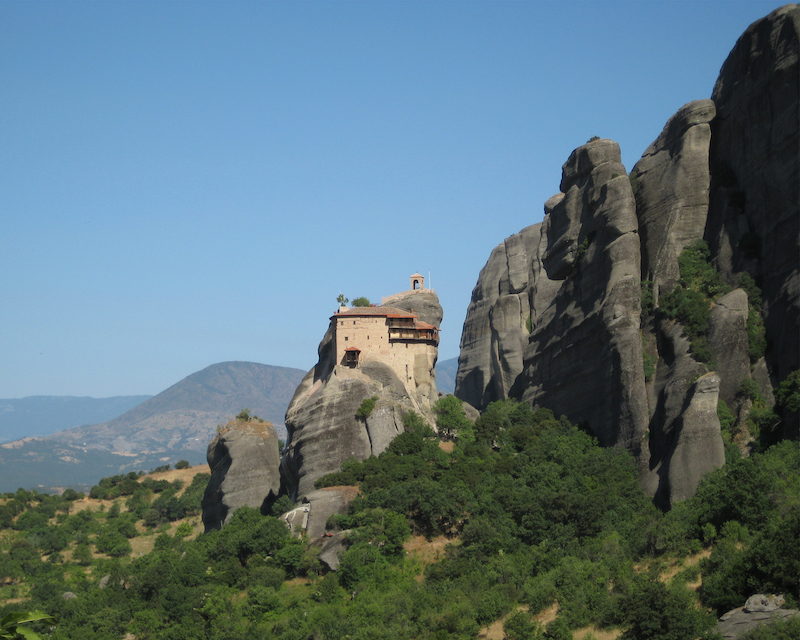
11 June 2011. Meteora is one of the most stunningly beautiful and other-worldly places on earth. Nearly a millennium ago, monks traveled throughout Greece in search of a place where they could get close to God and spend their days praying in undiluted solitude. Ultimately, six monasteries were established there, all but one perched atop stone pillars rising hundreds of feet above the plain below.

Metéora (Greek: Μετέωρα, ‘suspended rocks,’ ‘suspended in the air’ or ‘in the heavens above’) is one of the largest and most important complexes of Eastern Orthodox monasteries in Greece, second only to Mount Athos. The six monasteries are built on natural sandstone rock pillars, at the northwestern edge of the Plain of Thessalynear the Pineios River and Pindus Mountains, in central Greece. The nearest town is Kalambaka. The Metéora is included on the UNESCO World Heritage List.”

OK, I confess. The previous paragraph is lifted verbatim out of Wikipedia. But it’s a decent geographical description of the place. But nothing quite prepares you for Meteora’s rock formations that tower over the town below, the monasteries that melt into the sandstone pillars effortlessly, flush with the edges of the majestic columns, the eerie view of the ever-changing scenery as you drive on the perilous mountain switchbacks. 

But I’m getting ahead of myself. It’s just a few hours to get to this unique place from Athens. You get on National Highway 1 and travel up the eastern coastline, stopping to see where King Leonidas and 300 Spartans held off the original million-man march at Thermopylae. Then, the road begins to wind inland until you arrive at Kalambaka, where you must find lodging if you are to visit the monasteries. Kalambaka strikes me as a town that grew up around the convents, bringing visitors to the brick and stone cloisters that were built and inhabited for seclusion. For centuries, the only way to the top was via a basket attached to a line that must have been cranked for hours before unloading its cargo of personnel and necessities. When asked how one would know when to change the cables, the priests drolly replied, “God lets us know.” Beginning in the early twentieth century, pathways from adjacent mountains were built for the many visitors. One too many ropes had snapped, leaving those in the baskets barely enough time to collect their thoughts and offer a final prayer to God. 

In this place are scores of biblical manuscripts. As the only nunnery among the abbeys, St. Stephen (or Μονὴ Ἁγίου Στεφάνου) has a small collection of fascinating handwritten scriptures. But one in particular caught my attention—lectionary 2258. 

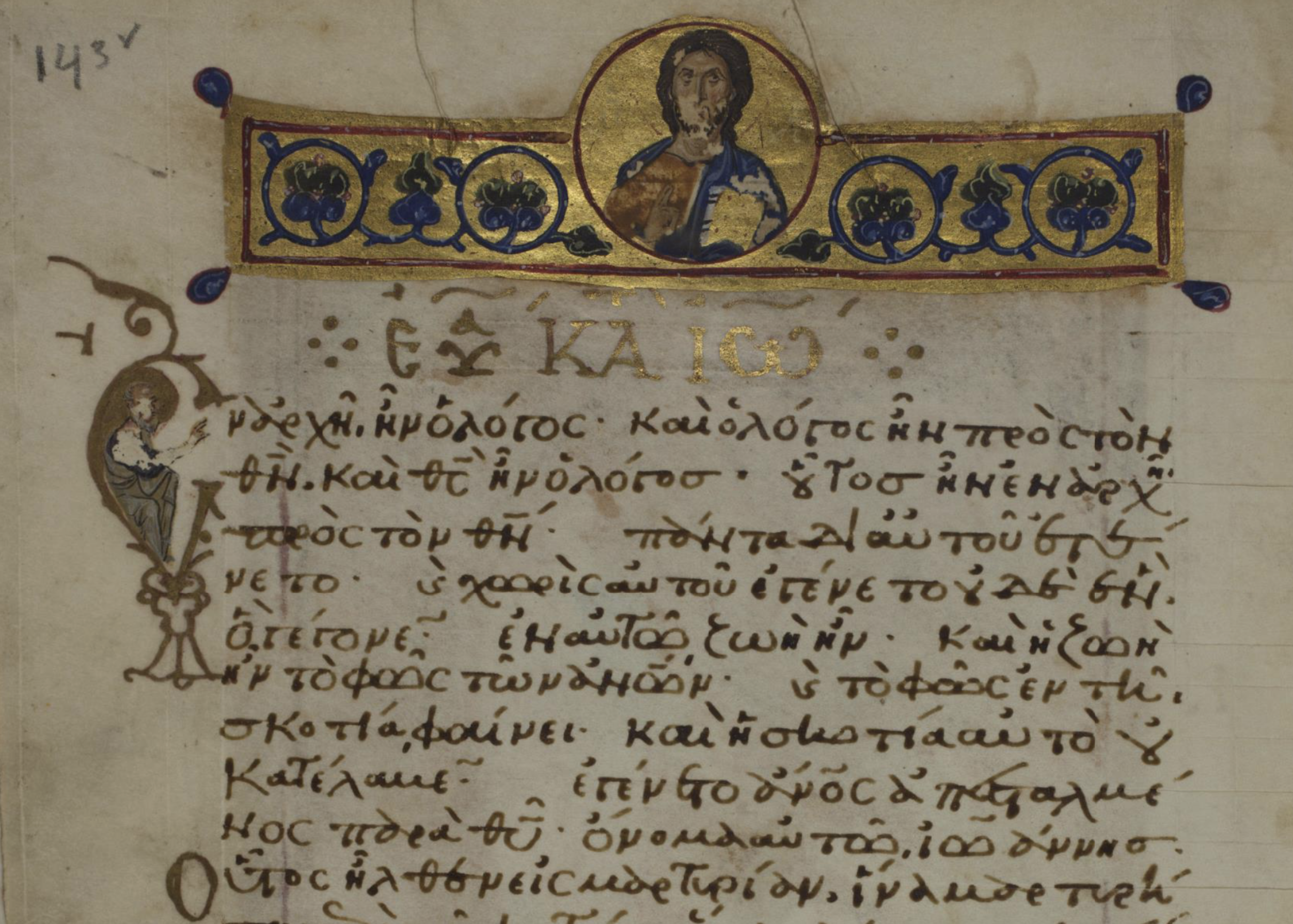
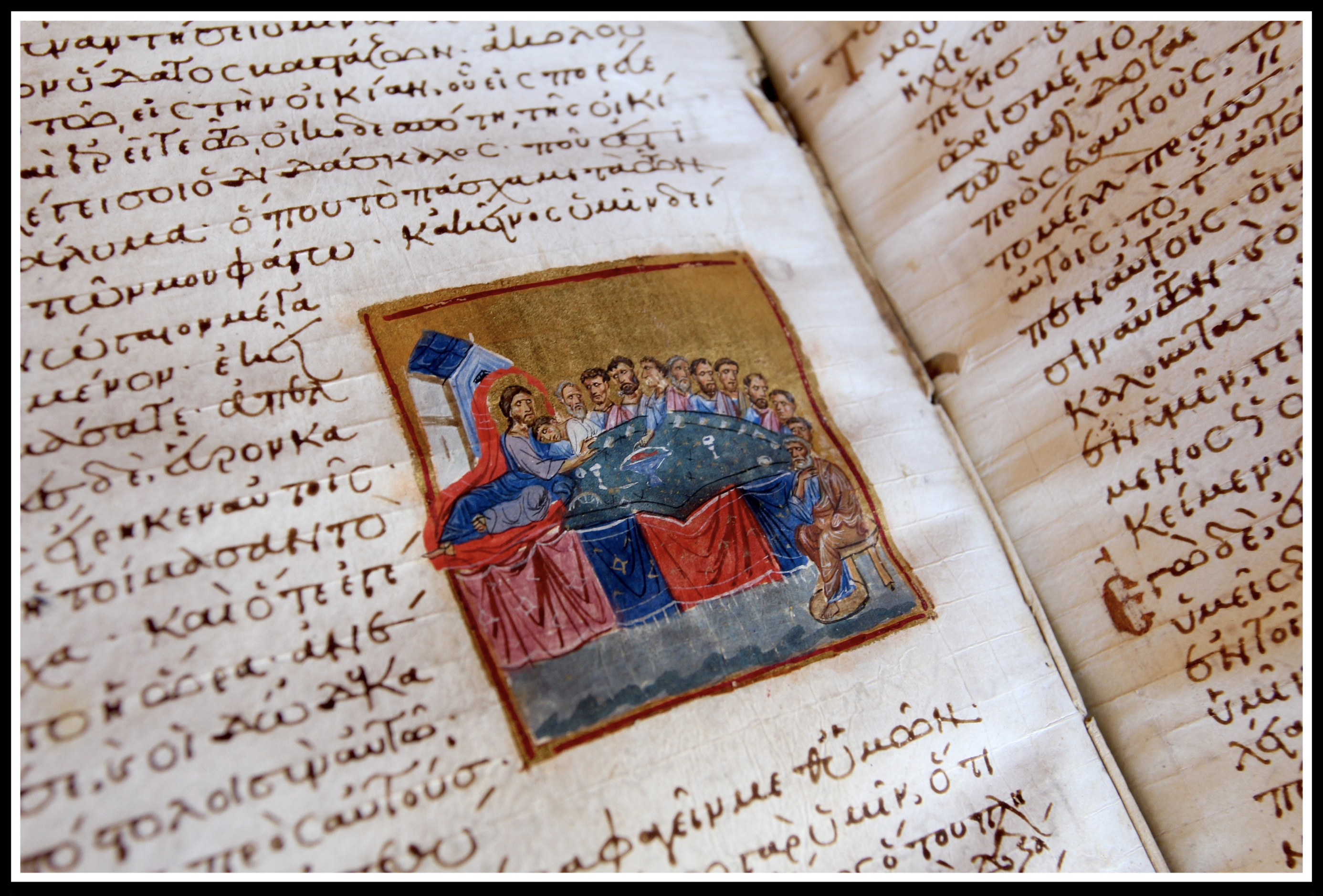
The manuscript is a 230-leaf paper codex with parchment covers glued to cardboard. The parchment jackets have minuscule handwriting, with a majuscule text previously glued on top of them, both for the front and back covers. It is these covers that are of interest to us, since just the majuscule writing is the lectionary.

At first glance, the manuscript appeared to be a palimpsest—a text that was scraped over and reused in later centuries for writing. By the middle ages, the practice of reusing vellum was so ubiquitous that Charlemagne had ordered an empire-wide order to cease and desist. This codex looked to be one such palimpsest, produced by some recalcitrant scribe who scoffed at the Carolingian edict. By definition, the under-text of a palimpsest is older than the upper-text. And majuscule handwriting was exclusively used for the first eight hundred years in biblical manuscripts, with minuscule codices coming into play beginning in the ninth century. The minuscule text was obviously later than eleventh century, the date that scholars had determined for the majuscule lectionary. But the majuscule text looked to be on top of the minuscule text. How could this be? It was impossible, of course, but there it was, staring us in the face, mocking us with its mysteries.

We looked closer at the text, hoping against hope that it would somehow reveal its secrets to us by some mystical union between man and manuscript. We tried to read the text, and this proved impossible as well. Although it had Greek letters, they did not form Greek words. 

Typing out each letter, there was nothing unusual about the Α, Δ, Η, Θ, Ι, Λ, Μ, Ν, Ο, Π, Τ, Υ, Φ, Χ, or Ω. But the other letters were different: they actually were written backwards. Because in majuscule script most of the letters look the same whether forward or backward, it took us some time to unlock the secret of this document. How did such a reverse image happen? That took some noodling, but the mirror image provided a sufficient clue. A majuscule text was apparently pressed against the minuscule text cover, got damp, and left a residue of letters. The majuscule leaf then vanished, but a shadow of its letters as a mirror image remained. For part of the majuscule handwriting, the outer layer of skin had completely peeled off, adhering to the paper below. We were reading the backside of the top layer of parchment, as though we were the parchment looking out as the scribe penned his words. 

As we followed this hunch, a text emerged. On the recto, we could make out the following letters:

λεια (in the first column, about four lines down)

κνα και παντα οσα (second column, about halfway down)

εν και αποδοθη (the underscoring = underdots, the traditional way to indicate uncertain letters)

The only text that fit this was Matthew 18.23, 25. The reconstructed lines thus read:

βασιλεια

τεκνα και παντα οσα

ειχεν και αποδοθη

The verso had the following (with brackets indicating our educated guess as to what was in the gaps):

ν]ηανι

σκος το]ν λο[γον

απη]λθεν λυπου

μενος ην γ]αρ εχ[ων 

κτ]ηματα πολλα

This was Matthew 19.22, with the variant spelling νηανισκος for νεανισκος. This confirmed that we were dealing with a lectionary. Before the lines that contained βασιλεια on the recto, there must have been the previous lection as well. The lections thus detected were: 

Unconfirmed

Lection κυριακη ια (12th week) for Sunday: Matt 18.23–35

Lection κυριακη ιβ (13th week), Sunday: Matt 19.16–26.

So, here was a manuscript that technically has no material on which it is written (except for the thin layer of skin for a small portion), because the material has vanished. All that is left is the shadow of letters, in mirror image, on another manuscript. I hesitate to call this unique; there may be other manuscripts that went through a similar process. But of the hundreds of biblical codices I have examined, this was a first for me. 

Update 29 April 2026. Elijah Hixson was able to determine new info from a mirror image deposit of ink in the infamous Codex Beza; the ink of the Greek text of Acts 10.4–9 was imprinted on the facing Latin page of this infamous diglot. (See Elijah Hixson, “A Lost Page of Codex Bezae: Traces of the Bezan Greek Text of Acts 10.4-9,” New Testament Studies 64 (2018):213–230. And Garrick Allen just published 42 new ‘pages’ of Codex H (015), an important sixth-century majuscule of Paul’s letters that is spread throughout many libraries in Europe. The new pages are mirrored ink traces found on other pages; thus, the 42 new pages are really ‘ghost pages,’ with only the ink residue remaining. The photographs were taken with multispectral imaging equipment. For more information, see here.
New Discoveries on Every Page: P45, P46, P47

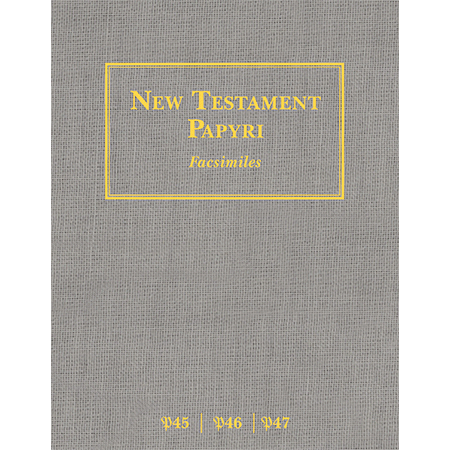
Nearly nine decades ago, three of the earliest and most extensive New Testament papyri were made available to scholars through color photographs. These facsimiles, together with their authoritative transcriptions, have remained the primary access that biblical scholars and papyrologists have had to them. Until now. With the multi-volume publication of New Testament Papyri 𝔓45, 𝔓46, 𝔓47 coming out later this year, new, exquisite, exact-size images will become available in print. After digitizing these priceless manuscripts at the Chester Beatty in Dublin and the University of Michigan, CSNTM has collaborated with Hendrickson Academic in the endeavor to offer fresh, library-quality images of these third-century copies of large portions of the New Testament.

P45 cover

The facsimiles will be published both with a white background and a black background, each of which offers different views of the texts. Perhaps surprisingly to many, the black background images were found to be much more helpful for creating accurate transcriptions.

For this initial offering, the transcription of just 𝔓47 will be included with the images of all the manuscripts. 𝔓45 and 𝔓46 will follow in coming years, as the task of transcription still continues. The process of transcribing, however, which has been done in large part on the other two papyri, should yield far more precise results than Sir Frederic Kenyon’s editio princeps of the 1930s. It is no exaggeration to say that thousands of corrections to Kenyon’s transcriptions are in the offing. To be sure, most of these are quite minor, but some are fairly stunning. But every correction to Kenyon’s brilliant but somewhat rushed efforts bring us one step closer to understanding the text of the New Testament in third-century Egypt.

By the use of careful measurements, rigorous comparisons with multiple close-ups of individual letters and ligatures, and intense arguments (!), the editors (Stratton Ladewig, Robert Marcello, and Dan Wallace) are able to offer a new standard transcription of each papyrus. In this short blog, I offer but one animation that lays out our procedure. (Thanks go to my son, Andrew Jon Wallace, for producing this illustration.)

The 28th edition of the Nestle-Aland text in Mark 8:22 reads Καὶ ἔρχονται εἰς Βηθσαϊδάν. Καὶ φέρουσιν αὐτῷ τυφλὸν καὶ παρακαλοῦσιν αὐτὸν ἵνα αὐτοῦ ἅψηται. One variant is listed—Βηθανιαν for Βηθσαιδαν in D and a couple other witnesses. What is not mentioned is the variant for ερχονται. The majority of manuscripts here, along with the key majuscules א* and A, have the singular ερχεται. Kenyon reconstructed the wording of 𝔓45 as having the plural, though underdotting every letter as dubious. But this identification is almost surely incorrect. The space for the word and the shape of the letter fragments fits like a glove for ερχεται. Due to the difficulty of making out the letters in the old plates, one can understand the wrong guess. But with better photographs coupled with the comparisons that digital images readily afford, the CSNTM editors have concluded that 𝔓45 here has ερχεται.

Such may not seem terribly significant. Yet every small decision, every correction, every change to the identification of the text in question gives us a better sense of what these scribes wrote eighteen centuries ago. Further, the singular here does offer a slightly different interpretation on the passage. Although it is true that Jesus and his disciples came to Bethsaida, whether Mark wrote “they came” or “he came” has some significance. On occasion the evangelists use a singular verb with a compound subject. This throws the spotlight on the first-named subject. And frequently, that subject is Jesus (see John 2:2; 3:22; cf. also Matt 13:55; Acts 5.29; 16:31). Mark concludes his pericope on the healing of the blind man with this idiom (Mark 8:27: Καὶ ἐξῆλθεν ὁ Ἰησοῦς καὶ οἱ μαθηταὶ αὐτοῦ). It is a distinct possibility that he would begin the pericope the same way. Such would be a subtle and fitting inclusio in one of Mark’s better-crafted stories. And 𝔓45 might just tip the scales for us to see it.

In the midst of a global pandemic, we still need to save Scripture


This coming Saturday, the Center for the Study of New Testament Manuscripts (CSNTM.org) had scheduled to have its annual Dallas Fundraising Banquet. Some weeks ago we pulled the plug on that. The coronavirus has spread exponentially since then.

Screen Shot 2020-03-30 at 4.53.54 PM

The world is facing a pandemic right now, and we are all sheltering at home. People are losing jobs, facing personal isolation, depression, and genuine crises. Many are dying, communities are dissolving, and a new normal may be emerging. We are praying that this is not the new normal for very long though!

In the midst of this global scenario, there are some things I am sure of. The sun will come up tomorrow, people need to eat, and our time on this planet is limited. CSNTM was founded 18 years ago because of another thing I am sure of: ancient, handwritten copies of the Bible are deteriorating. They are all written on organic material (papyrus, parchment, or paper), and because of this they are not permanent. Our initial task is to save Scripture. Each manuscript is unique. Every one has a story to tell. These are not books rolling off a printing press; they are individual works of love, gifts to future generations of people, written by men and women whose only thanks is from their Lord. The task of saving Scripture remains, and its necessity is underscored in light of the fragility of life that the whole world is now coming face to face with. Life has always been fragile, but sometimes it takes a crisis to bring this out of the shadows and put it front and center.

Screen Shot 2019-05-23 at 8.47.16 PM

Our mission is still the same. And our need is still the same. When this pathogen runs its course, CSNTM will be back at our preservation work throughout the world. There are more than 250 locales where these manuscripts are housed; our mission is to make sure they are digitally preserved, cover to cover and everything in between, with state-of-the-art equipment, allowing us to post the images on line and make them accessible to all. These images have always been free for all, and free for all time. We are ready to traverse the globe to save these Scriptures; we will pack up our equipment and fly out as soon as we are allowed.

This week, instead of a physical banquet, CSNTM is having its first-ever (and hopefully, only) VIRTUAL banquet! Please follow along this week, enjoy the testimonies, and watch the short videos, on the significant and exciting work that CSNTM is doing. Every day you will see new videos. In the least, you can watch these shorts and learn something about the Bible, its heritage, and the faithful, mostly anonymous scribes who labored in abysmal conditions to bring the Scriptures to generations of people they would never know.

Sometimes scribes penned a personal note at the end of a manuscript they were copying. One of them, Andrew, wrote this note to conclude the copy of the New Testament he had worked on for many months: “The hand that wrote this is rotting in the grave, but what is written will last until the fulness of times.” Andrew penned this note in AD 1079. The manuscript is not in great shape, but CSNTM was able to photograph it and preserve it digitally. Like Andrew, some day all of us will be rotting in the grave. Wouldn’t it be an incredible gift to  our descendants a thousand years from now to be able to read these manuscripts with the same clarity we have today?

Please join us for this virtual banquet. And please partner with us in a mission that is bigger than any of us; it’s an investment that will pay dividends for generations to come.


CSNTM’s Mission: Urgent and Significant

The Center for the Study of New Testament Manuscripts has recently hired a professional videographer to produce a four-minute video of our mission. Although I am the talking head, the whole staff of CSNTM worked very hard to make this film a reality. It’s short and communicates well what CSNTM is all about. Please take a look!

As we point out in the video, our work is urgent and significant. Manuscripts are deteriorating, some at an alarming rate. What is not mentioned is that CSNTM is funded solely by donations. Although hundreds of thousands of manuscript images can be viewed for free, they are costly to produce and archive. To digitize a single manuscript costs the Center $7500. Our job is a long way from being completed. And all these projects require funding. I’m asking you to consider making a donation to the Center.

We need more people to become part of the “Circle of Friends”—those who partner with us by donating monthly to our mission. Even more pressing is the need to fund projects that are waiting in the wings. Would you consider helping the Center in its mission to preserve unique, handwritten copies of the Christian Scriptures?

As I mention in the video, a thousand years ago a monk named Andrew wrote a personal note at the end of the manuscript he was copying: “The hand that wrote this is rotting in the grave, but the words that are written will last until the fullness of times.” His words have become our mission statement. Won’t you join us?

One-of-a-kind trip to Greece

The Center for the Study of New Testament Manuscripts is offering a one-of-a-kind trip to Greece next spring. We’re calling it the “Insider’s Expedition.” The trip will take place on March 7–16, 2020. It will feature sites in Athens—including an insider’s look at the National Library of Greece, the other-worldly monasteries of Meteora, select islands, and ancient Corinth.

MeteoraMonastery

We can only take twenty couples for this unique adventure. Thanks to Rob Marcello for working hard the last several months to make this expedition come to fruition! Details are on CSNTM’s website. Tickets are going fast!