There Were Giants in Those Days: Codex Robertsonianus, Part 2

In my previous post about the correspondence between Adolf Deissmann and A. T. Robertson concerning a Greek Gospels manuscript, I showed the pictures of Deissmann’s first letter, along with a transcription of it.

This is the second of four parts of that correspondence. These letters constitute the A. T. Robertson Papers, Box 7, Folder 3, Archives and Special Collections, James P. Boyce Centennial Library, The Southern Baptist Theological Seminary, Louisville, Kentucky. I am grateful to Adam Winters, archivist at SBTS, who provided the photographs. They are used with permission of the SBTS Archives & Special Collections.
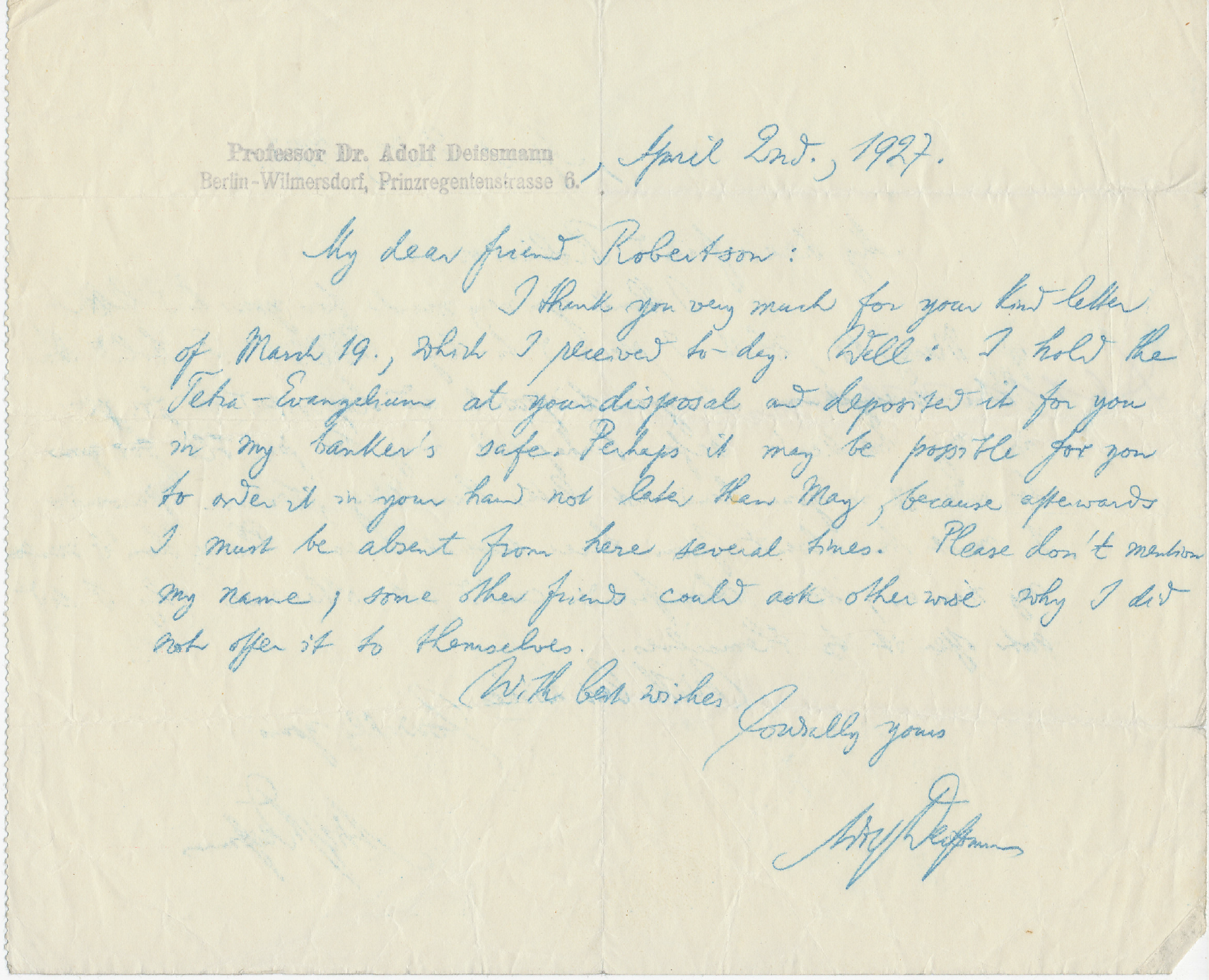
Deissmann to Robertson_2 Apr 1927

Professor Dr. Adolf Deissmann
Berlin-Wilmersdorf, Prinzregentenstrasse 6., April 2nd., 1927.

My dear friend Robertson:

I thank you very much for your kind letter of March 19., which I received to-day. Well: I hold the Tetra-Evangelium at your disposal and deposited it for you in my banker’s safe. Perhaps it may be possible for you to order it in your hand not later than May, because afterwards I must be absent from here several times. Please don’t mention my name; some other friends could ask otherwise why I did not offer it to themselves.

With best wishes
Cordially yours
Adolf Deissmann

Another Biblical Scholar is No More

David Martinez (Associate Professor in both the Classics and Divinity departments at the University of Chicago), one of Francis Gignac’s students a long time ago, once told me that Gignac was far and away the best Hellenistic Greek grammarian alive today. All of us waited for the third volume, Syntax, of his projected trilogy on Roman and Byzantine Greek (volumes 1 and 2 were on Phonology and Morphology, respectively). But the third volume never was published. Perhaps an alumnus of Catholic University of America could locate his files, edit the volume, and publish it for Gignac posthumously.

My friend and former intern, Chris Skinner, recently blogged about the passing of Father Francis Gignac earlier this month. Here’s the link: http://cruxsolablog.com/2014/06/04/francis-t-gignac-s-j-1933-2014-skinner/


There Were Giants in Those Days: Codex Robertsonianus (Gregory-Aland 2358), Part 1

In 1927, Adolf Deissmann began a correspondence with A. T. Robertson that led to the purchase of a Greek Gospels manuscript by Southern Baptist Theological Seminary. Some of the story of this manuscript’s travels and text is told by John W. Bowman in his 23-page booklet (with four plates), The Robertson Codex (Allahabad, India: Mission Press, 1928). The booklet was a reprinting of articles in The Indian Standard 139, nos. 8 and 9 (August and September, 1928). Bowman had been a student of Robertson’s at Southern and later became professor of New Testament and Church History at North India United Theological College in Saharanpur, India.

In Bowman’s booklet are two chapters, which correspond to the two articles in The Indian Standard. The first chapter addresses the process of photographing the manuscript, and is a window on the difficulties that attended such labors in the 1920s. It took the author nearly three months to photograph it! Today, with digital photography, the Center for the Study of New Testament Manuscripts normally photographs a 350-page manuscript (the size of Codex Robertsonianus) in less than a day. In this chapter he mentions the rarity of photographs of New Testament manuscripts: “Very few complete MSS of the N.T. or portions thereof have hitherto been photographed: I am personally aware of only five such” (5). Bowman’s second chapter discusses many fascinating details of the manuscript.

One thing is largely missing, however, from the book: except for small snippets here and there, the correspondence between Deissmann and Robertson is not mentioned. This blog thus supplements Bowman’s pamphlet with Deissmann’s letters to Robertson concerning the codex (I do not have access to Robertson’s responses to Deissmann).

Below are photographs of the first letter (along with the text printed beneath each one), which was obtained from Southern Baptist Seminary. In later blogs, I will post the rest of the letters and text. These letters constitute the A. T. Robertson Papers, Box 7, Folder 3, Archives and Special Collections, James P. Boyce Centennial Library, The Southern Baptist Theological Seminary, Louisville, Kentucky. I am grateful to Adam Winters, archivist at SBTS, who provided the photographs. They are used with permission of the SBTS Archives & Special Collections.

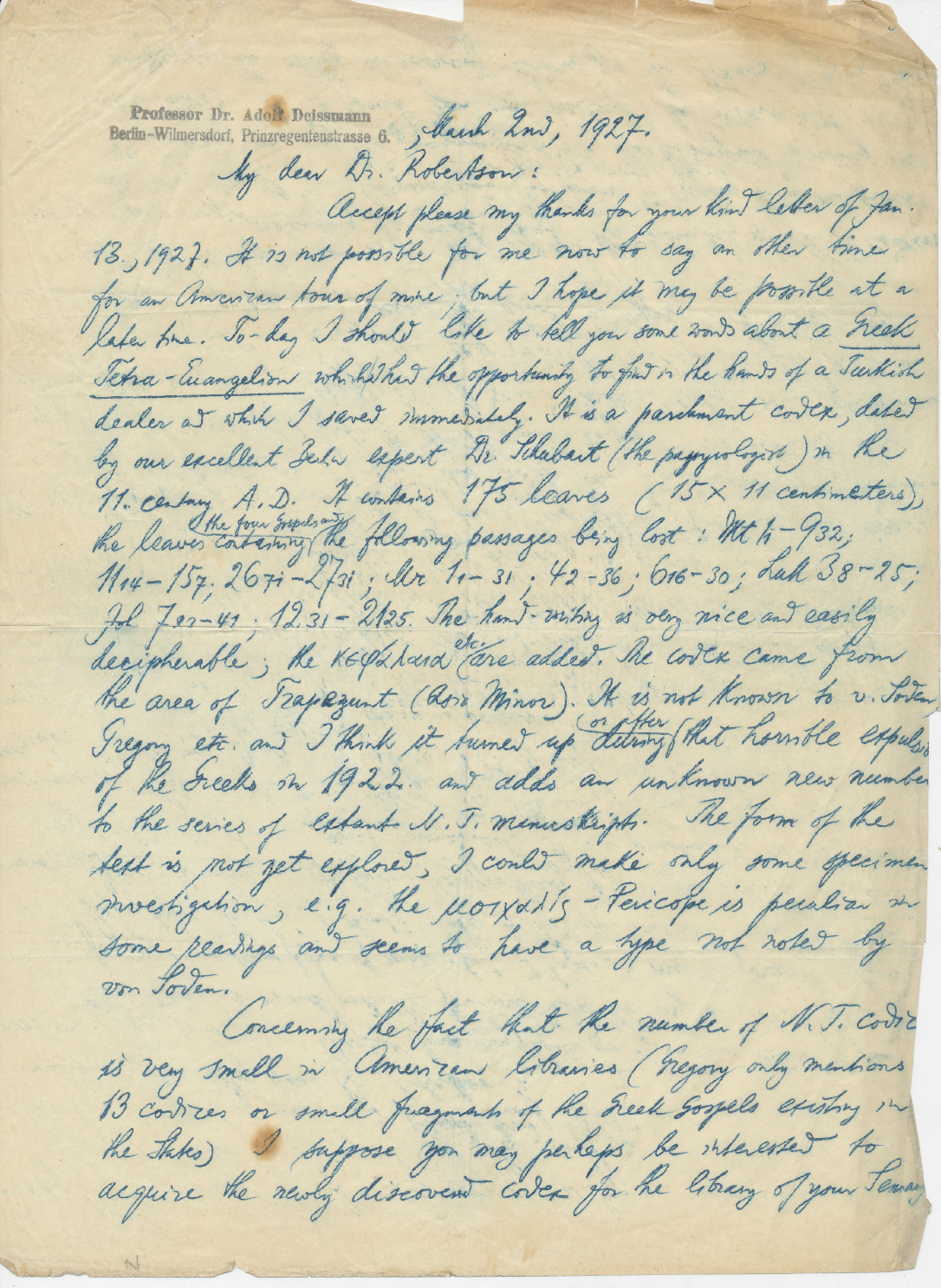
Deissmann to Robertson_2 Mar 1927_page 1 of 2

Professor Dr. Adolf Deissmann
Berlin-Wilmersdorf, Prinzregentenstrasse 6., March 2nd, 1927.

My dear Dr. Robertson:

Accept please my thanks for your kind letter of Jan. 13, 1927. It is not possible for me now to say an other time for an American tour of mine; but I hope it may be possible at a later date. To-day I should like to tell you some words about a Greek Tetra-Euangelion which I had the opportunity to find in the hands of a Turkish dealer and which I saved immediately. It is a parchment codex, dated by our excellent Berlin expert Dr. Schubart (the papyrologist) in the 11. century A.D. It contains 175 leaves (15 x 11 centimeters), the leaves containing the four Gospels and the following passages being lost: Mt 11–932; 1114–157; 2671–2731; Mr 11–31; 42–36; 616–30; Luk 38–25; Joh 723–41; 1231–2125. The hand-writing is very nice and easily decipherable; the κεφάλαια etc. are added. The codex came from the area of Trapezunt (Asia Minor). It is not known to v. Soden, Gregory etc. and I think it turned up during or after that horrible expulsio[n] of the Greeks in 1922. and adds an unknown new number to the series of extant N.T. manuscripts. The form of the text is not yet explored, I could make only some specimen investigation, e.g. the μοιχαλίς-Pericope is peculiar in some readings and seems to have a type not noted by von Soden.

Concerning the fact that the number of N.T. codic[es] is very small in American libraries (Gregory only mentions 13 codices or small fragments of the Greek Gospels existing in the States) I suppose you may perhaps be interested to acquire the newly discovered codex for the library of your Seminary[.]
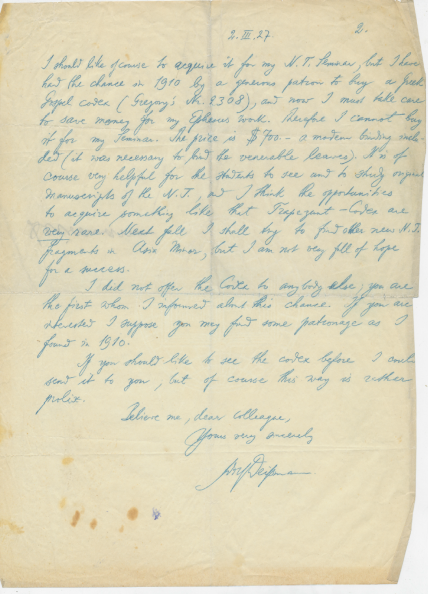
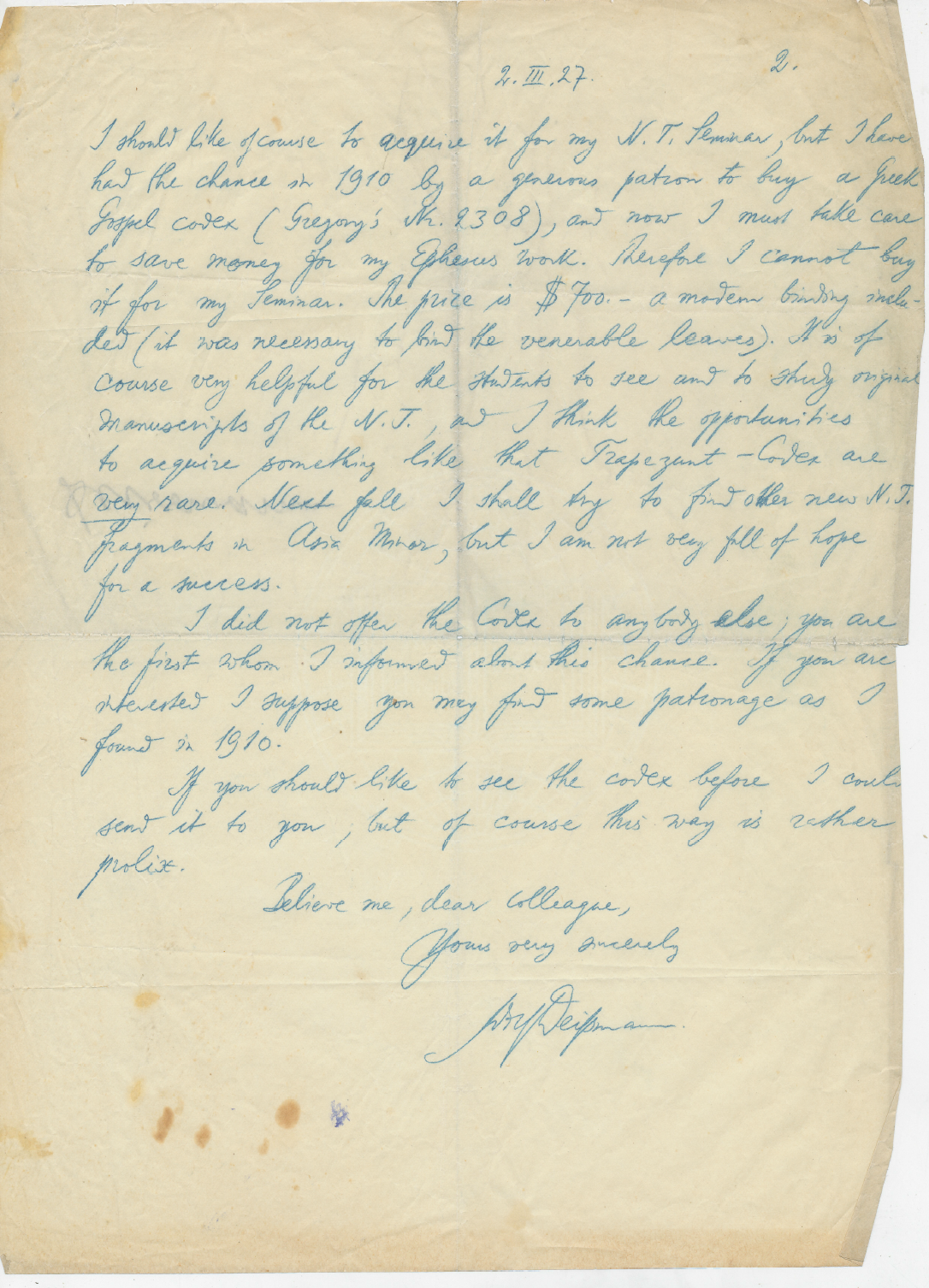
Deissmann to Robertson_2 Mar 1927_page 2

I should like of course to acquire it for my N.T. Seminar, but I have had the chance in 1910 by a generous patron to buy a Greek Gospel codex (Gregory’s Nr. 2308), and now I must take care to save money for my Ephesus work. Therefore I cannot buy it for my Seminar. The price is $700.—a modern binding included (it was necessary to bind the venerable leaves). It is of course very helpful for the students to see and to study original manuscripts of the N.T., and I think the opportunities to acquire something like that Trapezunt-Codex are very rare. Next fall I shall try to find other new N.T. fragments in Asia Minor, but I am not very full of hope for a success.

I did not offer the Codex to anybody else; you are the first whom I informed about this chance. If you are interested I suppose you may find some patronage as I found in 1910.

If you should like to see the codex before I could send it to you, but of course this way is rather prolix.

Believe me, dear colleague,

Yours very sincerely

Adolf Deissmann.

A New Twist on the Quadrilemma: Lord, Liar, Lunatic, or Legend?

The May/June 2014 issue of Touchstone has come out. In it is a provocative and, I might say, Lewis-esque piece of writing by Tom Gilson, the National Field Director of Ratio Christi. Called “The Gospel Truth of Jesus: What Happens to Apologetics if We Add ‘Legend’ to the Trilemma ‘Liar, Lunatic, or Lord’?” this article wrestles with the literary improbability of some author creating ex nihilo a person who is both absolutely powerful and absolutely good. Gilson wrestles with a number of objections, but marches through them and lays out an eminently reasonable case that no author could have created the likes of Jesus of Nazareth out of whole cloth. He may well be on to something. In turn, this argues for historicity. Take a look:

http://www.touchstonemag.com/archives/article.php?id=27-03-035-f

Josh McDowell’s Discover the Evidence

Last December I spoke at Josh McDowell’s Discover the Evidence conference in Dallas. There has been a flurry of activity commenting on this conference of late, and I wanted to set the record straight about a couple of things, but only a couple of things. My colleague, Darrell Bock, has quipped that the Internet rumor mill is just as fast as any angelic messenger, but it is not as reliable! His apothegm has proved true once again.

First, some blogposts have suggested that I was involved in the organizing of the event. This is not true. I was asked to speak at the event during lunch, which I was happy to do. I was one among many guest speakers, including some well-known scholars such as Father Columba Stewart, Director of the Hill Museum and Manuscript Library in Collegeville, Minnesota, and Dr. Peter Flint, Canada Research Chair of the Dead Sea Scrolls and Director of the Dead Sea Scrolls Institute, Trinity Western University. As a guest speaker at conferences, I usually have no input on what others are going to say. Such was the case here. My time at the conference was also quite limited. I heard no other lectures about the manuscripts, but simply gave mine and worked on identifying some papyrus fragments with some students for an hour or two. A terrible snowstorm hit Dallas that weekend, and my time at the event was significantly curtailed because of it.

Second, I am aware of what some bloggers are saying by way of criticisms against certain claims that were made by some of the participants at the conference. I never heard any of these claims so have no first-hand knowledge of them.

Third, other criticisms were made about the handling of archives and the dating of some of the papyri. Again, I was not a part of either of these features of the conference: we had papyrus fragments at our table and we never touched them by hand. We also did not have time to definitively date any of them.

Finally, some claims were made at the conference (so I am told) about one papyrus in particular, a fragment from Mark’s Gospel. What was said about that fragment was not said in my presence. And even if it had been, I can neither confirm nor deny the points made because I signed a nondisclosure agreement on this issue some time ago.

I realize that this note doesn’t satisfy the rumor mill much since there are no juicy revelations made here. And it hardly sets the record straight—except to note that my participation in this event, though happily entered into, was minimal. I am making no comment on conduct in handling the artifacts or statements made in my absence.