TIME-SENSITIVE: Put Stocks in Someone’s Stocking!

The year 2024 is almost in the books. It has been a wild roller coaster ride of a year. Ironically, instability seems to be the only thing that is consistent this year. The silver lining in the nimbostratus clouds of 2024 is that the U.S. stock market has done quite well overall. And that brings me to a special invitation.

As we enter the traditional season of giving, families also use this time to evaluate their tax situation. Granted, the continually shifting tax code doesn’t make that an easy exercise. But one constant of good news is that donating securities that have been held for a year or more offers the potential for a double tax benefit—a full fair market value tax deduction and elimination of capital gains taxes.

Many non-profits now allow direct stock donations (i.e., not having to sell the stock first). If the Lord has blessed you financially, you might want to consider giving some shares to one or more charitable organizations that you support. Many such organizations are in need of large financial infusions: although the stock market has done well, the economy is still doing poorly for too many of us. Giving a gift of shares is a very tangible way to show what really matters to you without adding to your living expenses.

The Center for the Study of New Testament Manuscripts now has a “stock option” for donations. You may donate stocks and bonds directly to CSNTM without having to sell them first. Stock gifts to CSNTM are handled by Overflow, the leading giving platform for the digital age. This can be a great way to invest in our shared mission to preserve the New Testament text and take advantage of the benefits for charitable giving in the U.S. Tax Code. (Alternatively, you can use these instructions to complete the transaction with your brokerage on your own.)

I wanted to put my stock where my mouth is, so I clicked on the CSNTM “donate stocks” page https://www.csntm.org/partnership/donate-stocks and donated some stock.
Giving securities to CSNTM was a snap. It took less than 10 minutes (and I’m old and slow!) to make the donation. Overflow makes it easy.

There is some urgency for such donations, both for CSNTM and other charities. Stock donations through Overflow must be made by December 10 to guarantee posting for 2024. That’s for the guarantee; Overflow recommends giving by December 13 to almost ensure (not quite a guarantee) that the gift will be credited for 2024. 

But there’s something else to consider for the long term: a donor-advised fund. Some donors like to set up their own private family foundation as a means of distributing gifts to favorite charities. But establishing a donor-advised fund with a firm like Fidelity Charitable can provide the ability to claim a higher tax deduction of 30% of your adjusted gross income compared to the 20% limit with a private foundation.

And the news gets better when you want to donate securities. By opening a giving account and contributing the shares to your donor-advised fund, you eliminate capital gains tax exposure and secure a charitable deduction based on the shares’ fair market value. Best of all, you can decide where to donate at a later date and, when the time comes, recommend a larger grant from your donor-advised fund than if you sell the shares and donate the net proceeds!

Our partner, Overflow, streamlines this process as well. You can donate from your donor-advised fund simply and securely here.

This is timely news for me and my family. I will be contributing more to my stock donations today, because I want to give CSNTM a generous Christmas present so that the Center can carry on the work that faithful scribes began 2000 years ago.
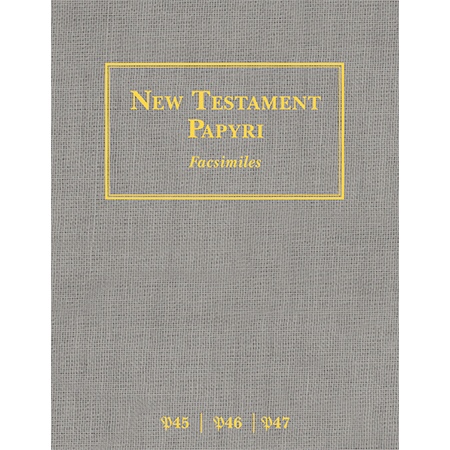
New Discoveries on Every Page: P45, P46, P47

Nearly nine decades ago, three of the earliest and most extensive New Testament papyri were made available to scholars through color photographs. These facsimiles, together with their authoritative transcriptions, have remained the primary access that biblical scholars and papyrologists have had to them. Until now. With the multi-volume publication of New Testament Papyri 𝔓45, 𝔓46, 𝔓47 coming out later this year, new, exquisite, exact-size images will become available in print. After digitizing these priceless manuscripts at the Chester Beatty in Dublin and the University of Michigan, CSNTM has collaborated with Hendrickson Academic in the endeavor to offer fresh, library-quality images of these third-century copies of large portions of the New Testament.

P45 cover

The facsimiles will be published both with a white background and a black background, each of which offers different views of the texts. Perhaps surprisingly to many, the black background images were found to be much more helpful for creating accurate transcriptions.

For this initial offering, the transcription of just 𝔓47 will be included with the images of all the manuscripts. 𝔓45 and 𝔓46 will follow in coming years, as the task of transcription still continues. The process of transcribing, however, which has been done in large part on the other two papyri, should yield far more precise results than Sir Frederic Kenyon’s editio princeps of the 1930s. It is no exaggeration to say that thousands of corrections to Kenyon’s transcriptions are in the offing. To be sure, most of these are quite minor, but some are fairly stunning. But every correction to Kenyon’s brilliant but somewhat rushed efforts bring us one step closer to understanding the text of the New Testament in third-century Egypt.

By the use of careful measurements, rigorous comparisons with multiple close-ups of individual letters and ligatures, and intense arguments (!), the editors (Stratton Ladewig, Robert Marcello, and Dan Wallace) are able to offer a new standard transcription of each papyrus. In this short blog, I offer but one animation that lays out our procedure. (Thanks go to my son, Andrew Jon Wallace, for producing this illustration.)

The 28th edition of the Nestle-Aland text in Mark 8:22 reads Καὶ ἔρχονται εἰς Βηθσαϊδάν. Καὶ φέρουσιν αὐτῷ τυφλὸν καὶ παρακαλοῦσιν αὐτὸν ἵνα αὐτοῦ ἅψηται. One variant is listed—Βηθανιαν for Βηθσαιδαν in D and a couple other witnesses. What is not mentioned is the variant for ερχονται. The majority of manuscripts here, along with the key majuscules א* and A, have the singular ερχεται. Kenyon reconstructed the wording of 𝔓45 as having the plural, though underdotting every letter as dubious. But this identification is almost surely incorrect. The space for the word and the shape of the letter fragments fits like a glove for ερχεται. Due to the difficulty of making out the letters in the old plates, one can understand the wrong guess. But with better photographs coupled with the comparisons that digital images readily afford, the CSNTM editors have concluded that 𝔓45 here has ερχεται.

Such may not seem terribly significant. Yet every small decision, every correction, every change to the identification of the text in question gives us a better sense of what these scribes wrote eighteen centuries ago. Further, the singular here does offer a slightly different interpretation on the passage. Although it is true that Jesus and his disciples came to Bethsaida, whether Mark wrote “they came” or “he came” has some significance. On occasion the evangelists use a singular verb with a compound subject. This throws the spotlight on the first-named subject. And frequently, that subject is Jesus (see John 2:2; 3:22; cf. also Matt 13:55; Acts 5.29; 16:31). Mark concludes his pericope on the healing of the blind man with this idiom (Mark 8:27: Καὶ ἐξῆλθεν ὁ Ἰησοῦς καὶ οἱ μαθηταὶ αὐτοῦ). It is a distinct possibility that he would begin the pericope the same way. Such would be a subtle and fitting inclusio in one of Mark’s better-crafted stories. And 𝔓45 might just tip the scales for us to see it.

In the midst of a global pandemic, we still need to save Scripture


This coming Saturday, the Center for the Study of New Testament Manuscripts (CSNTM.org) had scheduled to have its annual Dallas Fundraising Banquet. Some weeks ago we pulled the plug on that. The coronavirus has spread exponentially since then.

Screen Shot 2020-03-30 at 4.53.54 PM

The world is facing a pandemic right now, and we are all sheltering at home. People are losing jobs, facing personal isolation, depression, and genuine crises. Many are dying, communities are dissolving, and a new normal may be emerging. We are praying that this is not the new normal for very long though!

In the midst of this global scenario, there are some things I am sure of. The sun will come up tomorrow, people need to eat, and our time on this planet is limited. CSNTM was founded 18 years ago because of another thing I am sure of: ancient, handwritten copies of the Bible are deteriorating. They are all written on organic material (papyrus, parchment, or paper), and because of this they are not permanent. Our initial task is to save Scripture. Each manuscript is unique. Every one has a story to tell. These are not books rolling off a printing press; they are individual works of love, gifts to future generations of people, written by men and women whose only thanks is from their Lord. The task of saving Scripture remains, and its necessity is underscored in light of the fragility of life that the whole world is now coming face to face with. Life has always been fragile, but sometimes it takes a crisis to bring this out of the shadows and put it front and center.

Screen Shot 2019-05-23 at 8.47.16 PM

Our mission is still the same. And our need is still the same. When this pathogen runs its course, CSNTM will be back at our preservation work throughout the world. There are more than 250 locales where these manuscripts are housed; our mission is to make sure they are digitally preserved, cover to cover and everything in between, with state-of-the-art equipment, allowing us to post the images on line and make them accessible to all. These images have always been free for all, and free for all time. We are ready to traverse the globe to save these Scriptures; we will pack up our equipment and fly out as soon as we are allowed.

This week, instead of a physical banquet, CSNTM is having its first-ever (and hopefully, only) VIRTUAL banquet! Please follow along this week, enjoy the testimonies, and watch the short videos, on the significant and exciting work that CSNTM is doing. Every day you will see new videos. In the least, you can watch these shorts and learn something about the Bible, its heritage, and the faithful, mostly anonymous scribes who labored in abysmal conditions to bring the Scriptures to generations of people they would never know.

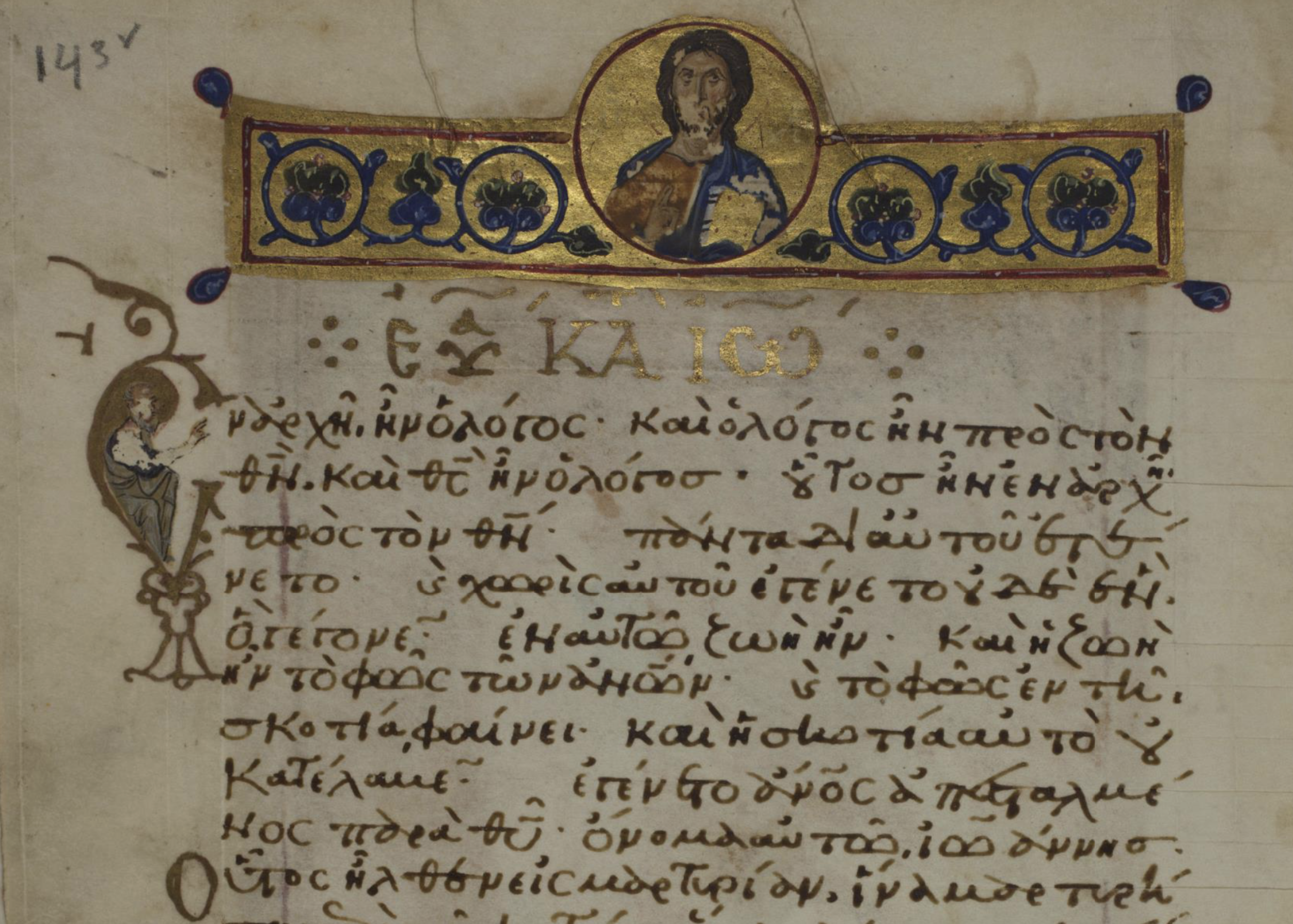
Sometimes scribes penned a personal note at the end of a manuscript they were copying. One of them, Andrew, wrote this note to conclude the copy of the New Testament he had worked on for many months: “The hand that wrote this is rotting in the grave, but what is written will last until the fulness of times.” Andrew penned this note in AD 1079. The manuscript is not in great shape, but CSNTM was able to photograph it and preserve it digitally. Like Andrew, some day all of us will be rotting in the grave. Wouldn’t it be an incredible gift to  our descendants a thousand years from now to be able to read these manuscripts with the same clarity we have today?

Please join us for this virtual banquet. And please partner with us in a mission that is bigger than any of us; it’s an investment that will pay dividends for generations to come.


Doing Internal Evidence First in Textual Criticism (Using Accordance)

For much of the history of the discipline of New Testament textual criticism, practitioners have overwhelmingly favored beginning with the external evidence before looking at the internal evidence. This has been largely a necessity because one could not determine by simply looking at the text the type of textual variant that would be found in the apparatus. Tischendorf’s magisterial Editio octava critica maior, with its extensive list of textual variants, nevertheless did not indicate in the text what kind of reading one would meet in the apparatus. Von Soden’s magnum opus also lacks any such pointers. The UBS text fares better in that it at least gives a footnote number after a word. But it still does not hint at what sort the variation is.

Perhaps this is why external evidence has been the first step in solving a textual problem: there was simply no other way to do it. Once someone glanced at the apparatus and saw their favored witnesses—whether they be א B, D F G, 𝔐, or any number after 𝔓—all too often the textual problem was considered solved. Second-year Greek students, regardless of instructions otherwise, tend to use internal evidence only as confirmation on the decision already arrived at on an external basis. Internal considerations are merely an afterthought, certainly not given equal weight with the external.

The Nestle tradition, however, gives sigla in the text to indicate what kind of variant one might expect to see in the apparatus, as follows:

⸆       insertion
⸀       substitution of one word
⸂ ⸃      substitution of more than one word between these two symbols
o       omission of one word
⸋ ⸌    omission of more than one word between symbols
⸉ ⸊   transposition between symbols
[ ]     word(s) in brackets omitted in witnesses listed in apparatus

At least the Nestle-Aland text gives some clues to the user as to the kind of variation one can expect to find. These symbols were not in the early editions of the Nestle but have been included for many decades.

This is fortuitous for the approach I take to solving textual problems. First, I ask the student to start with the Nestle-Aland text and refrain from looking at the apparatus. Second, I ask the student to come up with some guesses as to what the variant(s) might be. This is of course not necessary for omissions, simple transpositions, and bracketed words; the variants can be deduced from the sigla. But substitutions and insertions require some guesswork. And if the student can guess what the variant is, this reveals a predictable reading. If the modern student can come up with it, then scribes whose work has no genetic connection to each other’s could have come up with it on their own. But even when there is a genetic connection, working this way helps the student to create a more level playing field between external and internal evidence.

Take, for example, Phil 1.14. The Nestle text reads: καὶ τοὺς πλείονας τῶν ἀδελφῶν ἐν κυρίῳ πεποιθότας τοῖς δεσμοῖς μου περισσοτέρως τολμᾶν ἀφόβως τὸν λόγον ⸆ λαλεῖν. There is an addition after λόγον. Obviously, some adjunct, probably a genitive modifier. What is the ‘word’ that these Christ-followers might dare to speak? Typical student answers are the word ‘of God’ or the word ‘of the Lord.’ And this is exactly what we find in the apparatus: του θεου or κυριου.

This is where things get a bit muddled, however. Students notice immediately the pedigree of the longer readings: του θεου is found in major Alexandrian witnesses, along with several significant witnesses of other types (ℵ A B [⸉ D*] P Ψ 048vid. 075. 0278. 33. 81. 104. 326. 365. 629. 1175. 1241s. 2464 al lat syp.h** co; Cl); κυριου is found in F G, two leading Western MSS. The Nestle text reading is found in 𝔓46 D1739. 1881 𝔐 r vgms; McionT. Even with the papyrus and 1739 the evidence is not nearly as impressive as the ‘word of God’ reading. If students begin with the external evidence, as has been the customary practice, they may well be prejudiced against the shorter reading from the get-go because of its lack of credentials. This, in fact, seems to be the case with the third edition of the UBS text: the shorter reading garnered only a ‘D’ rating; the fourth and fifth editions elevated it to ‘B’ status.

What if students could look at the internal evidence without bias? What if they could ignore the witnesses in the apparatus and work out the problem before listening to the external voices? As we have noted, students can do this with certain kinds of variants with the Nestle-Aland text. But I did not know of any way to assist students in not letting their left hand know what their right hand was doing. Until now.


Feature in Accordance

During the spring semester of 2019, while teaching an elective on NT textual criticism at Dallas Seminary, I wrote to Helen and Roy Brown of Accordance to see if they could create a module that would enable students to do internal evidence first and without prejudice. As is typical with Accordance, I received a quick reply. They worked on this problem and soon realized that the software already could do just what I was asking for!

Here is what Helen wrote:

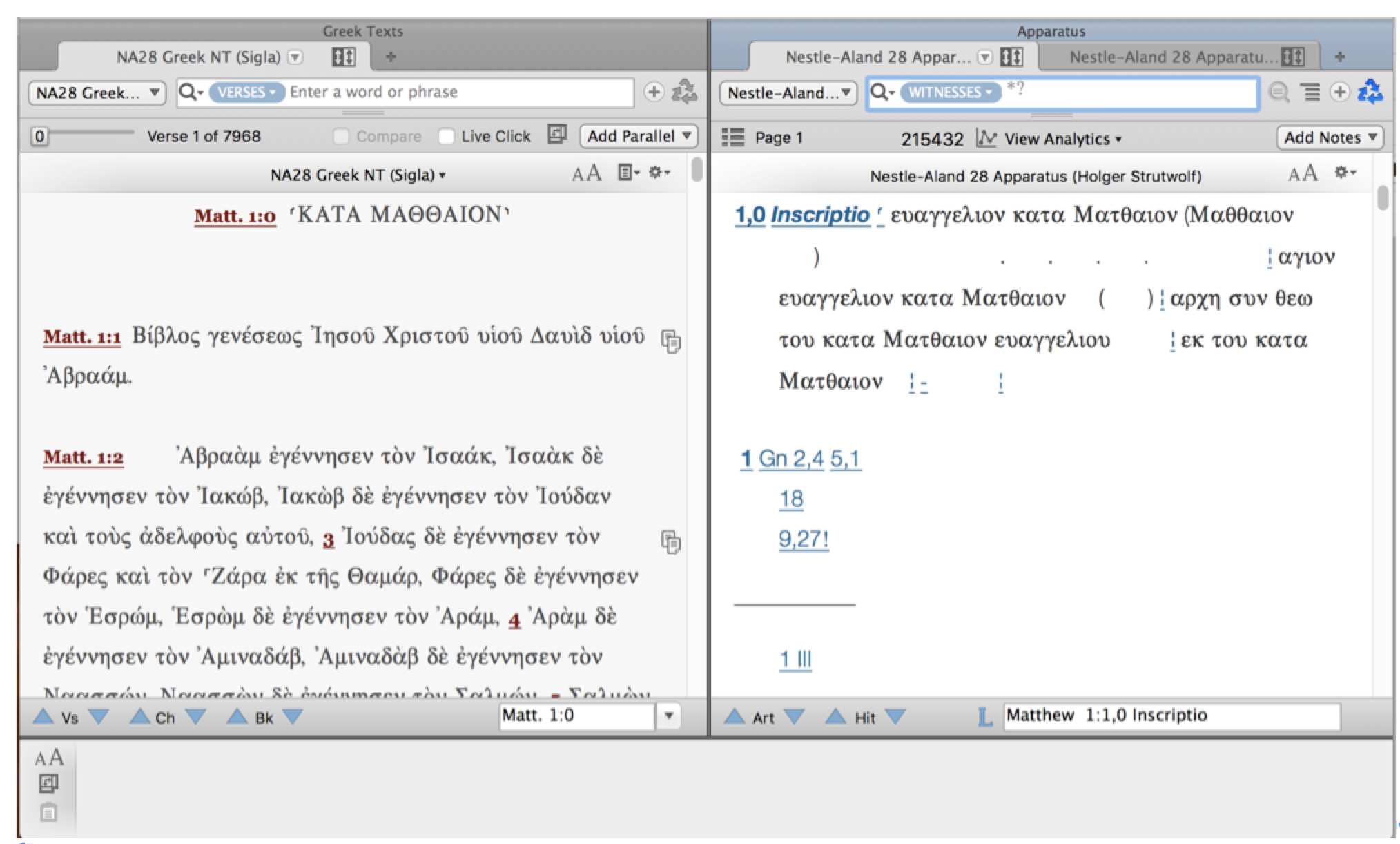
The illustration below shows a tab with the apparatus where the Witness field is apparently hidden, while the tab behind it has the regular display. Both are tied to the text so the user can consult whichever version he wants.

Screen Shot 2019-05-23 at 8.19.54 PM

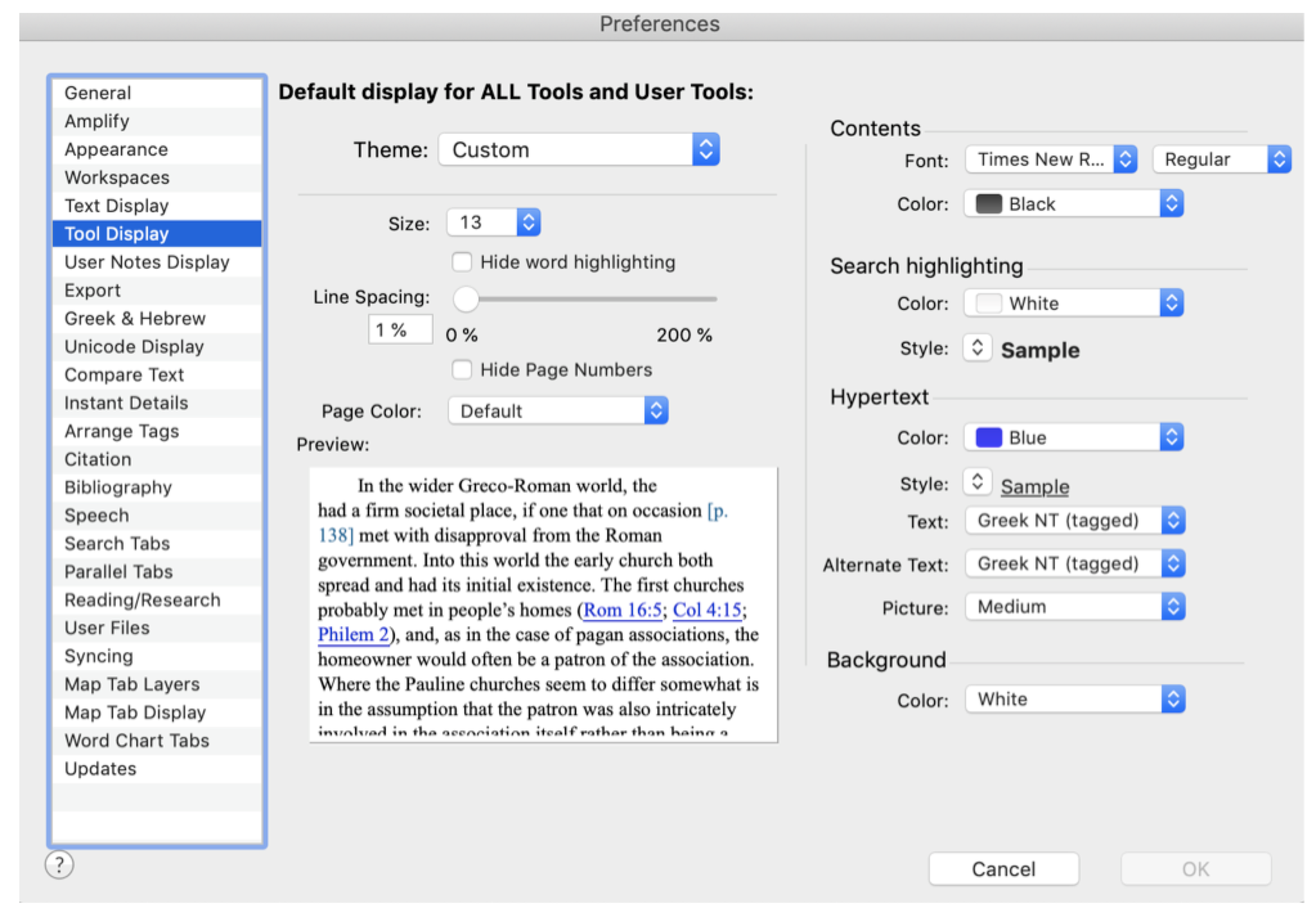
You can do this in a separate tab (not a parallel pane), searching the Witness field for *? to highlight all the contents of that field. Then go to Set Tool Display.

[You go to Tool Display by clicking “command,”; this window will pop up:]

Screen Shot 2019-05-23 at 8.20.40 PM

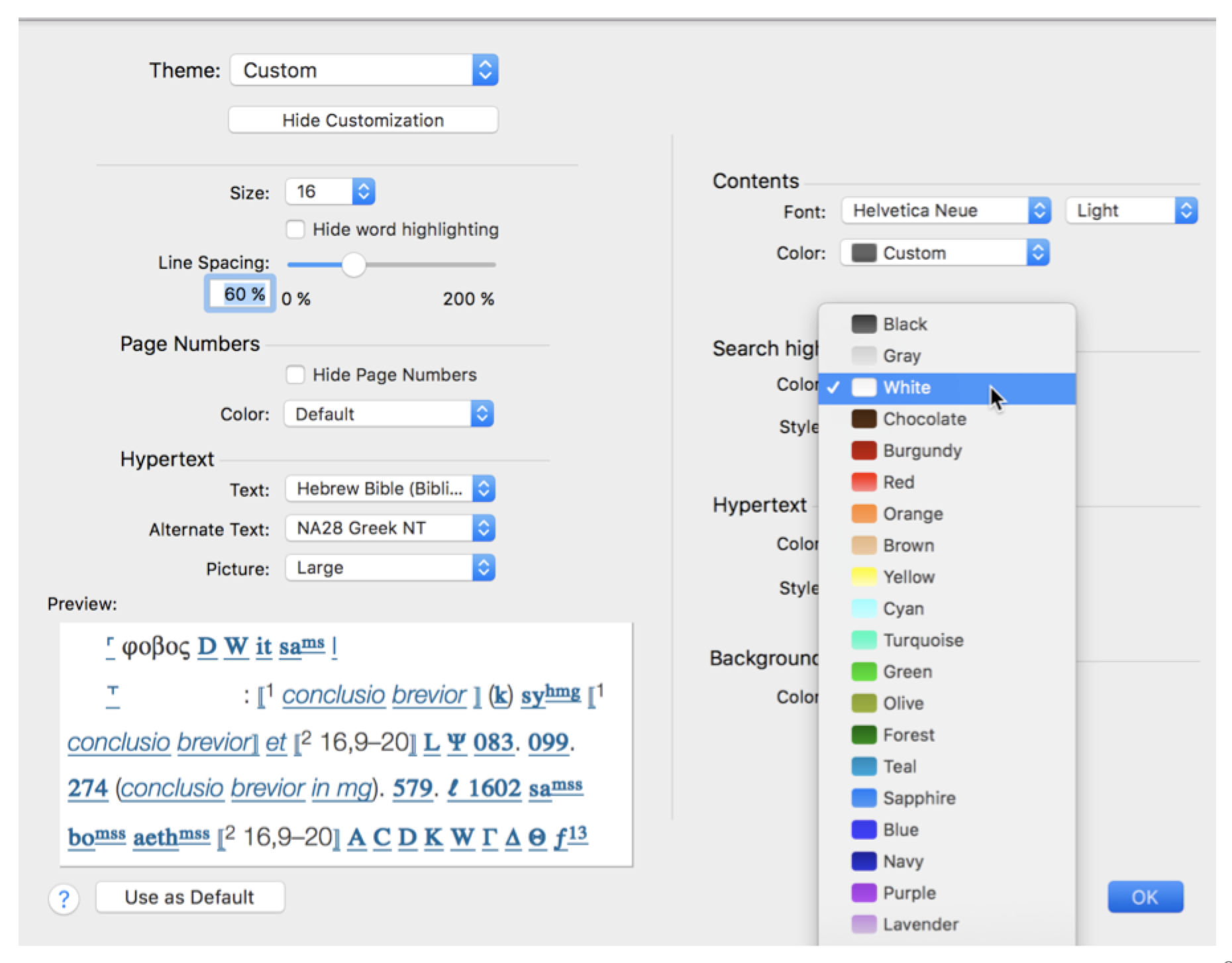
You click the Customize button, and choose White as the Search Highlighting color (or whatever color your background is set to). This effectively hides all your hits. DO NOT click Use as Default as this will apply to all new views of the tool. You can however, save the workspace and the tab will retain its characteristics when it is reopened.

Screen Shot 2019-05-23 at 8.21.40 PM

Sincerely,
Helen

See what we have done For BibleWorks Users.

*********************************
Dr. Helen A. Brown
Chief Administrative Officer
Accordance/OakTree Software, Inc.
http://www.accordancebible.com/


I would also recommend saving the session so that you can return to it any time you’re working with the apparatus. I called mine “NO MSS.accord.” And here is what that shows for Phil 1.14:

Screen Shot 2019-05-23 at 8.22.11 PM

Conclusion

I wonder if textual critics have for a long time made a virtue out of a necessity. Of course, since the days of Lachmann, Tischendorf, and Hort, the emphasis in most schools of thought has been on the external evidence. But more and more, textual scholars are recognizing that internal evidence must have its say, and it needs to do so with blinders on (as much as is possible) about what the external evidence reveals. Perhaps now that day has come.


I wish to thank Helen Brown of Accordance for help in seeing yet another potential use of this outstanding Bible software program.


One-of-a-kind trip to Greece

The Center for the Study of New Testament Manuscripts is offering a one-of-a-kind trip to Greece next spring. We’re calling it the “Insider’s Expedition.” The trip will take place on March 7–16, 2020. It will feature sites in Athens—including an insider’s look at the National Library of Greece, the other-worldly monasteries of Meteora, select islands, and ancient Corinth.

MeteoraMonastery

We can only take twenty couples for this unique adventure. Thanks to Rob Marcello for working hard the last several months to make this expedition come to fruition! Details are on CSNTM’s website. Tickets are going fast!