There Were Giants in Those Days: Codex Robertsonianus, Part 3

In my previous posts about the correspondence between Adolf Deissmann and A. T. Robertson concerning a Greek Gospels manuscript, I showed the pictures of Deissmann’s first and second letters, along with a transcription of them.

This is the third of four parts of that correspondence. These letters constitute the A. T. Robertson Papers, Box 7, Folder 3, Archives and Special Collections, James P. Boyce Centennial Library, The Southern Baptist Theological Seminary, Louisville, Kentucky. I am grateful to Adam Winters, archivist at SBTS, who provided the photographs. They are used with permission of the SBTS Archives & Special Collections.


Deissmann to Robertson_30 May 1927_page 1 of 2


Professor Dr. Adolf Deissmann
Berlin-Wilmersdorf, Prinzregentenstrasse 6., May 30th., 1927.

My dear Dr. Robertson:

Some days ago I received your kind letter of May 10, 1927 and the enclosed draft. Best thanks. Imediately [sic] I sent the Codex to your address by one of our best Berlin forwarding offices (Edmund Franzkowiak & Co, Berlin–Wilmersdorf, Uhlandstraße 83/84). According to your request I insured it for full value and took care that they packed the valuable object in a zinc box and in a wooden box. The costs are

             two boxes, charge for postage, expedition           10.05 Marks
insurance 1½% of the value                                   45.—
________
55.05 Marks, that

are about $13.—

I was very much interested, of course, in your communication about Rev. John W. Bowman and I wish to congratulate him that he will find such an object for his Thesis. Please tell him that it was not possible for me to hear from the Levantine dealer further details about the discovery of the MS. These gentlemen are very reserved in such things. The only fact he discovered to me was that the Codex came from the Trapezunt area. This is, in my opinion, credible. The Trapezunt area was inhabited by many Greeks before 1922, and there were some Greek monasteries which possessed Greek manuscripts. I suppose that our Codex was put on the market after that tragic catastrophe of 1922. You know there are other Trapezunt Codices noted by Gregory.


Deissmann to Robertson_30 May 1927_page 2

If you give any communication[n]s about the Codex please don’t mention that it came fr[o]m a Turkish dealer. The Turkish authorities would otherw[i]se perhaps take precautions in other cases to make impossible the export. I think such treasures ought to be in Christian libraries, and therefore it is better not to prevent the possibility of getting them. I think the only detail for publicity should be:

“The Library of The Sout[h]ern Baptist Theological Seminary . . . .
has had the opportunity to acquire a Parchment Tetra-Evangelion
coming from the Trapezunt area (Asia Minor).”

The Codex must have, as you suggested, a number. Please write concerning this question, after getting the MS., to

Professor Dr. Ernst von Dobschütz,
Lafontaine = Lh. 2i,    Halle a. Saale, Germany

He is the specialist who undertook the continuation of that system. But concerning the origin of the MS don’t give him other details than the above mentioned lines. Of course you should give him the most important details about the contents, measures etc. of the MS.

Now I hope that the Codex will reach you safely. Please give me a notice immediately.

With kind regards
Cordially yours
Adolf Deissmann
 

LSJ’s Greek-English Lexicon in Logos Bible software: a Review

Anyone who has more than a passing acquaintance with ancient Greek is familiar with the venerable Liddell-Scott-Jones Greek-English Lexicon. It is a huge book, with a history reaching back more than 150 years. I have two copies, both extensively marked up—one for school and one for home. But the sheer size of the volume has sometimes caused my hand to falter. A digitized version would make my life so much easier.

The folks at Logos apparently recognized the need of many students and digitized this standard lexicon. It seems that they have thought through everything to make it truly user-friendly. Rather than simply digitize the Lexicon, they have brought it into the electronic world in a superb way. One of the basic problems with using LSJ in print-form was that the Supplement at the back of the Lexicon needed to be consulted for a very large number of words, requiring the user to first examine the entry in the main lexicon, then see the update in the back. This two-step process has created quite a bit of inertia so that many students simply look at the main body of the Lexicon, thus short-changing themselves in the process.

The Logos version, however, has combined both sections: “Lexicon users no longer need to examine two different locations in the lexicon when studying a word that is included in the supplement. The content has been seamlessly integrated.” This alone is worth the price of the module!

But Logos has done even more. One of the key changes has been to eliminate the hyphens in LSJ’s word entries, allowing for an easier search for a word. Other very useful search features make this tool an indispensable resource for those studying ancient Greek.

There are a few irritating features, however. Chief among them are the numerous accent mistakes on word entries. All too frequently, accents are left off words, especially adjectives and nouns. Sometimes double accents are used; other times a grave accent is found over the penult. (Some examples of these mistakes: ἀβουλητος, ἀβουλος, ἁβροβιος, ἁβρογοος, ἁβροδαις, ἁβροπηνος, ἁβροπλουτος, ἀγνωμων, ἀγορὰζω, ἀγορασμα, βᾰρῠχειρ, βαυκισμα, βεβαιωμα, ἐρῆμος, ἑτερογνης, λογογρᾰφημα, λογοποιημα, λογχοομαι, λοιμη, μαγγᾰνον, μαιευσις, οἷόνπερ, οἰστρημα). These errata definitely need to be cleaned up for later iterations. Nevertheless, the positive features far outweigh these mistakes, making this resource a goldmine of efficient, searchable data.

The module can be ordered here: https://www.logos.com/product/3879/liddell-and-scott-greek-english-lexicon?utm_source=http%3A%2F%2Fdanielbwallace.com%2F&utm_medium=partner&utm_content=productreview-3879&utm_campaign=promo-productreview 

There Were Giants in Those Days: Codex Robertsonianus, Part 2

In my previous post about the correspondence between Adolf Deissmann and A. T. Robertson concerning a Greek Gospels manuscript, I showed the pictures of Deissmann’s first letter, along with a transcription of it.

This is the second of four parts of that correspondence. These letters constitute the A. T. Robertson Papers, Box 7, Folder 3, Archives and Special Collections, James P. Boyce Centennial Library, The Southern Baptist Theological Seminary, Louisville, Kentucky. I am grateful to Adam Winters, archivist at SBTS, who provided the photographs. They are used with permission of the SBTS Archives & Special Collections.

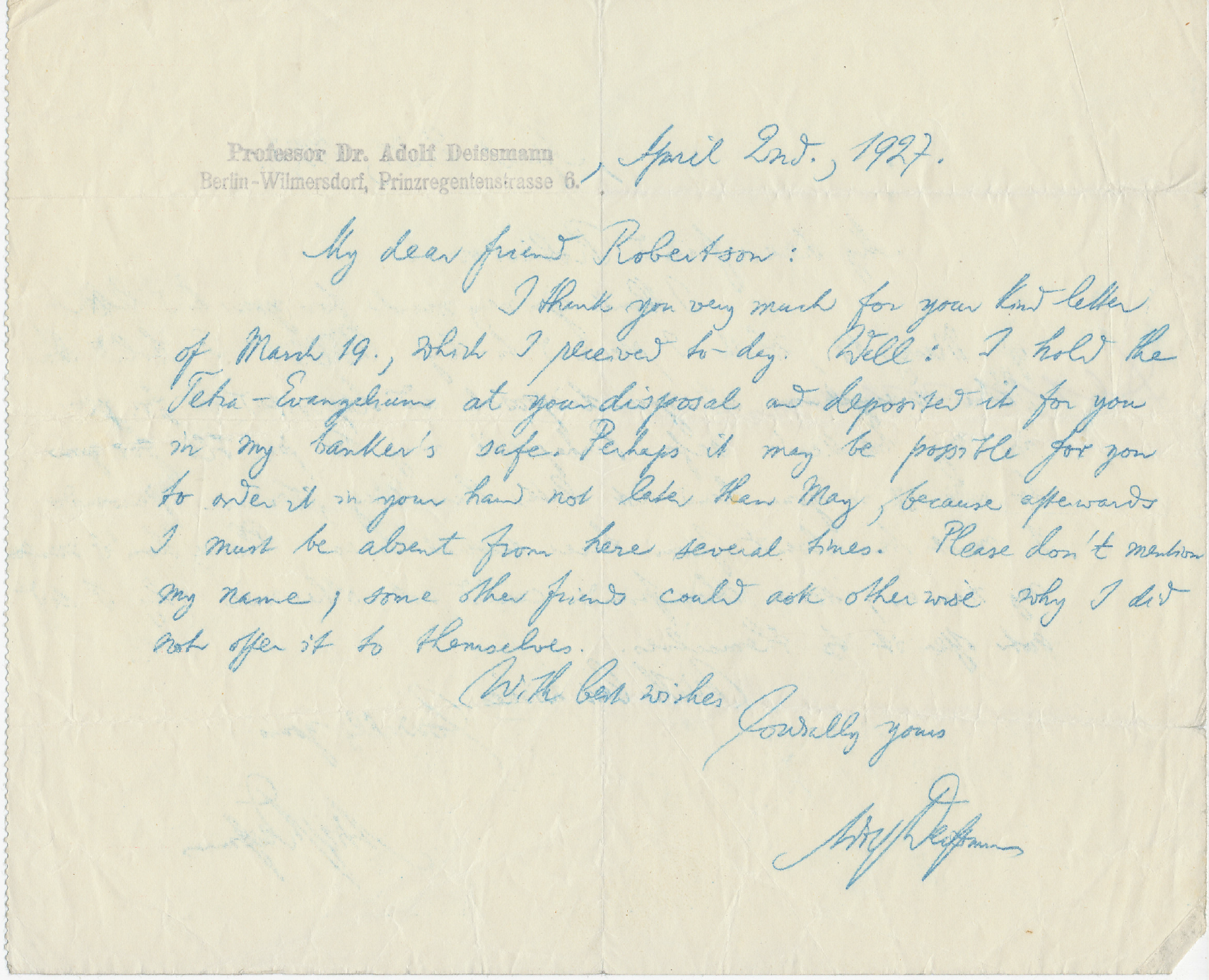
Deissmann to Robertson_2 Apr 1927

Professor Dr. Adolf Deissmann
Berlin-Wilmersdorf, Prinzregentenstrasse 6., April 2nd., 1927.

My dear friend Robertson:

I thank you very much for your kind letter of March 19., which I received to-day. Well: I hold the Tetra-Evangelium at your disposal and deposited it for you in my banker’s safe. Perhaps it may be possible for you to order it in your hand not later than May, because afterwards I must be absent from here several times. Please don’t mention my name; some other friends could ask otherwise why I did not offer it to themselves.

With best wishes
Cordially yours
Adolf Deissmann
Another Biblical Scholar is No More

David Martinez (Associate Professor in both the Classics and Divinity departments at the University of Chicago), one of Francis Gignac’s students a long time ago, once told me that Gignac was far and away the best Hellenistic Greek grammarian alive today. All of us waited for the third volume, Syntax, of his projected trilogy on Roman and Byzantine Greek (volumes 1 and 2 were on Phonology and Morphology, respectively). But the third volume never was published. Perhaps an alumnus of Catholic University of America could locate his files, edit the volume, and publish it for Gignac posthumously.

My friend and former intern, Chris Skinner, recently blogged about the passing of Father Francis Gignac earlier this month. Here’s the link: http://cruxsolablog.com/2014/06/04/francis-t-gignac-s-j-1933-2014-skinner/


Review of Lexham Discourse Greek New Testament Bundle (Logos Bible Software)

As would be expected from anything produced by Steven Runge, this is a most useful tool. It is intended to help readers understand why an author chooses the forms he does to convey meaning. Discourse grammar has become an increasingly helpful approach in the last few years to supplement standard grammars. It does not replace traditional grammars, but supplements them. Occasionally, discourse grammars, including this one from Logos, will see meaning in the wrong places. For example, the illustration of the use of the participle like an indicative verb conveying some meaning that is somehow different from an indicative may be overplayed (repeatedly mentioned in the Introduction). The participle used as an indicative verb is quite rare in the NT, never seems to occur in classical Greek, and is most likely due to Semitic influence. Most of the NT examples occur in the Apocalypse, a book whose author R. H. Charles famously described as “thinking in Hebrew but writing in Greek.” Whether there is any meaning beyond revealing the author’s linguistic capacity is not a given. The same can be said for countless other grammatical phenomena in the NT (e.g., paratactic structure in Mark, anacolutha in Paul, redundant pronouns in John). Nevertheless, used with caution, discourse grammar can be extremely valuable.

On the BDF revision committee (now defunct due to the deaths of Robert W. Funk and Daryl D. Schmidt [chairman of the committee]), the team of scholars discussed for many years how best to approach the revision. One of the approaches was to include a section on semantics as a cross-reference tool so that the user could learn about the features of the Greek NT through two routes: (1) textual route, in which the student reads the text and then uses the grammar to determine meaning of the syntactical phenomena; (2) meaning route, in which the student inquires about things like how to express purpose, possession, commands, etc. This comes close to what discourse grammar does, though discourse grammar has made quite a few advances over the narrowly-defined categories of meaning that grammarians typically work with.

The main body of the six-volume work is discourse analysis of the Greek NT, seriatim from Matthew 1 through Revelation 22. There’s also a helpful introductory volume and a glossary.

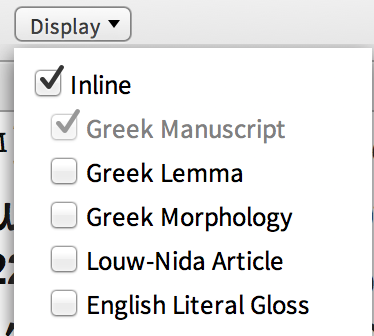
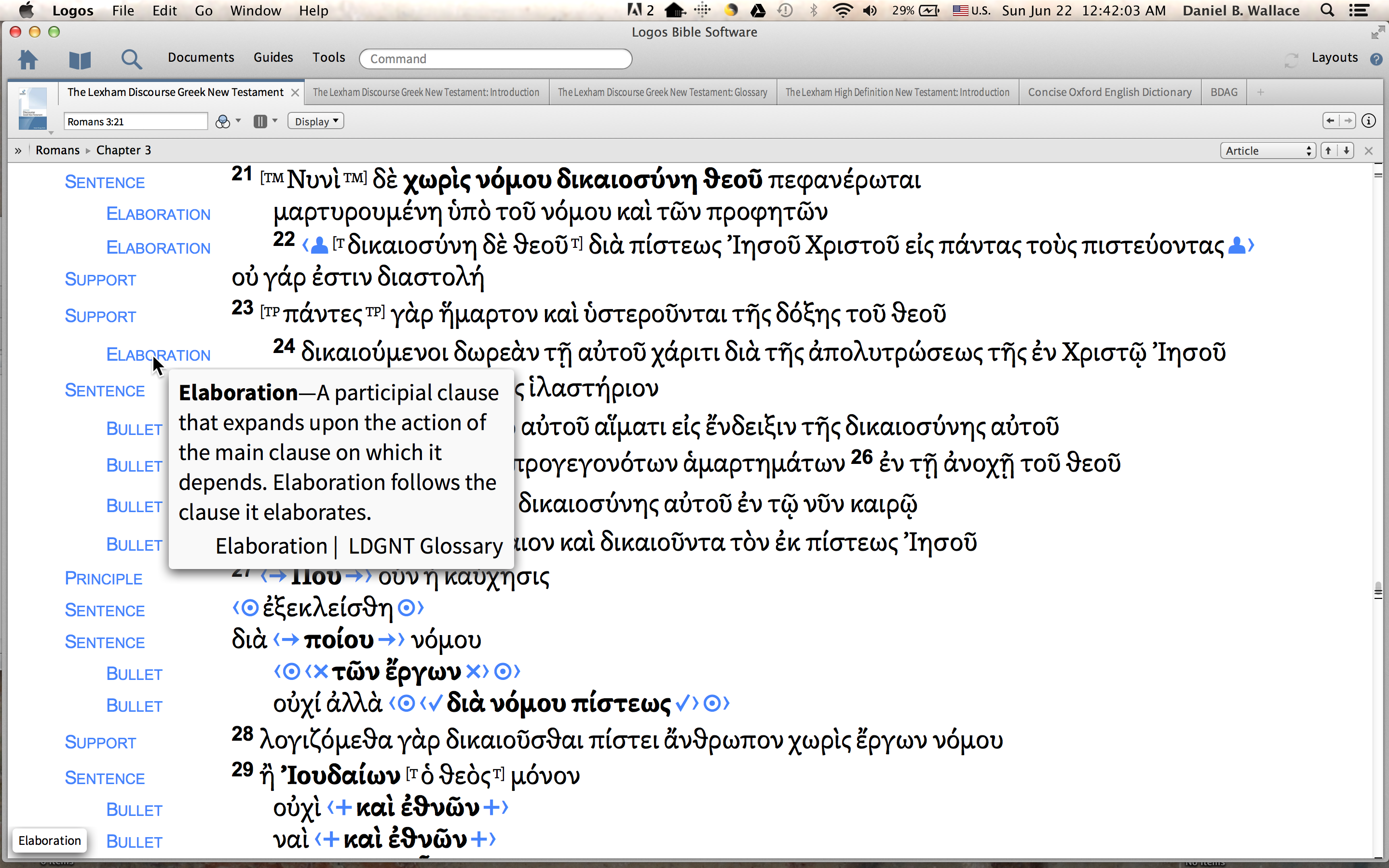
Below are illustrated some of the features.

 definitions in introductionDefinitions in Introduction

 display feature--minimalDisplay feature—minimal

 Rom 3.21-26 with minimal display features

Rom 3.21-26 with minimal display features

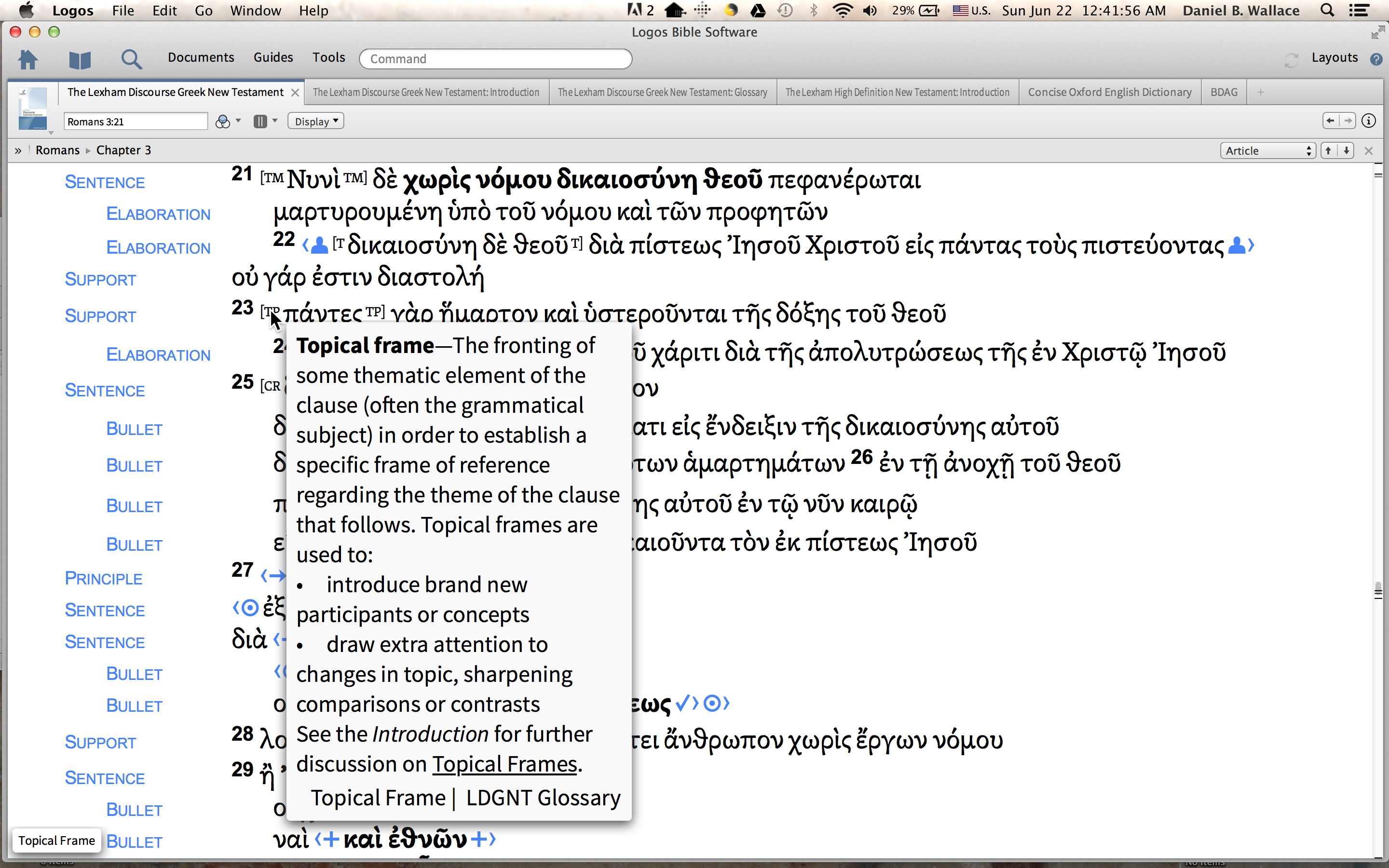
A few limitations of this approach should be noticed. For example, although μαρτυρουμένη in Rom 3.21 is mentioned as an elaboration, the user is not told what kind of participle it is. Whether it’s adjectival ([the righteousness of God…] which is being witnessed), adverbial (being witnessed), or more particularly concessive (although it is witnessed), is not discussed. Yet how this participle is taken affects the exegesis of the text. Notice that what πάντες in 3.22 and 23 relates to is not mentioned; this requires careful exegesis and a good understanding of Greek syntax to figure out.


Highlighting feature in Rom 3.22

Highlighting feature in Rom 3.22

Highlighting feature in Rom 3.23

Highlighting feature in Rom 3.23

 Rom 3.24--elaboration explained

Rom 3.24—’elaboration’ explained

The problem with this explanation is that not everyone sees the participle as subordinate and thus fitting into ‘elaboration’ (most, in fact, take it as an indicative participle), although see J. Will Johnston, “Which ‘All’ Sinned? Rom 3:23–24 Reconsidered,” Novum Testamentum 52 (2010) 1–12.

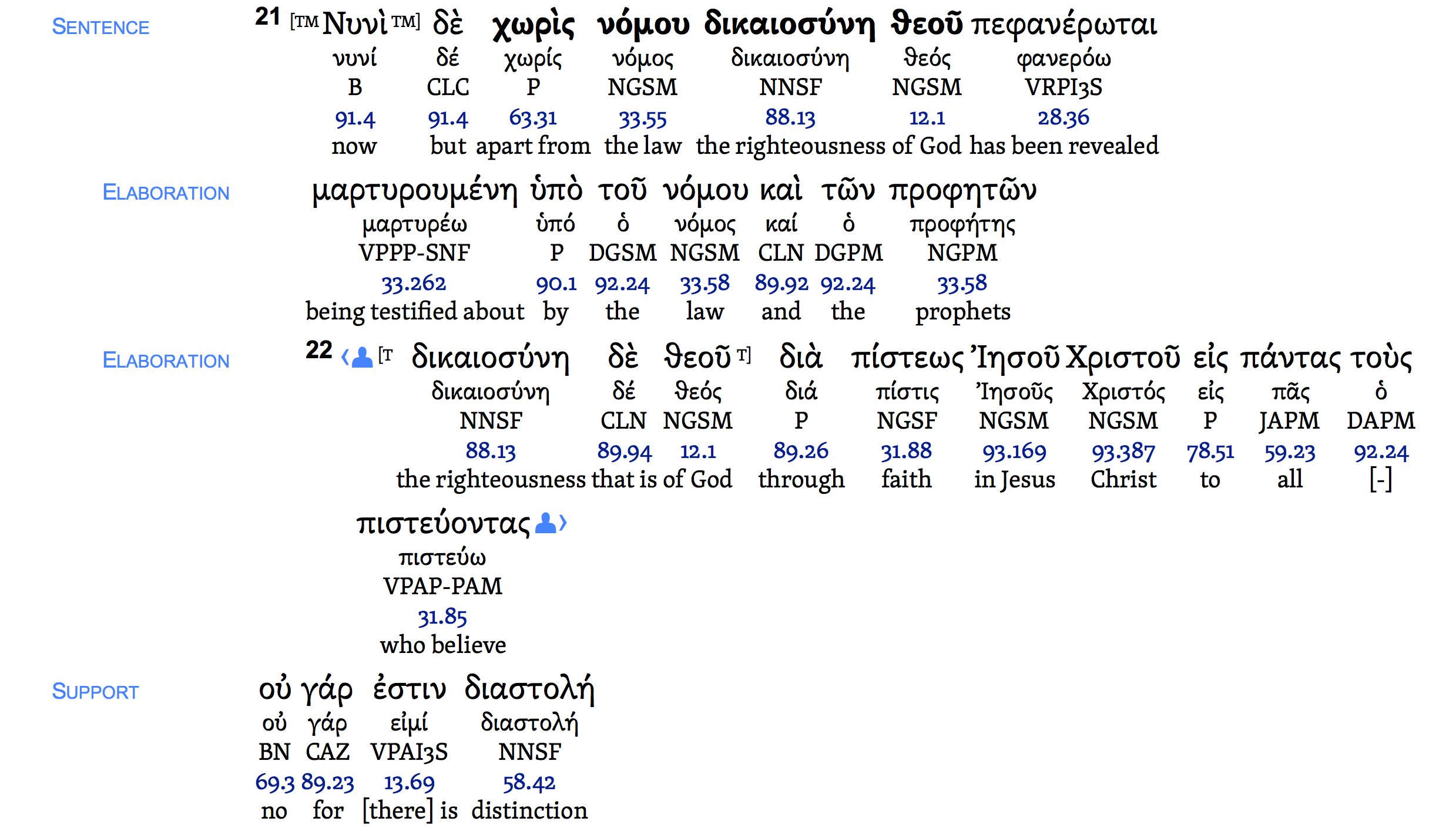
Display feature--everything

Display feature with everything checked

Rom 3.21-22 with maximum features displayed

Rom 3.21–22 with maximum features displayed

A wealth of data is here—either visually or at a click of the mouse.

In short, the Lexham Discourse Greek New Testament is a tool whose time has come. Used in conjunction with traditional grammars, it can only strengthen one’s understanding of Hellenistic Greek and how the NT authors communicate meaning—every exegete’s dream!

It can be purchased here.