
We have a team from CSNTM working at the National Library of Greece in Athens this summer. A big team—from seven to nine people at any given time. The work is both exhausting and exhilarating. Handling precious documents all day long, while trying to produce accurate, aesthetically-pleasing photographs, can be emotionally draining work. But every new day the teams are ready for more.
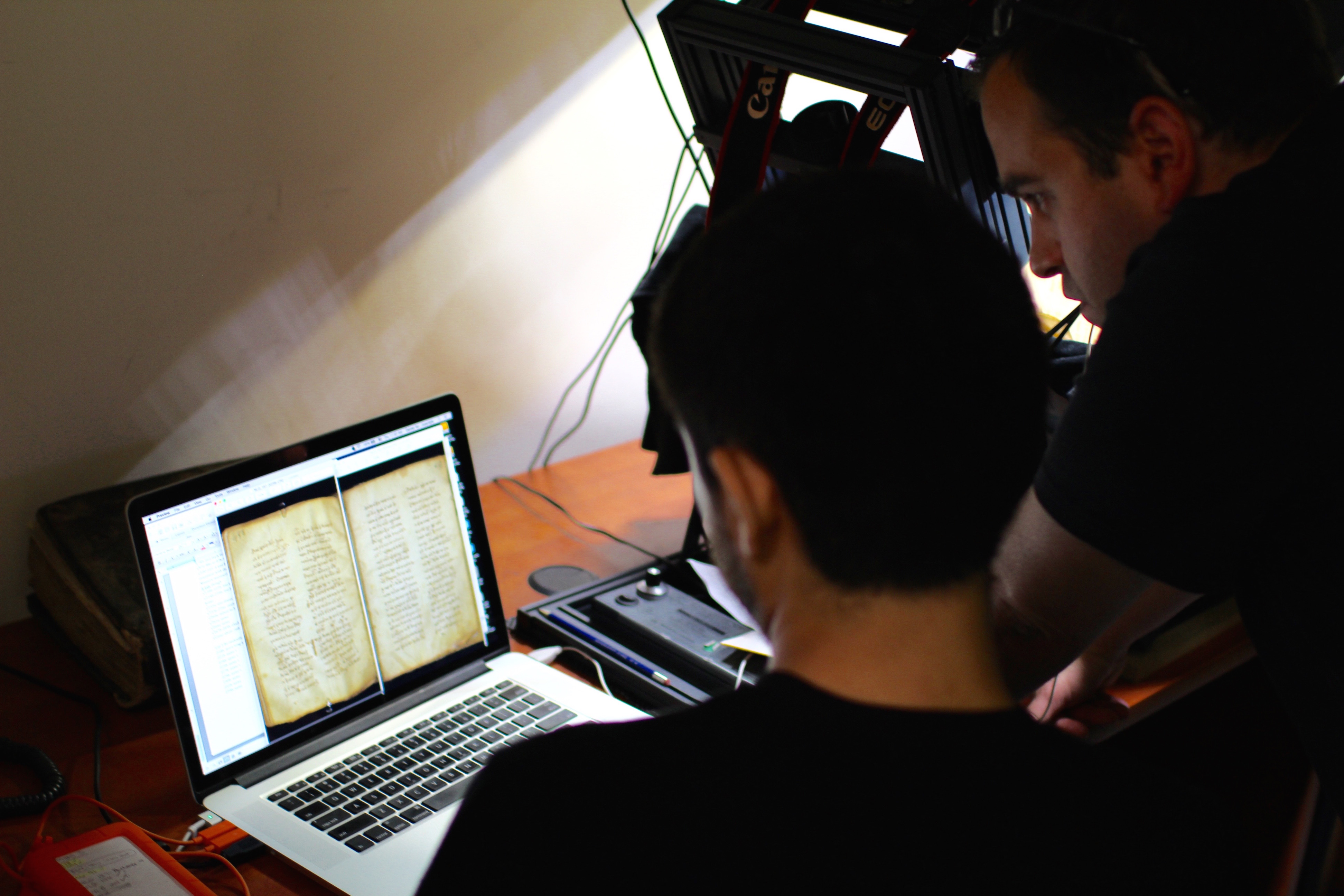
Counting Quires
One of my tasks is to count quires. A quire is, medievally speaking, eight leaves or four double-leaves (bifolia) laid down, then folded vertically in the middle. These leaves then form a quire and they are sewn into the binding at the crease. Some scribes numbered their quires by writing, in very faint and small ink, the number of the quire on either first page (recto) or last page (verso) of a quire. Then, when it came time to stitch all the quires together they would know what order they would go in and assemble the book. But not all scribes wrote out these quire numbers, and even for many who did later book-owners trimmed the pages, inadvertently cutting off either the entirety or a portion of the quire number. And often, they wrote in red ink—the kind that fades so badly that it is now invisible.
There are three ways to identify the number of leaves in a quire quickly: (1) notice and document where the quire numbers are; (2) notice where the sewed strings are (always in the middle of the quire); and (3) feel the pressure of the leaves—if a leaf wants to go to the left, it belongs with the previous quire; if it wants to lay flat, it begins a new quire.
There are problems with each of these methods, but it’s essential that the quire counts are done while examining the manuscripts instead of via photographs since the latter approach eliminates the third method for determining quire counts. The binding may be tight, and the strings won’t show up in the photographs, which makes approach #2 difficult to accomplish. Frequently, a magnifying glass is used to determine if the strings are there, but this of course can only be done while examining the actual manuscript.
An Interesting Feature in GA 1761
Gregory-Aland 1761 posed an interesting problem. It’s a manuscript of Acts, the Catholic letters, and the corpus Paulinum (including Hebrews). The first quire reveals no number, but quire 2 has the number κε or 25. The numbers are then seen on every quire and they are in sequence without any gaps, going all the way through μθ or 49. Only one leaf is missing in this entire manuscript, which is unusual. Normally, at least a few leaves are missing from a manuscript, even one as late as the fourteenth century (the date of GA 1761).
Since the Institut für neutestamentliche Textforschung in Münster, Germany is the de facto cataloguer of the Greek NT manuscripts, they list this manuscript as an “ap” document—that is, Acts and Catholic letters (a) and Paul (p). They do not indicate that anything is missing, although one leaf is absent. However, judging by the quire numbers far more than one leaf is missing—184 leaves to be exact! 184 leaves is the number for the first 23 quires (since the second quire in the extant manuscript begins with ‘25’).
What was originally in this manuscript? One’s immediate hunch would be all four Gospels, and that turns out to be correct. With an average of 360 words per leaf in the extant manuscript, 183 leaves would be required for the Gospels. Thus, this manuscript was originally an eap, with ‘e’ standing for evangelists or εὐαγγέλιον.
Examining quires and counting the number of leaves in them is largely neglected by institutes that own manuscripts as well as by New Testament scholars. But it is the fastest way to determine if a manuscript is complete or is missing leaves—and where they are missing. Now, with digital images, many of the quire numbers are visible. When CSNTM prepares a manuscript, we routinely list the quires by number, Greek letter (if visible), and number of leaves. Below is what this information looks like in CSNTM’s ‘prep doc’ for GA 1761:
Quires:
1.1–8, 2[κε].9–16, 3[κς].17–24, 4[κζ].25–32, 5[κη].33–39 [short quire], 6[κθ].40–47, 7[λ].48–55, 8[λα].56–63, 9[λβ].64–71, 10[λγ].72–79, 11[λδ].80–87, 12[λε].88–95, 13[λς].96–103, 14[λζ].104–111, 15[λη].112–119, 16[λθ].120–127, 17[μ].128–135, 18[μα].136–143, 19[μβ].144–151, 20[μγ].152–159, 21[μδ].160–167, 22[με].168–175, 23[μς].176–183, 24[μζ].184–191, 25[μη].192–199, 26[μθ].200–207. Rest is paper MS added later.
We are documenting a number of features in these manuscripts, as we have traditionally done, which will help those who study them get some help in reading the texts. For example, for all continuous texts manuscripts, we provide a scripture index showing on what pages each book of the NT are to be found. Some of the incidental material is idiosyncratic, but the scripture indexes especially should be useful for researchers. For this particular manuscript, below is what is provided:
1a–52b: Acts
52b–53b: information about Luke and Acts
54a: hypothesis for James
54a–59a: James
60a: hypothesis for 1 Peter
60a–65b: 1 Peter
65b–66a: hypothesis for 2 Peter
66a–69b: 2 Peter
69b–70b: hypothesis for 1 John
71a–76a: 1 John
76ab: hypothesis for 2 John
76b–77a: 2 John
77ab: hypothesis for 3 John
77b–78a: 3 John
78ab: hypothesis for Jude
78b–80a: Jude
81a–82b: hypothesis for Romans
82b–102a: Romans
102a: subscription: written from Corinth through Phoebe; stichoi mentioned.
102b–103a: hypothesis for 1 Corinthians
103a–120b: 1 Corinthians
121ab: hypothesis for 2 Corinthians
121b–134a: 2 Corinthians
134a: subscriptio: written from Philippi through Titus, Barnabas, and Luke
134b: hypothesis for Galatians
135a–141a: Galatians
141a–142a: hypothesis for Ephesians
142b–149a: Ephesians
149ab: hypothesis for Philippians
149b–154a: Philippians
154ab: hypothesis for Colossians
154b–159a: Colossians
159ab: hypothesis for 1 Thessalonians
160a–164a: 1 Thessalonians
164b–165a: hypothesis for 2 Thessalonians
165a–167b: 2 Thessalonians
167b–168a: hypothesis for 1 Timothy
168a–173b: 1 Timothy
173b–174a: hypothesis for 2 Timothy
174a–178a: 2 Timothy
178ab: hypothesis for Titus
178b–181a: Titus
181ab: hypothesis for Philemon
181b–182b: Philemon
182b–183b: hypothesis for Hebrews
183b–: Hebrews
183b–199b: title: “the letter to the Hebrews” (Paul not mentioned as author)
200a–207a: abbreviations
208a–219a: non-biblical text, paper, later hand
220a–243b: third hand, paper text, later hand, non-biblical
244a–250b: fourth hand, paper text, non-biblical
The work at the National Library progresses well; we will soon wrap up our first of two summers here. And in the end, we will provide approximately 150,000 high-resolution images of c. 300 manuscripts and over 700 pages of documentation. When all the manuscripts we are digitizing at the National Library are photographed, we will post them on csntm.org, along with all the prep docs. This has been our custom since the beginning, though CSNTM continues to refine its digitizing standards and prep doc information.


 Daniel B. Wallace