TIME-SENSITIVE: Put Stocks in Someone’s Stocking!

The year 2024 is almost in the books. It has been a wild roller coaster ride of a year. Ironically, instability seems to be the only thing that is consistent this year. The silver lining in the nimbostratus clouds of 2024 is that the U.S. stock market has done quite well overall. And that brings me to a special invitation.

As we enter the traditional season of giving, families also use this time to evaluate their tax situation. Granted, the continually shifting tax code doesn’t make that an easy exercise. But one constant of good news is that donating securities that have been held for a year or more offers the potential for a double tax benefit—a full fair market value tax deduction and elimination of capital gains taxes.

Many non-profits now allow direct stock donations (i.e., not having to sell the stock first). If the Lord has blessed you financially, you might want to consider giving some shares to one or more charitable organizations that you support. Many such organizations are in need of large financial infusions: although the stock market has done well, the economy is still doing poorly for too many of us. Giving a gift of shares is a very tangible way to show what really matters to you without adding to your living expenses.

The Center for the Study of New Testament Manuscripts now has a “stock option” for donations. You may donate stocks and bonds directly to CSNTM without having to sell them first. Stock gifts to CSNTM are handled by Overflow, the leading giving platform for the digital age. This can be a great way to invest in our shared mission to preserve the New Testament text and take advantage of the benefits for charitable giving in the U.S. Tax Code. (Alternatively, you can use these instructions to complete the transaction with your brokerage on your own.)

I wanted to put my stock where my mouth is, so I clicked on the CSNTM “donate stocks” page https://www.csntm.org/partnership/donate-stocks and donated some stock.
Giving securities to CSNTM was a snap. It took less than 10 minutes (and I’m old and slow!) to make the donation. Overflow makes it easy.

There is some urgency for such donations, both for CSNTM and other charities. Stock donations through Overflow must be made by December 10 to guarantee posting for 2024. That’s for the guarantee; Overflow recommends giving by December 13 to almost ensure (not quite a guarantee) that the gift will be credited for 2024. 

But there’s something else to consider for the long term: a donor-advised fund. Some donors like to set up their own private family foundation as a means of distributing gifts to favorite charities. But establishing a donor-advised fund with a firm like Fidelity Charitable can provide the ability to claim a higher tax deduction of 30% of your adjusted gross income compared to the 20% limit with a private foundation.

And the news gets better when you want to donate securities. By opening a giving account and contributing the shares to your donor-advised fund, you eliminate capital gains tax exposure and secure a charitable deduction based on the shares’ fair market value. Best of all, you can decide where to donate at a later date and, when the time comes, recommend a larger grant from your donor-advised fund than if you sell the shares and donate the net proceeds!

Our partner, Overflow, streamlines this process as well. You can donate from your donor-advised fund simply and securely here.

This is timely news for me and my family. I will be contributing more to my stock donations today, because I want to give CSNTM a generous Christmas present so that the Center can carry on the work that faithful scribes began 2000 years ago.

Help Train the Next Generation of Christian Scholars

The Center for the Study of New Testament Manuscripts (csntm.org) has been involved for the past twenty years in a hugely successful internship program. The highlight for the new batch of interns each year is participation in the fall academic conferences. They sit at the feet of some of the best biblical scholars on the planet and get to see firsthand what an academic paper/presentation looks like, including the Q&A that follows. 

The impression made on these students lasts a lifetime, and it very often changes the trajectory that they are on in their service to the body of Christ. The long-range objective is to raise up the next generation of biblical scholars to be leaders with a profound respect and deep appreciation for the New Testament. In this way, CSNTM is training the next generation of biblical scholars. 

But none of this would be possible without serious financial backing. There is an opportunity right now to double the impact of any donations you give from now until September 19North Texas Giving Day is on Thursday, September 19, and from now till then, you have the opportunity to support CSNTM’s interns—bright students who have demonstrated excellence in academic work and hold great promise for a future in biblical scholarship and church leadership.

Over the four decades of my teaching career, I have had the privilege of mentoring nearly two hundred interns—starting with Dallas Seminary students and continuing on, for the past twenty years, with CSNTM interns. These incredible scholars-in-the-making have gone on to earn PhDs from prestigious schools such as Cambridge, Oxford, Edinburgh, St Andrews, Aberdeen, Baylor, Notre Dame, Sheffield, Birmingham, Yale, Exeter, and the Catholic University of America—to name but a few. These alumni now teach in seminaries and universities, write world-class works on the Bible and theology, and help to keep New Testament scholarship on sound footing. They are today’s scholars, professors, translators, missionaries, and pastors, collectively helping others see the truth and beauty of Scripture and keeping Christian faith tethered to the biblical text.

Not only do these interns receive individual instruction from me and our research team, but they also engage in a rigorous and enriching program that is intentionally designed to equip them with the skills to seek truth and approach biblical scholarship with integrity, excellence, and faith. 

Meet Tomorrow’s Bible Scholars—Interns You Can Support Today: https://www.northtexasgivingday.org/story/Csntminterns

When you help us reach our $20,000 goal this North Texas Giving Day by allowing your combined donations of $10,000 to be matched, you enable this year’s interns to attend two prestigious academic conferences—the annual meetings of the Evangelical Theological Society and the Society of Biblical Literature. These conferences provide invaluable experiences for emerging scholars. In fact, last year, one of our interns secured a publishing deal for his book while attending the ETS conference with CSNTM!

Be sure to give between now and September 19 to have your gift DOUBLED!

With gratitude,

Dan Wallace

Some Random Thoughts on the Tyndale House Greek New Testament

I received in the mail from the publisher a couple of weeks ago a copy of The Greek New Testament, which will probably be referred to as the Tyndale House Greek New Testament or THGNT. The official release date is 15 November 2017. Published by Crossway and produced at Tyndale House, Cambridge, under the editorial leadership of Dirk Jongkind (with assistance from Peter Williams, Peter Head, and Patrick James), this is a volume that has been in the works for ten years. It promises to offer many new features that have been overlooked in other Greek New Testaments.

Tyndale House GNT image

Among them, the editors have particularly focused on the spelling of various verbs that may involve an itacism (if that’s even the right word—something the editors challenge). On the Evangelical Textual Criticism blogsite Peter Williams notes that γίνομαι in Luke is always to be spelled γείνομαι, “a prestigious koine spelling by careful scribes to bring out the long vowel which arose when the second gamma of the Classical form γιγνομαι was dropped.” At first I thought that this ETC note showed that Luke’s usage was a higher register of Koine Greek, but when I looked at the Introduction in the THGNT I saw that this spelling is followed in Luke, Mark (!), and Romans through Colossians, as well as a couple of verses in John (THGNT, 509). The editors do express the view that their objective was to represent the wording of the autographs—“This edition aims to present… the best approximation to the words written by the New Testament authors…” (THGNT, 505 [italics added]). But they do not seem to follow this same spelling for the first principal part of γίνομαι for Acts. The reason is presumably due to documentary evidence: we have P75 for Luke, but nothing truly comparable for Acts. But are we to suppose that Luke’s spelling of this verb changed to the shorter form every time it occurs in Acts (Acts 2.43 [bis]; 4.30; 5.12; 8.13; 12.5, 9; 14.3; 19.26; 21.14; 23.10; 24.2; 26.22; 27.33; and 28.6)? This raises the question of how rigid we should be in following the earliest documentary evidence (through the fifth century), a principal explicitly stated several times in the THGNT Introduction. Overall, however, reproducing the earliest documented spellings is a noteworthy contribution of this tome.

Χριστός is not capitalized in spite of the fact that “it may sometimes be a proper noun” (THGNT, 511). That ‘sometimes’ is quite the understatement since in the Epistles this is the normative force.

Another innovation is to follow the actual paragraphing of the manuscripts, especially the early ones. The reader will notice several differences from the Nestle-Aland text in this regard. For example, in Ephesians 5, Nestle-Aland starts the third paragraph with v. 21 which incorporates the following three verses (22–24). THGNT ends the previous paragraph with v. 21, thus implicitly distinguishing the instructions to wives from the concluding adverbial participle, which would make that participle dependent on the command to be filled by the Spirit (πληροῦσθε in v. 18). This is indeed the paragraph break found in Sinaiticus and Alexandrinus. Vaticanus incorporates a much longer section as its paragraph (P46 has no ekthesis or paragraph notation for Ephesians). But the question is raised whether the break at v. 22 is due, in part, to the editorial decision to include υποτασσεσθωσαν in 5.22—in spite of our two earliest witnesses to this text—B and P46—lacking any verb for the verse.

The editors, as a rule, always base their text on at least two Greek manuscripts, and one of these must be from the fifth century or earlier (THGNT, 506; the Apocalypse is the only exception to the rule of having at least one early manuscript). This is in keeping with the strong documentary basis for this edition of the NT. This principle, however, seems to create some inconsistencies, one of which was noted above. It seems in fact that the documentary principle is often pitted against the recovery-of-the-original-wording principle. Many scholars today would question whether such a strong emphasis on the external evidence should be followed religiously. Readings such as Ιησουν and Ιησουν τον in Matt 27.16, 17 respectively, οργισθεις in Mark 1.41, εχομεν in Rom 5.1, and χωρις in Heb 2.9 are rejected by the editors in spite of strong internal support for these variants. Yet they have ηπιοι in 1 Thess 2.7 even though this is poorly attested among the earliest Greek witnesses.

The apparatus is barebones and intentionally so. The editors want this work to focus on the text. They include variants of just three sorts: (1) viable, (2) exegetically important, and (3) those that illustrate scribal practices (THGNT, 515). The textual commentary on the decisions in this Greek New Testament is eagerly anticipated.

I was of course happy to see acknowledgment of the Center for the Study of New Testament Manuscripts (www.CSNTM.org) as one of the main Internet sites that the editors utilized for reading digitized images of the manuscripts (THGNT, 526).

Criticism is easier than construction, and the editors of the THGNT are to be commended for offering a significant alternative to the Nestle-Aland text—and one which is still based on the principles of reasoned eclecticism. This volume joins the work of Michael Holmes, The Greek New Testament: SBL Edition (2010), as a viable option for students learning New Testament Greek. THGNT depends more on external evidence while GNTSBL leans more toward internal, yet both are well within the broadly consensus method of NT textual criticism as it is practiced today. Of course, nothing can replace the decades of careful research that Münster has poured into their apparatus, but these two editions (Holmes and Tyndale) are important offerings; they help students of the New Testament realize that the Textus Receptus status of the Nestle-Aland text may still be a bit premature.

Interviews with Text-Critical Scholars

csntm_itunesThe Center for the Study of New Testament Manuscripts (CSNTM) conducted a series of interviews with scholars of textual criticism at the Society of Biblical Literature conference in San Diego, California in 2014. These videos are currently being released on CSNTM’s iTunes U site for free. The first two interviews are by Dr. Ekaterini Tsalampouni of the Aristotle University of Thessaloniki and Peter Gurry, a PhD candidate at the University of Cambridge.

Make sure to check out these interesting and significant videos as they continue to come out over the next few weeks.

There Were Giants in Those Days: Codex Robertsonianus (Gregory-Aland 2358), Part 1

In 1927, Adolf Deissmann began a correspondence with A. T. Robertson that led to the purchase of a Greek Gospels manuscript by Southern Baptist Theological Seminary. Some of the story of this manuscript’s travels and text is told by John W. Bowman in his 23-page booklet (with four plates), The Robertson Codex (Allahabad, India: Mission Press, 1928). The booklet was a reprinting of articles in The Indian Standard 139, nos. 8 and 9 (August and September, 1928). Bowman had been a student of Robertson’s at Southern and later became professor of New Testament and Church History at North India United Theological College in Saharanpur, India.

In Bowman’s booklet are two chapters, which correspond to the two articles in The Indian Standard. The first chapter addresses the process of photographing the manuscript, and is a window on the difficulties that attended such labors in the 1920s. It took the author nearly three months to photograph it! Today, with digital photography, the Center for the Study of New Testament Manuscripts normally photographs a 350-page manuscript (the size of Codex Robertsonianus) in less than a day. In this chapter he mentions the rarity of photographs of New Testament manuscripts: “Very few complete MSS of the N.T. or portions thereof have hitherto been photographed: I am personally aware of only five such” (5). Bowman’s second chapter discusses many fascinating details of the manuscript.

One thing is largely missing, however, from the book: except for small snippets here and there, the correspondence between Deissmann and Robertson is not mentioned. This blog thus supplements Bowman’s pamphlet with Deissmann’s letters to Robertson concerning the codex (I do not have access to Robertson’s responses to Deissmann).

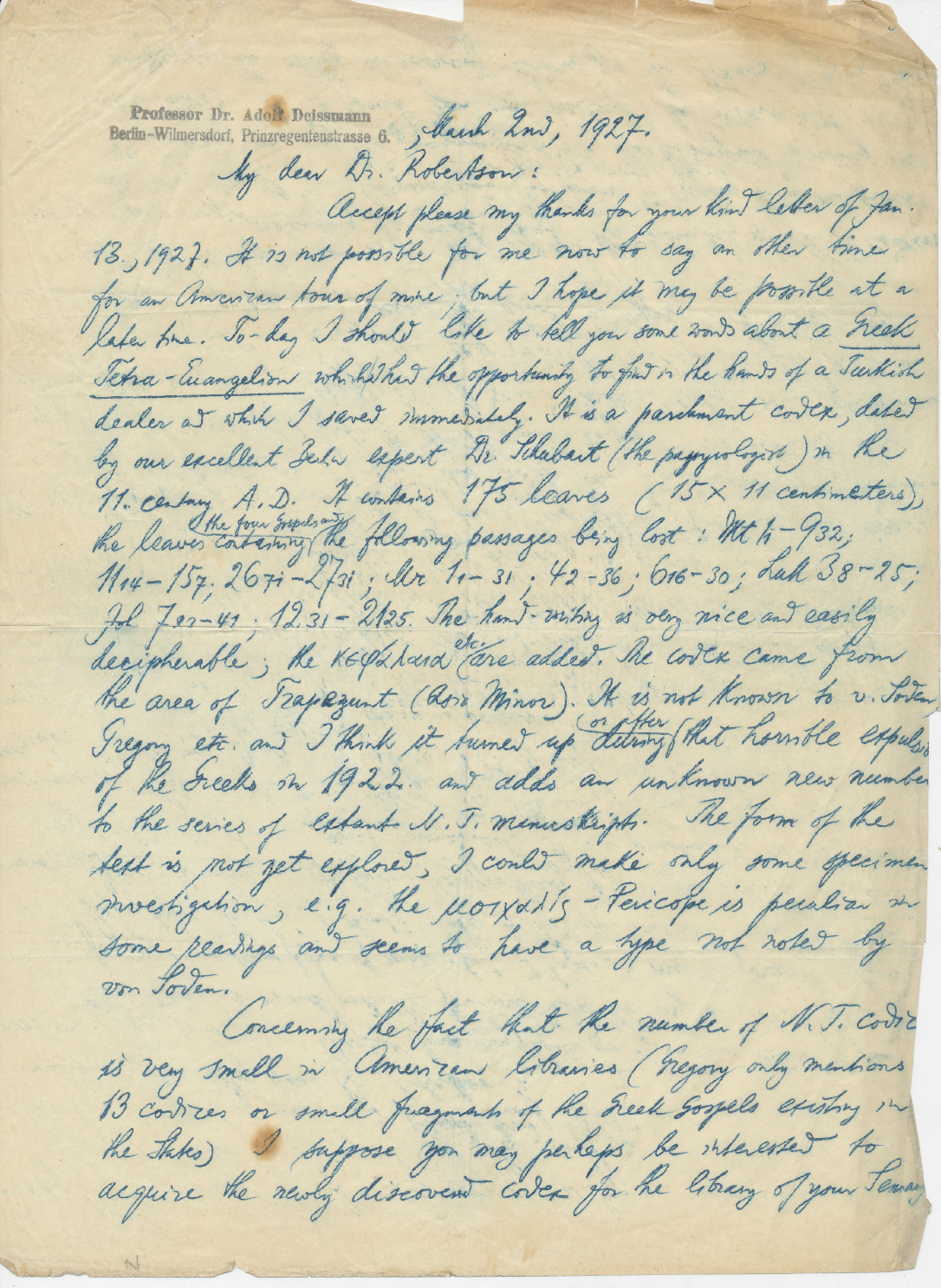
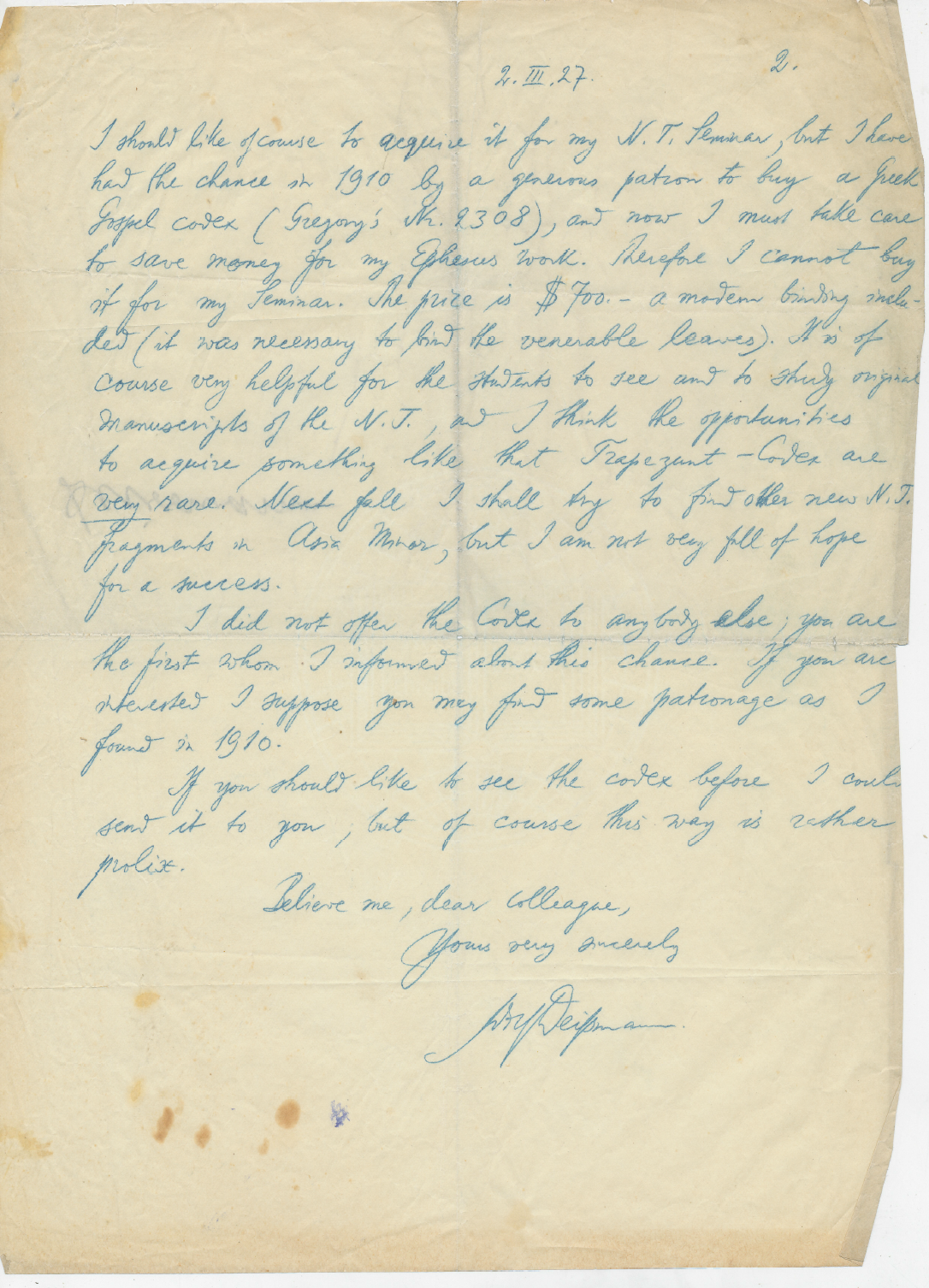
Below are photographs of the first letter (along with the text printed beneath each one), which was obtained from Southern Baptist Seminary. In later blogs, I will post the rest of the letters and text. These letters constitute the A. T. Robertson Papers, Box 7, Folder 3, Archives and Special Collections, James P. Boyce Centennial Library, The Southern Baptist Theological Seminary, Louisville, Kentucky. I am grateful to Adam Winters, archivist at SBTS, who provided the photographs. They are used with permission of the SBTS Archives & Special Collections.

Deissmann to Robertson_2 Mar 1927_page 1 of 2

Professor Dr. Adolf Deissmann
Berlin-Wilmersdorf, Prinzregentenstrasse 6., March 2nd, 1927.

My dear Dr. Robertson:

Accept please my thanks for your kind letter of Jan. 13, 1927. It is not possible for me now to say an other time for an American tour of mine; but I hope it may be possible at a later date. To-day I should like to tell you some words about a Greek Tetra-Euangelion which I had the opportunity to find in the hands of a Turkish dealer and which I saved immediately. It is a parchment codex, dated by our excellent Berlin expert Dr. Schubart (the papyrologist) in the 11. century A.D. It contains 175 leaves (15 x 11 centimeters), the leaves containing the four Gospels and the following passages being lost: Mt 11–932; 1114–157; 2671–2731; Mr 11–31; 42–36; 616–30; Luk 38–25; Joh 723–41; 1231–2125. The hand-writing is very nice and easily decipherable; the κεφάλαια etc. are added. The codex came from the area of Trapezunt (Asia Minor). It is not known to v. Soden, Gregory etc. and I think it turned up during or after that horrible expulsio[n] of the Greeks in 1922. and adds an unknown new number to the series of extant N.T. manuscripts. The form of the text is not yet explored, I could make only some specimen investigation, e.g. the μοιχαλίς-Pericope is peculiar in some readings and seems to have a type not noted by von Soden.

Concerning the fact that the number of N.T. codic[es] is very small in American libraries (Gregory only mentions 13 codices or small fragments of the Greek Gospels existing in the States) I suppose you may perhaps be interested to acquire the newly discovered codex for the library of your Seminary[.]

Deissmann to Robertson_2 Mar 1927_page 2

I should like of course to acquire it for my N.T. Seminar, but I have had the chance in 1910 by a generous patron to buy a Greek Gospel codex (Gregory’s Nr. 2308), and now I must take care to save money for my Ephesus work. Therefore I cannot buy it for my Seminar. The price is $700.—a modern binding included (it was necessary to bind the venerable leaves). It is of course very helpful for the students to see and to study original manuscripts of the N.T., and I think the opportunities to acquire something like that Trapezunt-Codex are very rare. Next fall I shall try to find other new N.T. fragments in Asia Minor, but I am not very full of hope for a success.

I did not offer the Codex to anybody else; you are the first whom I informed about this chance. If you are interested I suppose you may find some patronage as I found in 1910.

If you should like to see the codex before I could send it to you, but of course this way is rather prolix.

Believe me, dear colleague,

Yours very sincerely

Adolf Deissmann.