New Manuscripts Available at CSNTM

Another fantastic new press release from CSNTM:

New manuscripts digitized by the Center for the Study of New Testament Manuscripts (CSNTM) have just been added to our searchable collection. These include 10 new manuscripts from the National Library of Greece in Athens, the site of our ongoing digitization project for 2015–16.

  • GA 777: From the 12th century, this manuscript (MS) contains the complete Tetraevangelion. The manuscript features 22 beautiful icons, many of which are from the life of Jesus.
  • GA 792: From the 13th century, this is a rare MS in that its New Testament contents include only the Gospels and Revelation. Also included are selected passages from the Old Greek.
  • GA 798: From the 11th century, this MS of the Gospels contains Matthew and Mark. CSNTM had previously digitized the other portion (containing Luke and John) housed at the Institute for New Testament Textual Research (INTF), so digital images are now available for the entire MS.
  • GA 800: From the 12th or 13th century, this MS of the Gospels has extensive commentary wrapping around the text on three sides, and some unique textual features.
  • GA 1411: From the 10th or 11th century, this MS of the Gospels contains extensive commentary on John and Luke by Chrysostom and Titus of Bostra.
  • GA 1412: From the 10th or 11th century, this MS of the Gospels interweaves the biblical text with commentary by Chrysostom and Titus of Bostra, using a variety of different methods to distinguish the text from the commentary.
  • GA 1973: From the 13th century, this MS of Paul’s letters contains commentary from Theophylact of Bulgaria.
  • GA Lect 440: Paper lectionary dated to 1504, which was damaged and then repaired with other paper texts with script at some later point in its history.
  • GA Lect 1524: Paper lectionary dated to 1522, a well-used manuscript.
  • GA Lect 2007: Paper lectionary from the 15th century.

We have also added images for 12 manuscripts that are now in our digital library. Many of these are older images from microfilm.

  • GA 08
  • GA 010
  • GA 014
  • GA 015
  • GA 017
  • GA 018
  • GA 019
  • GA 020
  • GA 034
  • GA 035
  • GA 038
  • GA 044

These images have now been added to our growing searchable collection, which gives everyone free access to the best available digital images of Greek New Testament manuscripts.

All images are available at the new CSNTM.org

The New CSNTM.org

Press release from the Center for the Study of New Testament Manuscripts (CSNTM) today announcing some very exciting things:

Since we began our work in 2002, a core part of our mission has been to make it possible to view and study New Testament manuscripts from anywhere in the world. We have worked toward this by traveling around the globe and capturing beautiful digital images of some of the most important extant manuscripts. Today, we are taking another step forward by making it easier than ever for you to access manuscripts. We’re launching the new CSNTM.org.

NewCSNTM

Here are some of the features that you can expect to find now and in the coming weeks:

  • New Manuscripts – We will be adding 10-20 new manuscripts to our website weekly for the next few months. These will be from the National Library of Greece in Athens (our ongoing project for 2015–16), as well as previously unposted images from hundreds of manuscripts and rare books in our collection.
  • New Look – We have revamped our entire website to make it both simpler and richer in content. We have new content, which narrates how we go about digitizing and archiving manuscripts. We also explain what goes into our extensive training program that enables our teams to work quickly while capturing high-quality images.
  • New Viewing Environment – The website is equipped with a new viewer, which makes it easier than ever to navigate manuscripts and view our stunning new images.
  • New Usability – Our new site is also designed to work perfectly with mobile devices and tablets, enabling you to view manuscripts or to access other resources quickly, whenever you need them.
  • New Search Features – The website is now outfitted with an extensive search functionality. Searches can be performed at the manuscript level, allowing you to find manuscripts that meet certain criteria (e.g., date, contents, material, location). They can also be performed at the image level, which allows you to find specific features within a manuscript. For instance, we now have a Jump to Book option that allows you to find the beginning of each book that a manuscript contains. Also, one can search tagged manuscripts for verse references. Every place, for example, in which John 1.1 is tagged will automatically populate when the verse is searched.
  • New Search Database – The search database holds tags for each manuscript and individual image. As our team continues tagging our growing collection, the search function will become more comprehensive each week. But the task is daunting. We want your help for the tagging! If interested, you can reach us via our contact page.

Please share our new site with colleagues and friends, so more and more people can continue to utilize CSNTM’s library, which is free for all and free for all time. We sincerely hope that you enjoy using the site. It represents a giant leap forward in accomplishing our mission to bring ancient New Testament manuscripts to a modern world.

Interviews with Text-Critical Scholars

csntm_itunesThe Center for the Study of New Testament Manuscripts (CSNTM) conducted a series of interviews with scholars of textual criticism at the Society of Biblical Literature conference in San Diego, California in 2014. These videos are currently being released on CSNTM’s iTunes U site for free. The first two interviews are by Dr. Ekaterini Tsalampouni of the Aristotle University of Thessaloniki and Peter Gurry, a PhD candidate at the University of Cambridge.

Make sure to check out these interesting and significant videos as they continue to come out over the next few weeks.

Gregory-Aland 1761: A Gospels Manuscript?

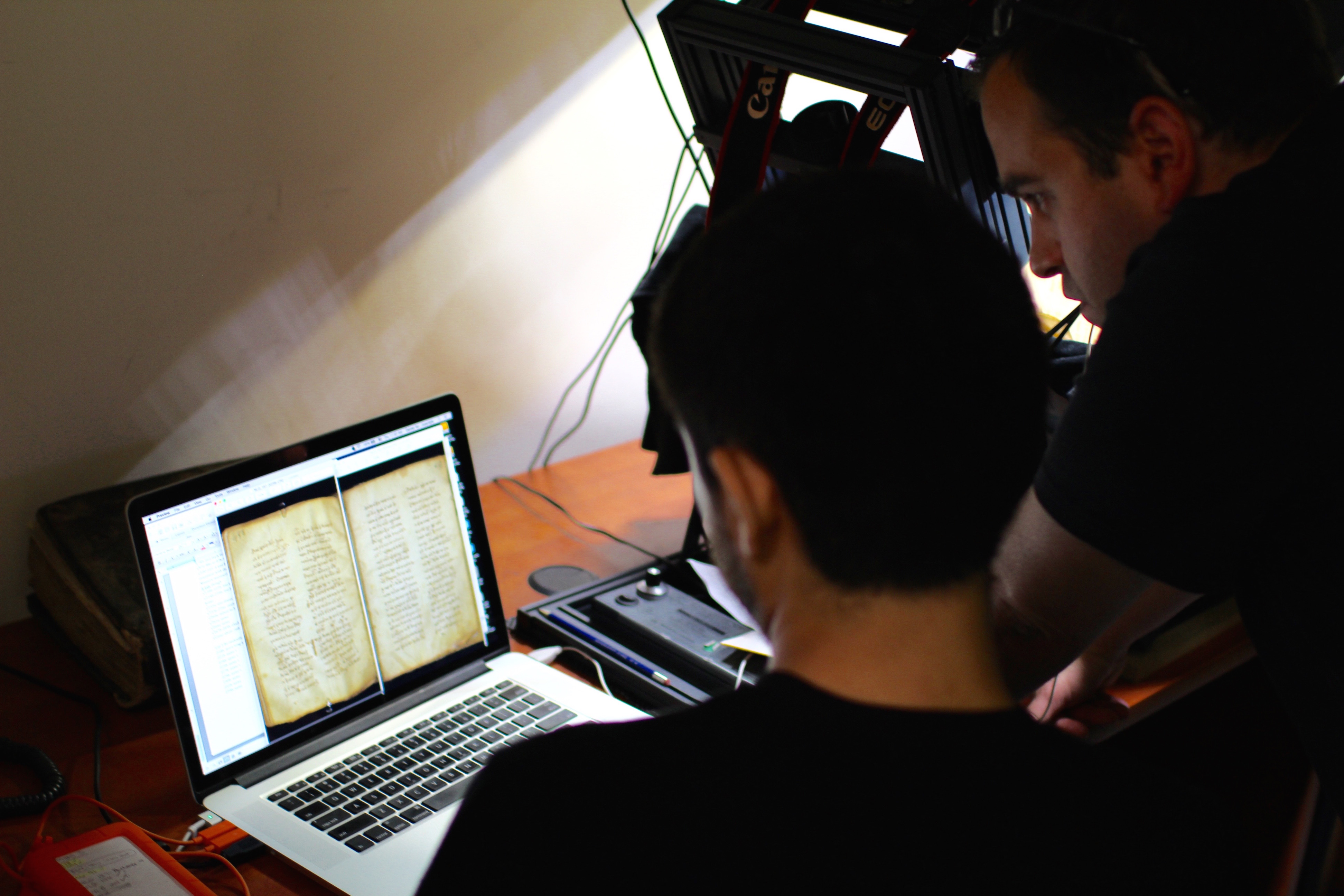
We have a team from CSNTM working at the National Library of Greece in Athens this summer. A big team—from seven to nine people at any given time. The work is both exhausting and exhilarating. Handling precious documents all day long, while trying to produce accurate, aesthetically-pleasing photographs, can be emotionally draining work. But every new day the teams are ready for more.

digitizing st NLG

Counting Quires

One of my tasks is to count quires. A quire is, medievally speaking, eight leaves or four double-leaves (bifolia) laid down, then folded vertically in the middle. These leaves then form a quire and they are sewn into the binding at the crease. Some scribes numbered their quires by writing, in very faint and small ink, the number of the quire on either first page (recto) or last page (verso) of a quire. Then, when it came time to stitch all the quires together they would know what order they would go in and assemble the book. But not all scribes wrote out these quire numbers, and even for many who did later book-owners trimmed the pages, inadvertently cutting off either the entirety or a portion of the quire number. And often, they wrote in red ink—the kind that fades so badly that it is now invisible.

There are three ways to identify the number of leaves in a quire quickly: (1) notice and document where the quire numbers are; (2) notice where the sewed strings are (always in the middle of the quire); and (3) feel the pressure of the leaves—if a leaf wants to go to the left, it belongs with the previous quire; if it wants to lay flat, it begins a new quire.

There are problems with each of these methods, but it’s essential that the quire counts are done while examining the manuscripts instead of via photographs since the latter approach eliminates the third method for determining quire counts. The binding may be tight, and the strings won’t show up in the photographs, which makes approach #2 difficult to accomplish. Frequently, a magnifying glass is used to determine if the strings are there, but this of course can only be done while examining the actual manuscript.

An Interesting Feature in GA 1761

Gregory-Aland 1761 posed an interesting problem. It’s a manuscript of Acts, the Catholic letters, and the corpus Paulinum (including Hebrews). The first quire reveals no number, but quire 2 has the number κε or 25. The numbers are then seen on every quire and they are in sequence without any gaps, going all the way through μθ or 49. Only one leaf is missing in this entire manuscript, which is unusual. Normally, at least a few leaves are missing from a manuscript, even one as late as the fourteenth century (the date of GA 1761).

Since the Institut für neutestamentliche Textforschung in Münster, Germany is the de facto cataloguer of the Greek NT manuscripts, they list this manuscript as an “ap” document—that is, Acts and Catholic letters (a) and Paul (p). They do not indicate that anything is missing, although one leaf is absent. However, judging by the quire numbers far more than one leaf is missing—184 leaves to be exact! 184 leaves is the number for the first 23 quires (since the second quire in the extant manuscript begins with ‘25’).

What was originally in this manuscript? One’s immediate hunch would be all four Gospels, and that turns out to be correct. With an average of 360 words per leaf in the extant manuscript, 183 leaves would be required for the Gospels. Thus, this manuscript was originally an eap, with ‘e’ standing for evangelists or εὐαγγέλιον.

Examining quires and counting the number of leaves in them is largely neglected by institutes that own manuscripts as well as by New Testament scholars. But it is the fastest way to determine if a manuscript is complete or is missing leaves—and where they are missing. Now, with digital images, many of the quire numbers are visible. When CSNTM prepares a manuscript, we routinely list the quires by number, Greek letter (if visible), and number of leaves. Below is what this information looks like in CSNTM’s ‘prep doc’ for GA 1761:

Quires:

1.1–8, 2[κε].9–16, 3[κς].17–24, 4[κζ].25–32, 5[κη].33–39 [short quire], 6[κθ].40–47, 7[λ].48–55, 8[λα].56–63, 9[λβ].64–71, 10[λγ].72–79, 11[λδ].80–87, 12[λε].88–95, 13[λς].96–103, 14[λζ].104–111, 15[λη].112–119, 16[λθ].120–127, 17[μ].128–135, 18[μα].136–143, 19[μβ].144–151, 20[μγ].152–159, 21[μδ].160–167, 22[με].168–175, 23[μς].176–183, 24[μζ].184–191, 25[μη].192–199, 26[μθ].200–207. Rest is paper MS added later.

We are documenting a number of features in these manuscripts, as we have traditionally done, which will help those who study them get some help in reading the texts. For example, for all continuous texts manuscripts, we provide a scripture index showing on what pages each book of the NT are to be found. Some of the incidental material is idiosyncratic, but the scripture indexes especially should be useful for researchers. For this particular manuscript, below is what is provided:

1a–52b: Acts
52b–53b: information about Luke and Acts
54a: hypothesis for James
54a–59a: James
60a: hypothesis for 1 Peter
60a–65b: 1 Peter
65b–66a: hypothesis for 2 Peter
66a–69b: 2 Peter
69b–70b: hypothesis for 1 John
71a–76a: 1 John
76ab: hypothesis for 2 John
76b–77a: 2 John
77ab: hypothesis for 3 John
77b–78a: 3 John
78ab: hypothesis for Jude
78b–80a: Jude
81a–82b: hypothesis for Romans
82b–102a: Romans
102a: subscription: written from Corinth through Phoebe; stichoi mentioned.
102b–103a: hypothesis for 1 Corinthians
103a–120b: 1 Corinthians
121ab: hypothesis for 2 Corinthians
121b–134a: 2 Corinthians
134a: subscriptio: written from Philippi through Titus, Barnabas, and Luke
134b: hypothesis for Galatians
135a–141a: Galatians
141a–142a: hypothesis for Ephesians
142b–149a: Ephesians
149ab: hypothesis for Philippians
149b–154a: Philippians
154ab: hypothesis for Colossians
154b–159a: Colossians
159ab: hypothesis for 1 Thessalonians
160a–164a: 1 Thessalonians
164b–165a: hypothesis for 2 Thessalonians
165a–167b: 2 Thessalonians
167b–168a: hypothesis for 1 Timothy
168a–173b: 1 Timothy
173b–174a: hypothesis for 2 Timothy
174a–178a: 2 Timothy
178ab: hypothesis for Titus
178b–181a: Titus
181ab: hypothesis for Philemon
181b–182b: Philemon
182b–183b: hypothesis for Hebrews
183b–: Hebrews
183b–199b: title: “the letter to the Hebrews” (Paul not mentioned as author)
200a–207a: abbreviations
208a–219a: non-biblical text, paper, later hand
220a–243b: third hand, paper text, later hand, non-biblical
244a–250b: fourth hand, paper text, non-biblical

The work at the National Library progresses well; we will soon wrap up our first of two summers here. And in the end, we will provide approximately 150,000 high-resolution images of c. 300 manuscripts and over 700 pages of documentation. When all the manuscripts we are digitizing at the National Library are photographed, we will post them on csntm.org, along with all the prep docs. This has been our custom since the beginning, though CSNTM continues to refine its digitizing standards and prep doc information.

Update from Athens: New Apostolos Manuscript

8 June 2015: There are eight of us from CSNTM in Athens right now. We’ve begun the process of digitizing New Testament manuscripts at the National Library of Greece this summer. CSNTM has a contract with the NLG to digitize all their NT manuscripts—over 300 manuscripts altogether! The director of the NLG, Dr. Philippos Tsimpoglou, is a visionary with energy, drive, innovation, and desire to bring the NLG into much greater prominence in the international discussions about ancient texts. CSNTM is very grateful to Dr. Tsimpoglou for this key partnership in digitally preserving and making accessible 150,000 pages of biblical manuscripts.

I have spent more time in Athens than in America this year, preparing manuscripts for the photographing teams. In the process of documenting each manuscript, I have come across some exciting discoveries—many of which were already known to the library, but not all. The Institut für neutestamentliche Textforschung in Münster, Germany is the official cataloguer of Greek NT MSS. And until INTF has catalogued a manuscript, it is generally not known to New Testament scholars. To date, we have found at least ten manuscripts that are not yet catalogued by INTF. In this blog, I want to discuss an apostolos (Acts and Catholic Epistles) manuscript that is glued to the inside front and back covers of a lectionary.

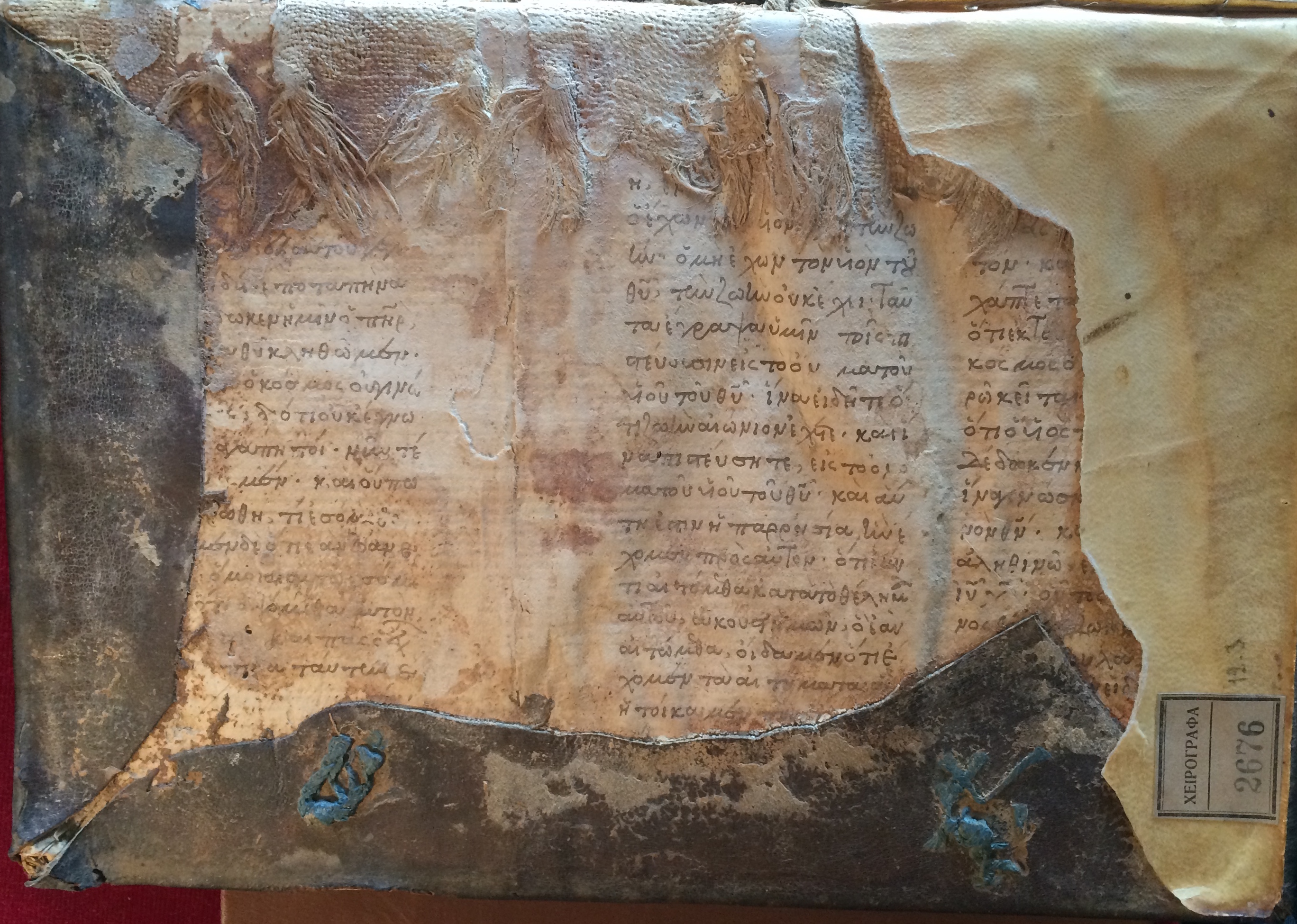
NLG 2676—known to biblical scholars as Lectionary 1813—is a 12th century Gospel lectionary, written on beautiful vellum, with 240 leaves still extant. It has ornate headpieces for each of the Gospels, produced by a true craftsman. Glued to the inside of the front cover is a manuscript leaf of a decidedly different character. Written in a professional but rather utilitarian hand is a two-column paper leaf. A leaf from the same manuscript is glued to the back inside cover.
front_inside_cover_NLG_2676

Front Inside Cover of NLG 2676

(picture taken with iPhone)


1 John 3, 5

This paper manuscript is written in a later hand, 13th or perhaps 14th century. On the front inside cover three columns are visible. There is a vertical crease after the first column, which is our first clue that what is extant is a bifolio (or double leaf). The left column begins with 1 John 2.29 and ends at 1 John 3.3a.


The text is as follows:

] ην εξ αυτου γεγε-            [2.29]

] ιδετε ποταπην α-             [3.1]

]δωκεν ημιν ο π̅η̅ρ̅,

θ̅υ̅ κληθωμεν.

] . ο κοσμος ου γινω-

] αγαπητοι. νυν τε               [3.2]

] . . μεν. και ουπω

]ρωθη τι εσομεθα

]μεν δε οτι εαν φανε-

] ομοιοι αυτω εσομε-

] οτι οψομεθα αυτον,

]… και πας ο εχων                 [3.3]

]πιδα ταυτη επ


The next two columns are from the same page; the text is 1 John 5.11b–15 in the first column and 1 John 5.18b–21 in the second. The left column of this page gives us the full lines so that we have firm evidence of how much text would be written on each line (they average 19.5 letters). The gap between 1 John 3.3 and 1 John 5.11 tells us that the bifolio is not the middle double-leaf of the quire, but is the bifolio prior to the midpoint. This is due to the fact that (1) there are approximately 30–31 lines per column (only 17 of which are extant), (2) there are approximately 600 letters per column, with two columns per page (and four per leaf), and (3) 1 John 3.3b–5.11a would involve approximately 250 lines or 8 columns. Thus, the gap would involve two columns per page, four per leaf, eight per bifolio. Therefore, this is the bifolio just before the midpoint of the quire.


The text of 1 John 5.11b–15 in this fragment is as follows:

η, εν                                                 [5.11]

ο εχων τον υιον …. τη ζω-           [5.12]

ην. ο μη εχων τον υιον του

θ̅υ̅, την ζωην ουκ εχει. ταυ-   [5.13]

τα εγραψα υμιν τοις πι-

στευουσιν εις το ονομα του

υιου του θ̅υ̅. ινα ειδητε ο-

τι ζωη αιωνιον εχετε. και ι-

να πιστευσητε, εις το ονο-

μα του υιου του θ̅υ̅. και αυ-      [5.14]

τη εστιν η παρρησια ην ε-

χομεν προς αυτον. οτι εαν

τι αιτωμεθα κατα το θελημα

αυτου, ακουει ημων, ο εαν           [5.15]

αιτωμεθα, οιδαμεν οτι ε-

χομεν τα αιτηματα α

ητοικαμεν ……


Although this MS follows the Byzantine text, it has a rare variant of the aorist subjunctive πιστευσητε (049 218 945 1751 2374) instead of the present subjunctive πιστευητε in v. 13. It also has what may be a unique variant in v. 15, ητοικαμεν instead of ητηκαμεν. In the era in which this manuscript was written, the pronunciation of οι and η would have been identical. But the spelling alteration is most likely due to the scribe’s faulty memory as he repeated to himself the word he saw in his exemplar before writing it down.

Acts 3

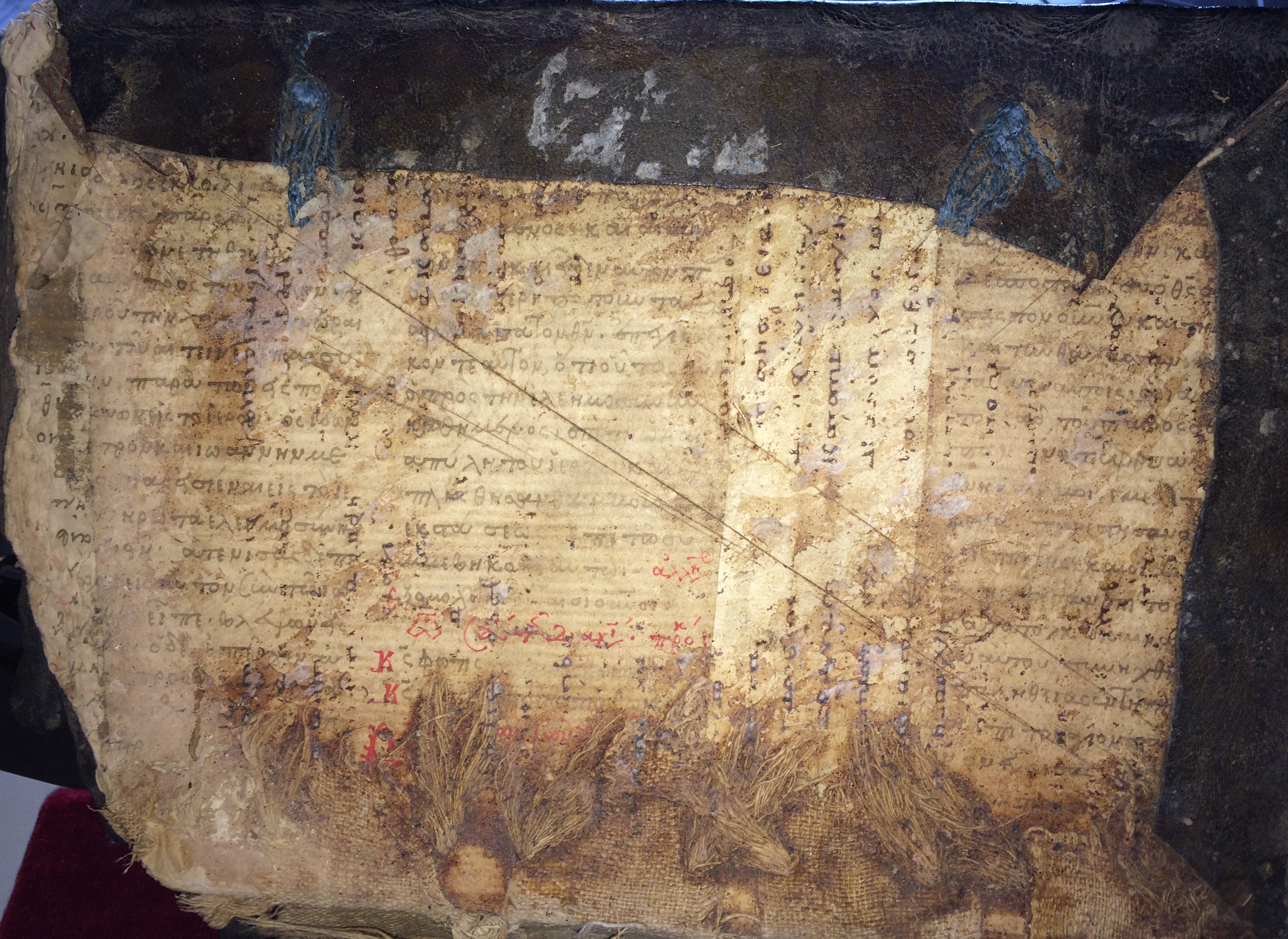
The paper glued to the inside of the back cover is also a two-column bifolio, with the first two columns on the left side, followed by a vertical reinforcement strip, with text (which would have been used to strengthen the joint between the two leaves), then one column on the right. This bifolio is in worse condition, with the residue of ink from another leaf, along with the intrusive reinforcement strip, covering a large section of the text. Further, the original script has been written on top of in certain places, making the task of positive identification a bit tricky at times.
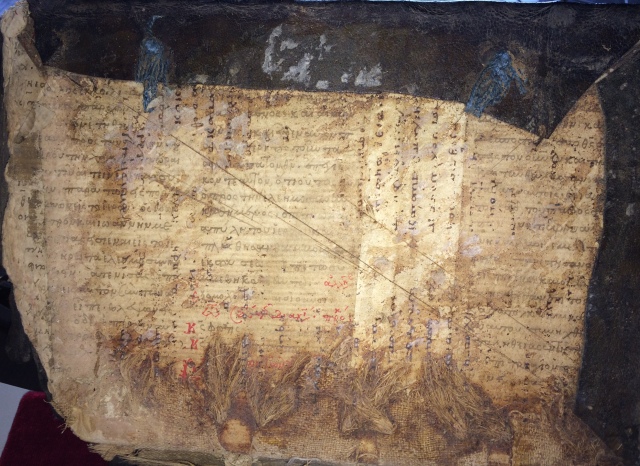
 

back_inside_cover_NLG_2676

Back Inside Cover of NLG 2676

(picture taken with iPhone)

The text begins at Acts 3.1; χω]λος εκ κοιλιας (Acts 3.2) is visible on the what appears to be the third or fourth line in the far left column. This goes through Acts 3.5a (ο δε επειχεν αυ–). The second column picks up at v. 8 (the second line reads αλλομενος και αινων) and continues through v. 10. After this, it gets confusing. The next line appears to begin with a rubricated and enlarged epsilon. That would normally indicate a new section of material, whether it be the next paragraph in Acts, a new lection (if this is a lectionary), or perhaps the beginning of a commentary section. The word looks like εξομολογ…, so we should expect it to say something about confession. The string of letters doesn’t seem to match anything in the NT, nor is it the beginning of a lection. Further, the letters look as though they are written on top of others—yet there’s a mismatch between the under-text and upper-text. The whole thing is a puzzle. I invite any readers who may have access to better tools than I do while away from my library to offer their solutions to this conundrum. It’s probably an easy solution that is simply escaping me at the moment.

There are 57 known apostolos minuscules from the thirteenth or fourteenth centuries that have both 1 John and Acts in them. Tentatively, this manuscript is the 58th, but we will most likely need to resolve what comes after Acts 3.10 on the backside to make that a definite assertion. Nevertheless, it’s always a thrill to find another manuscript of the New Testament. It is not uncommon to see manuscripts carved up and used as binding leaves in other codices. Obviously, it is unfortunate that a manuscript would be cannibalized, but many such manuscripts have been partially preserved by gluing them to wood-and-leather covers. Without such treatment, they might not have been preserved at all!


For Further Reading

The following tools are helpful for those who are fascinated by Greek New Testament manuscripts but are not sure how even to begin studying them—either online or in the flesh. This is a very basic bibliography (we didn’t want to overwhelm you right from the beginning). This is not a bibliography for New Testament textual criticism per se; rather, it is intended to be a primer on examining the manuscripts.

Aland, Kurt, et al., eds. Kurzgefasste Liste der griechischen Handschriften des Neuen Testaments, 2nd ed. Volume 1 of the Arbeiten zur neutestamentlichen Textforschung (ANTF). Berlin: Walter de Gruyter, 1994.

Since 1963, the K-Liste has been the standard tool for comprehensive knowledge about Greek New Testament manuscripts. It lists every extant manuscript with content, date, dimensions, columns, material, leaves, and location. It also has a convenient section of conversions between Tischendorf’s and Gregory’s systems, and Gregory’s and von Soden’s. In the back of the book is a list of all the sites that have Greek NT manuscripts, listed by city and library, along with the shelf number. For those who wish to see actual manuscripts, this is the indispensable bible on Bibles. It has been and continues to be updated as an online version, which has many useful search features.

Cavallo, Guglielmo, and Herwig Maehler. Greek Bookhands of the Early Byzantine Period: AD 300–800. London: Institute of Classical Studies, 1987.

The standard resource on the professional scribal writing of manuscripts in the early Byzantine period.

Cavallo, Guglielmo, and Herwig Maehler. Hellenistic Bookhands. Berlin: Walter de Gruyter, 2008.

The standard resource on the professional scribal writing of papyrus manuscripts in the Hellenistic period.

Elliott, J. K. A Bibliography of Greek New Testament Manuscripts, 3rd ed. Leiden: Brill, 2015.

This is the standard first-stop for a comprehensive treatment of what has been written on the various Greek NT manuscripts known to exist. Written by a meticulous scholar, who leaves no stone unturned, Professor Elliott’s Bibliography is must reading for going deeper with each manuscript. Perhaps what is most surprising in the volume is how many manuscripts don’t even have a paragraph written on them yet—about 80%! But if there’s a publication, dissertation, or obscure journal article about a given manuscript, Elliott includes it. That so many have nothing on them indicates that there is much, much more work to be done.

Gardthausen, V. Griechische Palaeographie, 2nd ed. Leipzig, 1913.

Another classic that has stood the test of time.

Hatch, W. H. P. The Principal Uncial Manuscripts of the New Testament. Chicago: University of Chicago Press, 1939.

Another classical text that set the standard for dating Greek majuscule manuscripts of the New Testament.

Lake, Kirsopp and Silva. Dated Greek Minuscule Manuscripts to the Year 1200. 10 volumes(!). Boston: 1934–1939; Index (Boston, 1945).

For getting the scripts of dated manuscripts up to the beginning of the thirteenth century, there is nothing that compares to Lake and Lake’s 10-volume set. It’s also extremely difficult to come by. If you can find it, let me know—I’ll buy it!

Metzger, Bruce M. Manuscripts of the Greek Bible: An Introduction to Palaeography. Oxford: OUP, 1981.

This is the best primer on getting into Greek biblical manuscripts (both New Testament and Old Testament). It’s a classic text, with several plates and characteristically Metzgerian detailed discussions. Help is also found in dating manuscripts and collating them.

Parker, David C. An Introduction to New Testament Manuscripts and Their Texts. Cambridge: CUP, 2008.

A breathtaking array of secondary literature and primary insights on NT manuscript study from Great Britain’s leading active NT textual critic.

Roberts, C. H., and T. C. Skeat. The Birth of the Codex. Oxford, 1983.

The standard introduction to when and why the codex book-form came into existence and later become the standard book-form in late antiquity and the middle ages.

Thompson, E. M. An Introduction to Greek and Latin Palaeography. Oxford, 1912.

A standard introduction which, though dated, still has much useful material.

Turner, E. G. The Typology of the Early Codex. Philadelphia, 1977.

Eric Turner was one of the great scholars of paleography, papyrology, and codicology. His opinion is always sober and never to be treated lightly.

Turner, E. G. Greek Manuscripts of the Ancient World. Oxford: Clarendon, 1971.

The long-time standard against which all other works on ancient book-making have been measured.

van Groningen, B. Short Manual of Greek Palaeography, 4th ed. Leipzig, 1967.

And a third classic that is quite useful for dating manuscripts.

These ought to be enough to get any bibliophile started down a path of rich discovery and illumination.

Several other important volumes could have been listed as well. These are intended for those whose interests are not just in the texts of the biblical manuscripts but in all aspects of those manuscripts.