Five More Myths about Bible Translations and the Transmission of the Text

There’s an old Italian proverb that warns translators about jumping in to the task: “Traduttori? Traditori!” Translation: “Translators? Traitors!” The English proverb, “Something’s always lost in the translation,” is clearly illustrated in this instance. In Italian the two words are virtually identical, both in spelling and pronunciation. They thus involve a play on words. But when translated into other languages, the word-play vanishes. The meaning, on one level, is the same, but on another level it is quite different. Precisely because it is no longer a word-play, the translation doesn’t linger in the mind as much as it does in Italian. There’s always something lost in translation. It’s like saying in French, “don’t eat the fish; it’s poison.” The word ‘fish’ in French is poisson, while the word ‘poison’ is, well, poison. There’s always something lost in translation.

But how much is lost? Here I want to explore five more myths about Bible translation.

Myth 1: The Bible has been translated so many times we can’t possibly get back to the original.

This myth involves a naïve understanding of what Bible translators actually did. It’s as if once they translated the text, they destroyed their exemplar! Sometimes folks think that translators who were following a tradition (such as the KJV and its descendants, the RV, ASV, RSV, NASB, NKJB, NRSV, and ESV) really did not translate at all but just tweaked the English. Or that somehow the manuscripts that the translators used are now lost entirely.

The reality is that we have almost no record of Christians destroying biblical manuscripts throughout the entire history of the Church. And those who translated in a tradition both examined the English and the original tongues. Decent scholars improved on the text as they compared notes and manuscripts. Finally, we still have almost all of the manuscripts that earlier English translators used. And we have many, many more as well. The KJV New Testament, for example, was essentially based on seven Greek manuscripts, dating no earlier than the eleventh century. Today we have about 5800 Greek manuscripts of the New Testament, including those that the KJV translators used. And they date as early as the second century. So, as time goes on, we are actually getting closer to the originals, not farther away.

Myth 2: Words in red indicate the exact words spoken by Jesus of Nazareth.

Scholars have for a long time recognized that the Gospel writers shape their narratives, including the sayings of Jesus. A comparison of the Synoptics reveals this on almost every page. Matthew quotes Jesus differently than Mark does who quotes Jesus differently than Luke does. And John’s Jesus speaks significantly differentyly than the Synoptic Jesus does. Just consider the key theme of Jesus’ ministry in the Synoptics: ‘the kingdom of God’ (or, in Matthew’s rendering, often ‘the kingdom of heaven’). Yet this phrase occurs only twice in John, being replaced usually by ‘eternal life.’ (“Kingdom of Continue reading “Five More Myths about Bible Translations and the Transmission of the Text”
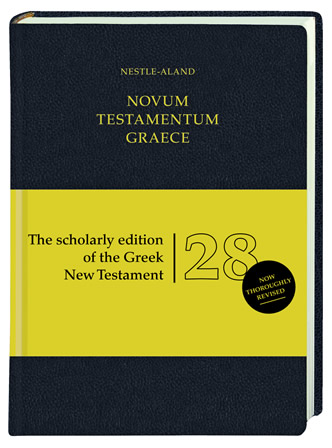
Nestle-Aland 28: The New Standard in Critical Texts of the Greek New Testament

Overview

At the annual Society of Biblical Literature conference held in Chicago last month, the latest edition of the Novum Testamentum Graece, or the Nestle-Aland Greek New Testament, was unveiled. This has been a long time coming—nineteen years to be exact. The Institut für neutestamentliche Textforschung (INTF) in Münster is behind this production, and deserves accolades for its fine accomplishment. This is the first new edition of the Nestle-Aland text since the death of Kurt Aland, the founder of the INTF.

Kurt_Aland

Inexplicably, even though the new text was available at SBL—both as just the Greek text and in diglot with English translations—it could not be acquired through Amazon until later. I pre-ordered a couple copies last April; the diglot arrived in November but the Greek-only text will not be released until January!

Several gave presentations on the new Nestle-Aland text at SBL. Klaus Wachtel of INTF gave an overview of NA28. In his lecture, he noted, inter alia, the following:

  • The textual differences from the previous edition only occur in the Catholic Epistles. This is due to the fact that behind the scenes INTF has been doing exhaustive research on many variants in these letters and has produced the impressive Editio Critica Maior (ECM) series. These are the only books that have been thoroughly examined; hence, the changes to the text are only in these books. A total of 34 textual changes have been made.
  • In these letters, the siglum Byz is used instead of the gothic M (M).
  • As INTF worked through the Catholic letters, they came to see much greater value of the Byzantine manuscripts than they had previously. In Wachtel’s presentation, he noted that the NA27 displayed “prejudice against the Byzantine tradition” while the NA28 recognized the “reliability of the mainstream tradition.” This is a welcome change in perspective, made possible because of exhaustive collations.
  • For the entire New Testament, the apparatus functions now as “a gateway to the sources” instead of the more restricted purpose of the previous edition “as a repository of variants.”

The Introduction to the new work adds much more information. Among these consider the following:

  • “from now on, the Nestle-Aland will not appear only as a printed book, but also in digital form” (48*). This is more than what is already available in the digital copies of the NA27 that are part of the Accordance and Logos Bible software packages. For example, “Abbreviations, sigla and short Latin phrases in the apparatus are explained in pop-up windows. Above all, the digital apparatus becomes a portal opening up the sources of the tradition, as it provides links to full transcriptions and, as far as possible, to images of the manuscripts included” (48*).
  • Gone are the “consistently cited witnesses of the second order”—that is, those witnesses that comprised the gothic M (M) in NA27. Although this siglum is still used, its meaning has changed. Individual non-Byzantine witnesses that are part of the ‘majority text’ (a term that means more than just the Byzantine witnesses in NA27; it is unclear exactly what this siglum means in NA28) are now apparently cited explicitly, even if they agree with the Byzantine minuscules.
  • Conjectures are no longer to be found in the Nestle-Aland apparatus. There were nearly 120 conjectures listed in the previous edition. Nevertheless, at Acts 16.12 the editors still print as the text a reading that is not found in any Greek manuscripts (Φιλίππους, ἥτις ἐστὶν πρώτης μερίδος τῆς Μακεδονίας πόλις). Continue reading “Nestle-Aland 28: The New Standard in Critical Texts of the Greek New Testament”

New Early Fragment of Romans

At the Society of Biblical Literature’s annual conference in Chicago last week (17–20 Nov 2012), Grant Edwards and Nick Zola presented papers on a new papyrus fragment from Romans. They have dated it to the (early) third century, which makes this perhaps only the fifth manuscript of Romans prior to the fourth (though a couple of others are usually thought to also be from the third century). This manuscript is part of the Green Collection (inventory #425). It will be published in the first volume of a new series by the Dutch academic publishing house, E. J. Brill. The series, edited by Dirk Obbink and Jerry Pattengale, is called the Green Scholars Initiative: Papyrus Series. Volume one is edited by Jeff Fish of Baylor University.

The text of the fragment is from Rom 9.18–21 and small portions of Rom 10. Edwards presented information about the paleography and provenance of the fragment, while Zola presented his findings on the textual affinities of the papyrus.

The papyrus was written on a codex rather than a roll, as is customary for even the oldest Christian documents. What these two scholars could determine is that the original size of each leaf of this papyrus would have been a little larger than that of P66—18 cm x 16 cm for this fragment compared to 16.2 cm x 14.2 cm for P66.

The dating of the manuscript was done rather prudently by comparing it to fixed-date manuscripts. Paleographically, the fragment was found to be close to POxy 1016 (a mid-third century papyrus), POxy 2703 (late second/early third), and POxy 2341 (208 CE).

Regarding the specific text, among early papyri of the corpus Paulinum, only P46 covers the same passage. But because of the lacunose state of P46, sixteen letters of text that are missing from the Beatty papyrus are found in the Green papyrus. Zola selected four textual problems for our consideration (are these all or does the fragment read for others?). In all four, it agrees with other manuscripts, chiefly Alexandrian. The certain readings all agree with the text of NA28. In the gaps, reconstructions were necessary and there Green 425 agrees with the main Alexandrian witnesses where they are united, with a portion of them when they split.

In 9.19, it has μοι ουν, in agreement with the Alexandrians, instead of ουν μοι found in the Western and Byzantine witnesses. The second ουν of v. 19 is apparently omitted in this fragment, in agreement with א A 1739 Byz, against P46 B D F G. In 9.20 Green 425 apparently omitted μενουνγε, agreeing with P46 D F G. In 10.1 the fragment agrees with the Alexandrian and Western witnesses in reading αυτων instead of the Byzantine reading, του Ισραηλ.

Edwards and Zola are to be thanked for making a fine presentation on the data of this new find. In keeping with other early papyri, its readings are no surprise: largely Alexandrian, with some Western strains also seen.

As an addendum, you can see images of this fragment (upside down!) on CNN in an interview that Steve Green did regarding its discovery which was made earlier this year: http://edition.cnn.com/video/?/video/bestoftv/2012/01/18/nr-hobby-lobby-religious-artifacts.cnn


Romans 9.1 and Asyndeton

As I was reading Romans 9 recently I noticed that the chapter begins asyndetically—that is, without a conjunction or other marker to connect it with the preceding. This is fairly rare in Greek and, apart from its use in staccato-like commands and aphorisms, almost always means one of two things: either a total disconnect from the preceding or a connection so strong that it would be superfluous to add the conjunction.

Paul uses asyndeton at the beginning of a major paragraph nine times in Romans. In 2.17, 10.1, 11.33, and 13.8 it is obvious that the same topic is in view. (On a smaller scale, see 2 Tim 3.16—which obviously connects to the previous verse; cf. also Phil 4.4b.) In Rom 12.9, 13.8, 16.3, and 16.21 the connection is not as clear, though it is probably there in most of these instances. Romans 13.1 offers the most obvious break without connection with the preceding. We thus see Paul beginning new paragraphs in Romans both for rhetorical effect (at least four instances, and perhaps eight) and to indicate a complete switch in topic (at least one instance but as many as five).

Significantly, Paul’s use of asyndeton for rhetorical purposes often requires the readers to think through his argument and make the connection for themselves. For example, in Eph 5.22—the only major paragraph since 1.3 in Ephesians to begin without a conjunction—we read “Wives, to your own husbands as to the Lord” (the reading of P46 B as well as Clement; Jerome also mentions that some MSS lack the verb here). Later MSS add the verb ‘be subject’ (D F G Byz Syriac), by picking up the participle in the preceding verse. This means that while v. 22 begins a new paragraph, it is still connected with the preceding conceptually (discussing submission), and almost lexically by the verb that must be supplied. The connection is thus quite subtle, but the connection is still there—so much so that the Nestle-Aland text begins a new paragraph with v. 21 instead of v. 22.

A similar thing is going on in Rom 9.1. Paul has just finished his hymn of assurance (8.35–39), letting genuine believers know that their salvation is secure because God always keeps his word. But a nagging question would have stuck in the craw of these readers: “How can we be certain that God will keep his word to us that nothing will ever separate us from the love of Christ if he didn’t keep his word to Israel?” The asyndeton that starts off the next section thus has a powerful rhetorical, though subtle, effect. Keeping this assurance to each individual believer is crucial if one is to grasp the full import of Rom 9.

Paul’s argument in Rom 9–11 is governed by his statement in 9.6: “it is not as though the word of God has failed.” The next three chapters demonstrate this thesis.

Although it is true that Paul is speaking of corporate election in chapter 9, this would give no comfort to the believers in Rome about their own salvation unless he was also speaking of individual election. (One piece of evidence that Paul is speaking both of corporate and individual election is that he uses individuals for his illustrations (Jacob vs. Esau, Moses vs. Pharaoh)—individuals who also represent nations.) A Christian in Rome would not be assured of his or her salvation if they thought that Paul was only speaking of corporate election because this tells them nothing about their own fate. The fact that Paul links the corporate promises to Israel to the individual belief of each Jew shows that for both covenants faith is the essential means of becoming the full beneficiaries of the promise.

And this means that eternal security is linked to unconditional election in Paul’s view since individual election is in view in Rom 9. Another way to state this is that Rom 9–11 is both about God’s promise to Israel and his promise to believers in Christ. This is why Paul interlaces throughout these three chapters statements about Gentile faith (Rom 9.23–26, 30, 33; 10.4, 5–13, 14–17; 11.17–23, 29). Indeed, so strong is the emphasis on individual faith that to ignore this theme is to miss the impetus for these chapters and its most relevant application to Gentile believers. In short, God’s promise of eternal security to the genuine believer in Christ is based on God’s elective purposes, his mercy and grace, and his sovereign choice. “The gifts and the calling of God are irrevocable” (Rom 11.29) because “God’s purpose in election would stand, not by works but by his calling” (Rom 9.11).