Wax Drippings and Favorite Passages

When the only access that students of the New Testament had to most images of manuscripts was through poor-quality microfilms, interpretation of the data was rather limited. The staff at the Institut für neutestamentliche Textforschung in Münster, which boasts about 90% of all NT MSS on microfilm, instructed student collators not to try to decipher the marginalia because such were virtually impossible to read. Just the text, please. And even with the text, the students had to guess at quite a bit of the letters and words because of blurred images. Below is an illustration of the kind of images they had to work with (this is codex 2813, photographed by INTF in 1989).
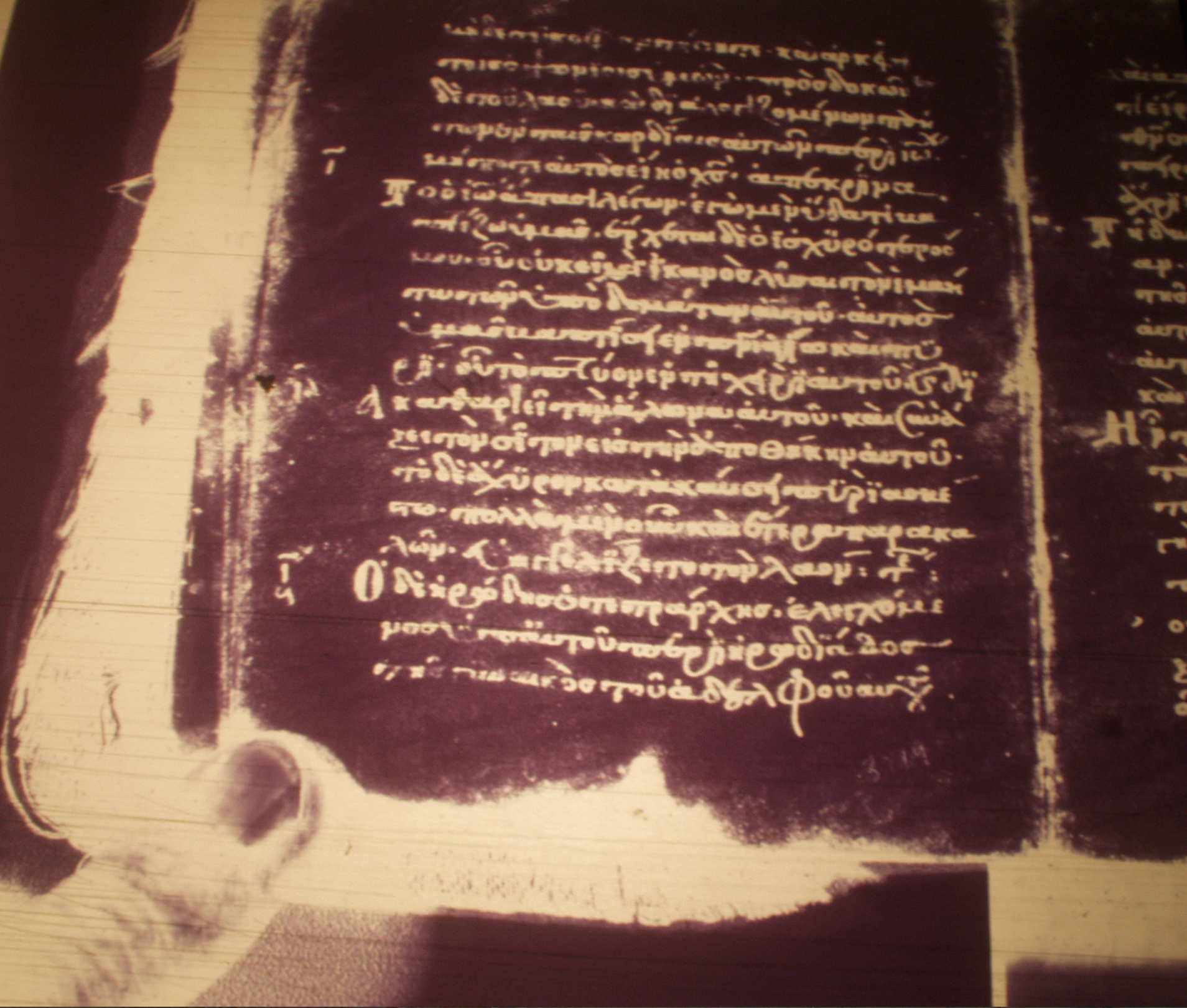
Screen Shot 2013-09-14 at 5.40.58 PM

Codex 2813 Microfilm Image

With digital photography, much more data can be seen and interpreted. This includes erasures, different colored ink (including the next-to-impossible-to-see-in-microfilm red and gold), smaller font, ornamentation, prickings (which are used to locate a MS’s scriptorium and age), etc. In addition, wax drippings are visible.

As innocuous as the wax drippings might seem, Henry Sanders, the editor of the editio princeps of Codex Washingtonianus, used them to show what pages were frequently on display. The reason, he argued, is that visitors would often read the pages with a candle, and less-than-careful lectors would inadvertently allow wax to drip from it onto the page.

Sanders’s comment, based on an examination of the actual MS, may have implications that go beyond codex W. With some caveats, it seems that wax drippings can be used to show what passages were favorites. If one were to examine the wax drippings seen in digital images of, say, a twelfth-century minuscule, he or she might be able to determine which passages were favorites from the twelfth century on. Of course, this kind of work would be needed to be done for a good number of manuscripts because an individual MS might be rather idiosyncratic—much the way codex W seemed to be (in that the wax drippings there, according to Sanders, only showed what passages were put on display, not what passages were otherwise favorites of readers). Lectionaries would probably be the least significant for interpreting wax drippings since they were regularly used in church services and the lector would of necessity be reading through the entire lectionary cycle, year after year. And when wax candles were used as opposed to oil lamps to read these MSS needs to be factored in as well. But MSS that were meant for study, personal use, or were otherwise not used much in public worship could contain many secrets of bygone generations of Christians.

I will offer two illustrations, one hypothetical and the other actual. John 3.16 is a favorite verse of American evangelicals today. It has even shown up on placards held by a crazed football fan wearing a multi-color afro, who would stand up in the end zone after a team scored, making sure that the TV cameras would capture the image.

 John 3.16 & multi-color doThe Gospel on the Simpsons

But was this text that well known and that well loved in ancient and medieval times? A look at digital images of MSS might reveal the answer. Of course, in order to make one’s case, a look at the entire MS’s images would be needed to see which pages had the most wax drippings. Another caveat: if the text on a given page was reworked, scraped, or had extensive marginalia, that might be the reason for extra wax drippings, produced in this case by the scribe him/herself.

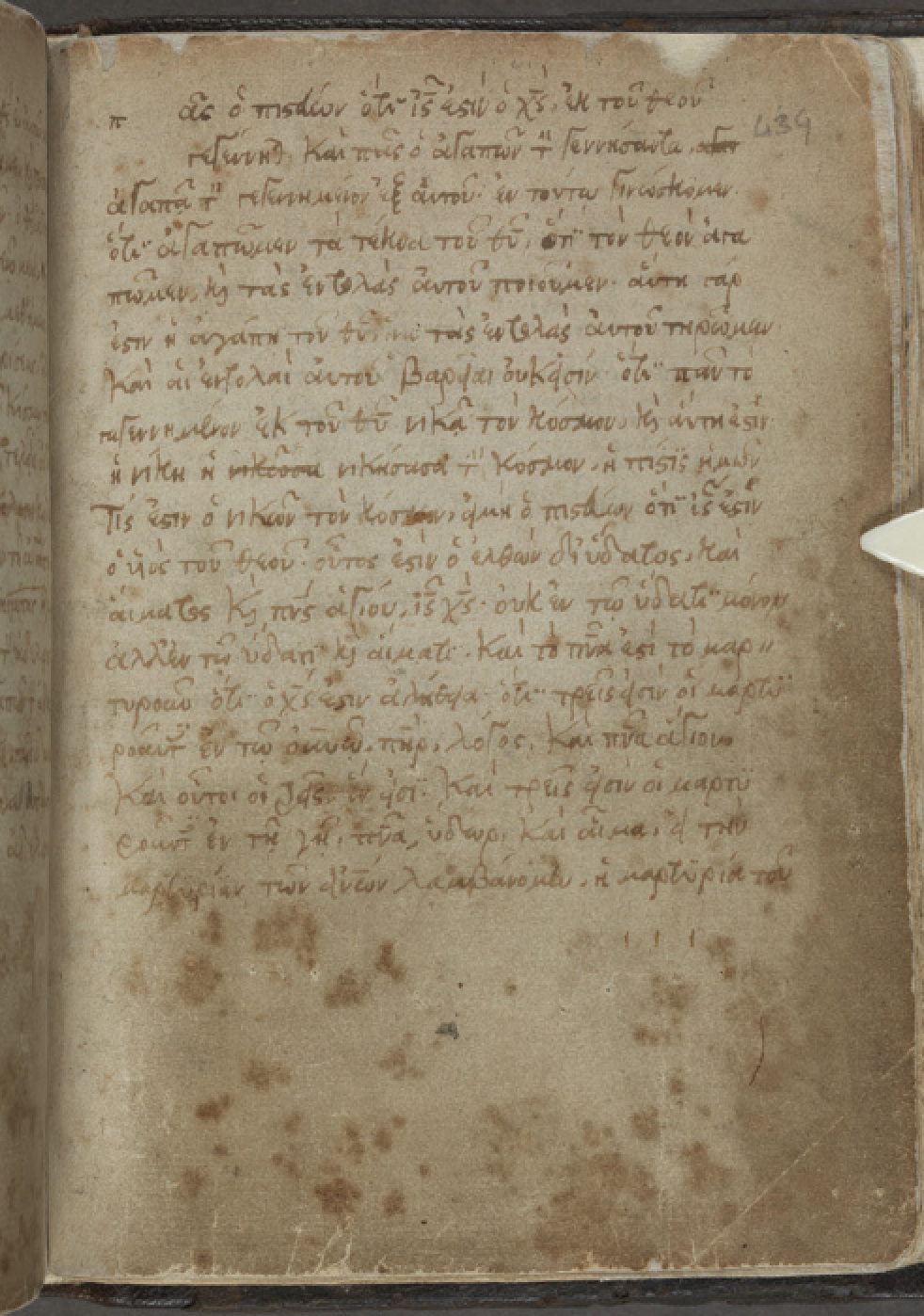
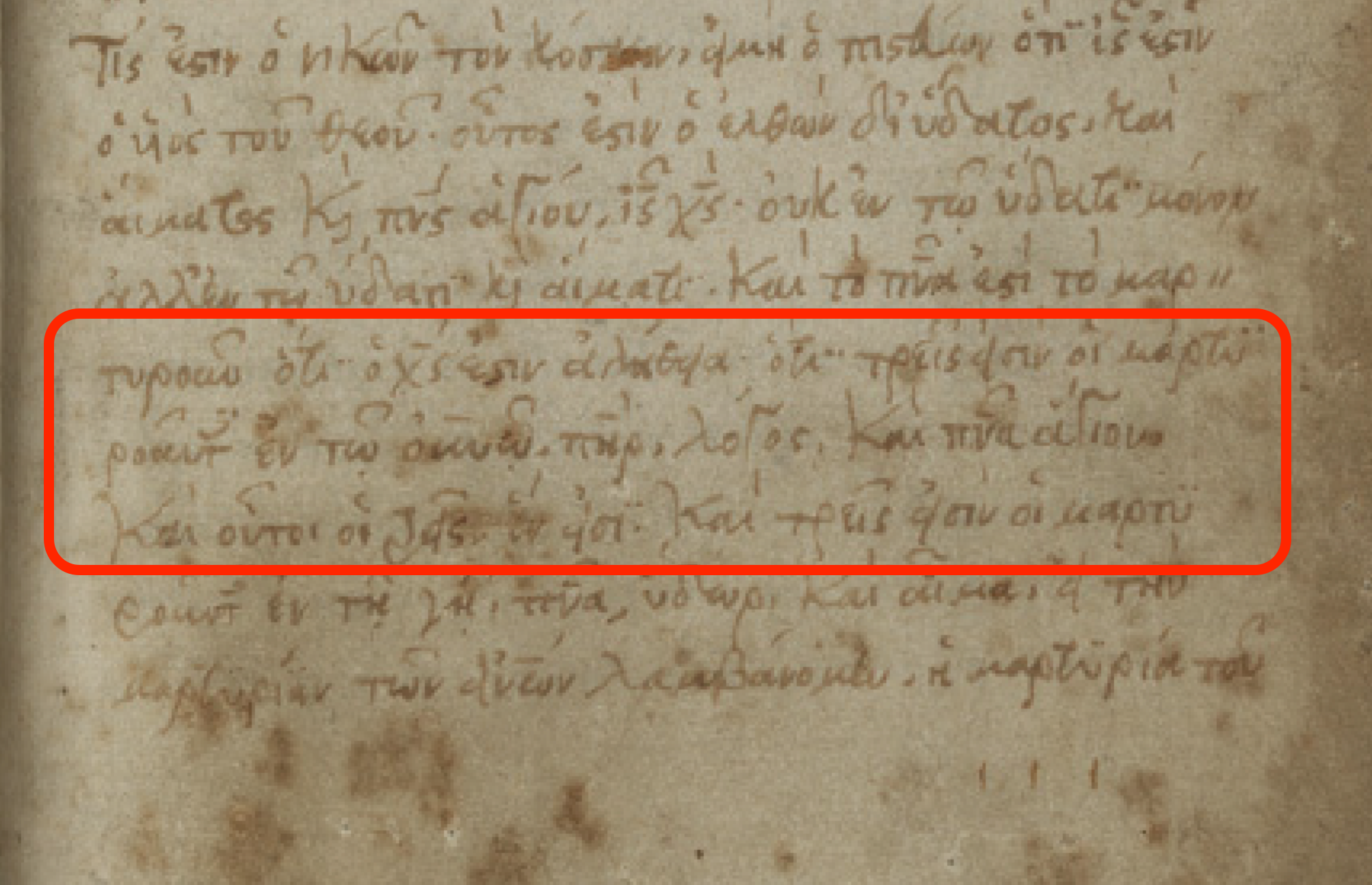
An actual illustration can be seen in codex 61, also known as Codex Montfortianus. This is the MS that was produced by a scribe in Oxford named (F)roy in 1520, which included the comma Johanneum (the Trinitarian formula at 1 John 5.7) that made its way into Erasmus’s third edition of the NT (1522). Now housed at Trinity College, Dublin, it is reported to have almost naturally fallen open to 1 John 5 because of the frequent consulting of this passage by researchers over the years. The MS nowadays is no longer available for direct consultation, but the library has produced some adequate digital images of it. And the page which contains the comma has more wax drippings by far than any other. It is also significantly dirtier than any other page, due to the constant handling of the page.

Screen Shot 2013-09-14 at 5.16.19 PM Codex 61: Two Pages before 1 John 5

 Screen Shot 2013-09-14 at 5.16.03 PMCodex 61 at 1 John 5

Screen Shot 2013-09-14 at 5.20.06 PM The Comma Johanneum in Codex 61

In the least, examining the wax drippings of digital images in continuous text MSS century by century and production-location by production-location (when known) could produce some interesting results. As these begin to be examined, certain guidelines should emerge on how to interpret the data. The necessary caveats may temper otherwise robust claims, but these should not keep students from examining the data.

Some Notes on the Earliest Manuscript of Paul’s Letters

The publication of P46 in 1935–37––then, and now, the oldest extant manuscript of Paul’s epistles––has not ceased to pique the interest of biblical scholars. Beginning with the plates and text published by Kenyon (1936, 1937), and continuing with the virtual birth of reasoned eclecticism with Zuntz’s magisterial The Text of the Epistles: A Disquisition on the Corpus Paulinum (1953), and reconsiderations of its date (Young Kyu Kim, “Palaeographical Dating of P46 to the Later First Century,” Biblica 69 [1988] 248–57), this priceless document has made its way to the front lines of biblical scholarship for a long time. Though Kim’s suggestion that Chester Beatty Biblical Papyrus II was written before the reign of Domitian (81–96 CE) has been refuted, the consensus continues that it was produced c. 200 CE.

Where Are the Pastoral Epistles?
One curiosity of this papyrus is that, in its current state, it lacks the pastoral letters. With 86 of the original 104 leaves still extant, scholars have a good amount of material to work with as to whether it would have originally contained the pastorals.

How do they know that it originally contained 104 leaves? Two features are used to infer this. First, the manuscript is a single quire codex. This means that all the double leaves (or bifolia) were laid down on top of each other, then folded and sewn into the binding. The fact that it was a single-quire codex can be detected by size of the pages: moving from the beginning to leaf 52, the pages get increasingly narrower. Then, from leaf 53 to the end, the pages get increasingly wider. This can only mean that all the bifolia were laid down in one stack, folded, then trimmed on the outside so that all the leaves were relatively flush. (The later, standard quire was eight leaves [or four double leaves], used throughout the early to middle ages.)

Second, each page is numbered by the original scribe. This is unusual for manuscripts of any age. Usually the quires are numbered, and frequently the leaves were numbered (on the front page), but not the pages. Since the first extant page is numbered 17 (folio 8), and starts with Romans 5.17, we can extrapolate that the manuscript began with Romans 1 and is missing the outer seven double leaves.

What is extant are nine ‘Pauline’ letters: Romans, Hebrews (almost always included in the Pauline corpus as far as ancient manuscripts are concerned), 1 Corinthians, 2 Corinthians, Ephesians, Galatians, Philippians, Colossians, and 1 Thessalonians. Missing are 2 Thessalonians, Philemon, and the pastoral letters.

Almost surely 2 Thessalonians followed 1 Thessalonians, as it does in all other manuscripts which have both letters. But what about Philemon? Most scholars are of the opinion that Philemon was also included in this codex.

But the pastorals? This is where opinions have varied. Kenyon started the ball rolling with the suggestion that the last five leaves were left blank and did not include the pastorals. The argument is that there was simply not enough room to include the pastorals and Philemon, which would require about twice as many leaves. Why would this be the case? Was the scribe unaware of them? If he was, this might suggest that they are not authentic.

Although Kenyon’s view held sway for many decades, and is even now occasionally affirmed, Jeremy Duff’s article in New Testament Studies 44 (1998), “P46 and the Pastorals: A Misleading Consensus?” challenged this hypothesis.

One of the points made by Duff is that the letters are more compressed at the end of the codex than in the middle. He noted that there are half again as many letters per page in the last leaves than in the middle leaves. But this is partially due to the fact that the outer leaves are wider than the inner leaves. Nevertheless, there are more letters in the back outer leaves than the front outer leaves, showing that at least some compression did take place. And this seems to suggest that the scribe was aware of the problem he had created for including the pastorals and he began to compensate upon realizing his mistake.

There are problems with Duff’s analysis, however. The scribe seemed to understand to some extent how much space it would require to produce his codex. This is seen in his notes at the end of each book of how many lines he wrote. This was customary for professional scribes; it was in essence a bill for services, since they were paid by the line. He may have been working from a manuscript that had already indicated the number of lines, and thus would have known how many leaves he needed for his manuscript. Of course, the fact that his words were more compressed at the end of the codex seems to show that as careful as he was in his calligraphy (and he was), this tells us nothing about his math skills.

A Fresh Examination of the Codex
This week I had the privilege of examining P46 in the flesh. Fifty-six of the 86 leaves are housed at the Chester Beatty Library in Dublin. I have spent the last three days examining them in some detail, comparing them to the editio princeps by Kenyon. Sir Frederic Kenyon produced the plates of this famous papyrus in 1937. Each image has been assumed to be exactly the same size as the actual leaf it represents. I measured each leaf against Kenyon’s plates and noticed some interesting phenomena.

Of the 88 plates (44 leaves) I was able to measure, the plates in Kenyon’s volume are off at least 61 times. Most of these are within 1 mm or so, but a few are fairly significant. At least three are off by 3 mm, and one is off by as much as 5 mm.

In addition, I noticed a curiosity: some of the plates in Kenyon’s volume were photographed without the lens plane exactly parallel to the leaf. For example, the photograph of folio 39 verso (1 Cor 1.14–23) is slightly wider than the actual leaf on the bottom, while the top of the leaf is the same size in both the photograph and actual manuscript. And leaves 49 recto (1 Cor 10.1–10), 50 recto (1 Cor 10.21–30), and 51 verso (1 Cor 10.31–11.6) are also somewhat trapezoidal. This suggests that the camera got cocked, or the tape around the plates (for Kenyon’s photographs were of the papyrus under glass) got doubled up, creating the trapezoidal effect.

How much the incorrect sizes of the leaves in Kenyon’s volume impact the discussion of whether P46 originally contained the pastorals is yet to be seen. But in the least, this anomaly needs to be factored into the discussion. Much can still be learned from this renowned papyrus.

Colorado Springs Friends of CSNTM Fundraiser Banquet

If you’re in Colorado–anywhere in Colorado–you won’t want to miss this event! You will learn about a unique project: The Center for the Study of New Testament Manuscripts is involved in digitally preserving ancient handwritten manuscripts of the New Testament and making them available online. Having access to the best images of the Word of God is the foundation for all future Bible translations. You owe it to yourself to find out about this exciting opportunity to invest in something that has eternal value.

Tickets are $25.00.
For more information please email Dana Cooper.

Colorado Springs

The Authenticity of the Gospel of Judas

Katherine Weber of the Christian Post asked me some questions this week about the recent revelation that the Gospel of Judas had been authenticated by a number of means. See http://science.nbcnews.com/_news/2013/04/08/17656331-scholars-reveal-how-they-scrambled-to-authenticate-gospel-of-judas for the news report, and http://www.christianpost.com/news/gospel-of-judas-free-of-forgeries-but-still-fake-heretical-says-new-testament-scholar-93781/ for Katherine’s article (published 11 April 2013).

Below are her questions and my responses. This will also be published in the Christian Post later this week.

1) What are your thoughts on the authenticity of the Gospel of Judas? Is ink testing and comparison, in your opinion, an adequate method of determining the validity of an ancient text?

Paleography—the discipline of analyzing, deciphering, and dating ancient manuscripts—is little known outside of specialized circles. Traditionally, scholars especially use handwriting analysis to date manuscripts. Handwriting changes over time, and ancient Greek papyri, of which there are hundreds of thousands still in existence, give us plenty of illustrations of these changes. Actual dated papyri give us concrete evidence for when a particular style of writing was used. Of course, the manuscripts do not use our modern dating system. Instead, they are indexed to the reigns of the Caesars, mention a known person in an official capacity whose dates are known, or speak of astronomical events. For example, a petition to a government official written in “the 25th year of Marcus Aurelius Severus Antoninus Caesar” was penned in AD 216. By such fixed dates on some of the papyri, scholars can fix the patterns of handwriting of other papyri to a range of dates. On such undated papyri, the range can be as short as fifty years.

But Coptic manuscripts are notoriously difficult to date because the handwriting was more stable than Greek manuscripts. Pinpointing the date to within one hundred years is difficult, if not impossible, in most cases. Ink analysis is important because of the shifts in ancient technology and methods that can be located in time. Radiocarbon dating is not usually used on ancient manuscripts because, until recently, it necessarily destroyed part of the document being analyzed. Apparently, radiocarbon dating was used on the Gospel of Judas, however. (There is a relatively new method for dating manuscripts that is non-destructive. I did not see any discussion of this in the report. Developed by Dr. Marvin Rowe of Texas A & M University and his doctoral assistant, Professor Karen Steelman, the method uses a plasma chamber that does not damage the artifact. See Marvin W. Rowe and Karen L. Steelman, “Non-destructive 14C Dating: Plasma-Chemistry and Supercritical Fluid Extraction,” March 2010, ACS National Meeting 2010. So it would indeed have been possible to get a relatively firm date on this fragment without destroying any text.) One problem with all kinds of radiocarbon dating, however, is that this too cannot give a precise date. Depending on the age of the artifact, the range can vary widely.

The recent revelations by Joseph Barabe indicate a date of “approximately A.D. 280,” but this seems to be more precise than the technology would suggest. Most likely, the confluence of ink analysis and radiocarbon dating have both legitimately authenticated this codex and fixed the date to the late third to early fourth century.

2) What criticisms do you have of the Gospel of Judas’ authenticity?

It is important to distinguish two concepts regarding its authenticity. First, there is the issue of whether this document is a modern forgery or a bona fide ancient text. The evidence seems to be quite strong that this is the latter. Second, when we hear the word ‘authentic’ regarding an early sub-Christian writing it is natural to conclude that authentic = true as regards the historicity of the Christian faith. This is not the case in this instance. All that is being claimed is that the manuscript really was produced in the late third century.

3) If it became a fact that the Gospel of Judas were real, how would this change the study of the New Testament?

Most likely, the original Gospel of Judas was written in the second half of the second century. Irenaeus, writing in about AD 180, condemned a gospel by this name as a fake, and described its contents as revealing that Judas “alone, who knew the truth as no one else did, accomplished the mystery of the betrayal” of Jesus. This fits well with the contents of the codex, in which Jesus praises Judas as the one who will set his spirit free from the bonds of his physical body. This is vintage Gnosticism, which made a hard distinction between the spiritual and material world, branding the one good and the other bad. But does this mean that there is any historical truth to the Gospel of Judas, that it actually tells us the real story about the relation of Jesus to Judas? Hardly. Not a single scholar thinks that this conversation has any historical credibility. Irenaeus was right: this is a fake gospel which promotes a heretical idea about Jesus of Nazareth. The discovery and authentication of the Judas codex does nothing to disturb that assessment.

A New Kind of Apologetics: Christian Renaissance

News on the Christian Renaissance Apologia Conference coming up on April 12–13:

I’ve mentioned this apologetics conference a couple of times on this site, but I thought I’d give a lot more information on it this go-around.

First, a word about Christian Renaissance. This is a new concept in apologetics. In fact, it’s much more than apologetics. In odd-numbered years, the Christian Renaissance will be hosting an apologetics conference (called Apologia); in even-numbered years CR will be hosting a right-brain creativity conference/session/get-away/whatever. That’s called Poiema.

What makes Christian Renaissance new are two things.

First, it’s apologetics geared toward the postmodern world. Without sacrificing the important content that modernist apologetics has contributed, CR wants to build on thats but also go in a slightly different direction. CR recognizes that we are firmly entrenched (as much as can be) in a postmodern world. This means that the  worldviews of people in Europe and America especially focus on authenticity more than truth, a holistic view of humanity as opposed to a view that elevates the mind above all else, a strong desire for community including community service, social justice more than proclamation of truth, a relativistic view of truth, ambiguity and uncertainty over neatly packaged and dogmatic claims. There is much in postmodernism that should resonate with Christians; there are some things that should not. Postmoderns seek community but tend to have little clue how to accomplish it. Postmoderns tend to view all truth as relative. And although evangelicals cannot hold to this, we should recognize that even absolute truth is not always accessible absolutely. This means that a measure of humility (rather than triumphalism) will be a key characteristic of these conferences. Christian Renaissance: Apologia is intended to showcase top-notch scholars, front-line thinkers in their fields, who also know how to communicate well. They are not the sorts of people who shy away from the tough questions, but recognize that evangelical Christianity has some answers, but by no means has all the answers. They are not dogmatic where dogma is not warranted. And they recognize that the question people are asking about the Christian faith today is not so much, Is it true? as much as Does it work?

Second, Christian Renaissance has a non-apologetics component known as Poiema. Poiema is the Greek word for poem or creation (with the accent on the truly imaginative aspects of creation). Christian Renaissance: Poiema, the even-yeared conference/symposium/??, focuses on the right-brain thinkers, the artisans, artists, actors, writers, littérateurs, creative problem-solvers, musicians, and the like. Those who will launch the inaugural event in 2014 have been given a tabula rasa: they can do anything that they see as that which helps to bring prominence back to those who are right-brainers, those who have been slowly disenfranchised in the American evangelical church. These two branches of Christian Renaissance unite the left-brain and right-brain thinkers in a way that has not been done in a long, long time. Stay tuned!

Now, back to the inaugural Christian Renaissance: Apologia Conference. The speakers are well-respected scholars (not just apologists) who are doing cutting-edge work in their respective disciplines. All of them have published extensively in academic spheres. Their work is peer-reviewed by the best scholars in their guild. And they all are excellent speakers who know how to communicate with people who have little to no theological training.

The theme of this inaugural conference is “Skeptics and the Savior: Did the Word Really Become Flesh?” The evidence for the person of Jesus Christ, accenting his divine nature, will be examined from Qumran to Constantine. The lectures and lecturers are as follows:

Darrell Bock: The Gospels: Recording before There Was Recording

Craig Evans: The Dead Sea Scrolls and Christology

Gary Habermas: A Resurrection Time-Line: Linking our Earliest Sources to the Earliest Witnesses

Daniel B. Wallace: Did Constantine Invent the Deity of Christ?

The conference kicks off at 7 PM on Friday, April 12, at the Hope Center (2001 West Plano Parkway) in Plano, Texas. Wallace will give the opening lecture, with time for Q&A afterwards. Snacks will be provided that evening. There will be TWO book-signings. Saturday morning a continental breakfast will be served, and the conference will begin at 9 AM. A delicious catered lunch will be provided, too. The conference on Saturday will include the other three speakers, with Q&A for each of them. Michael Patton of Credo House will be the emcee. Throughout the conference, attendees will be able to send in their questions (probably by cell phone text), and a panel discussion in which these questions are aired will conclude the conference. It gets over at 4 PM on Saturday.

But that’s not all! There will be a special and spectacular dinner with the scholars Saturday evening for those who wish to rub shoulders with them in a more intimate setting. We will be meeting at Chamberlain’s Steak House in Dallas–one of the finest steak houses in the Metroplex. I can’t tell you all that will be involved in this, but I can tell you that it will be well worth it. The meal is partially subsidized.

What does all this cost? And when do you need to sign up? For the conference proper, the tickets are $55 for an adult and $40 for students. The dinner on Saturday night is separate. That’s $100, and worth it! Room for only 60 people. Visit http://www.renaissanceconference.com for more info and to buy tickets. Tickets will be on sale through Wednesday, April 10. Because the caterers need to know how many meals to prepare, it’s best to sign up early. Seating is limited (especially at the Scholars Dinner), so reserve your place now and be a part of this historic event!