Μονογενής = ‘only begotten’?

So says Charles Lee Irons, “Let’s Go Back to ‘Only Begotten,’” Gospel Coalition website, 23 Nov 2016: https://www.thegospelcoalition.org/article/lets-go-back-to-only-begotten#_ftn3

Irons begins by noting that in the KJV there are five Johannine passages that speak of the “only begotten” Son of God (John 1.14, 18; 3.16, 18; 1 John 4.9). He then notes that in the modern era there has been a broad scholarly consensus that μονογενής means ‘one of a kind.’ He then accurately represents the rationale for this consensus: “Scholars have argued that the compound Greek adjective is not derived from monos (‘only’) + gennao (‘beget’) but from monos (‘only’) + genos (‘kind’). Thus, they argue, the term shouldn’t be translated ‘only begotten’ but ‘only one of his kind’ or ‘unique.’”

Irons offers as his first argument that μονογενής means ‘only begotten’ in some passages. This presumably means that there is no noun like ‘son’ or ‘daughter’ in the context to already suggest birth, though he does not say this. It is certainly what I expected in order for his argument to make much sense, however. Otherwise, ‘one and only son/daughter’ makes perfectly good sense, which would defeat his point.

Irons begins by citing one reference from Plato—Critias 113d: μονογενῆ θυγατέρα ἐγεννησάσθην. Here not only is ‘daughter’ mentioned explicitly, but also that she had been ‘born.’ If μονογενής here means ‘only begotten’ then an awkward tautology occurs: “They begot an only-begotten daughter.” (The Attic aorist middle dual is here used.)

Further, I was surprised to read his three biblical examples:
Luke 7.12: μονογενὴς υἱός—here ‘son’ is explicit.

Luke 8.42: θυγάτηρ μονογενής—again, explicit.

Luke 9.38: διδάσκαλε, δέομαί σου ἐπιβλέψαι ἐπὶ τὸν υἱόν μου, ὅτι μονογενής μοί ἐστιν. But here ‘son’ is already mentioned, so the ‘one and only’ [son] is simply good economical Greek style.

Thus, Irons’s approach so far is simply question begging.

He follows this up with 1 Clement 25.2 [Irons says it is 25.1], which speaks of the Phoenix as ‘one of a kind’ using μονογενής. He also mentions an unidentified text (‘an ancient treatise’) that speaks of trees as ‘in one kind.’ But he adds, “these are uniformly metaphorical extensions of the basic meaning…” That, too, is begging the question, because he is assuming that the essential idea of μονογενής has to do with birth.

Second, he says that “careful examination of the word list of Thesaurus Linguae Graecae reveals at least 145 other words based on the –genēs stem.” This is a more significant argument, but I would need to see his evidence before recognizing its validity. He also adds that “fewer than a dozen have meanings involving the notion of genus or kind.” To argue from other words that have the –γενής stem as though they must inform the meaning of μονογενής may seem to be imbibing etymological fallacy, especially since there are some –γενής words that have the force of ‘kind’ or ‘genus.’ However, if ‘begotten’ is the routine meaning diachronically, and especially synchronically during the Koine period, Irons may well have a point.

He does seem to engage in etymologizing, however, when he says that γενός and γεννάω “both genos and gennao derive from a common Indo-European root, ǵenh (‘beget, arise’).” He finishes his arguments by again claiming that –γενής essentially has to do with birth. The BDAG lexicon allows for the meaning ‘only begotten’ for μονογενής but seems to view this meaning as secondary. In addition, they note that in the Johannine literature “The renderings only, unique may be quite adequate for all its occurrences here.”

 All in all, Irons is right to focus on the data provided in TLG for this certainly expands our knowledge base of the term. But that he seems to have focused on cognates that have the morpheme –γενής rather than the specific usage of μονογενής, both diachronically and synchronically, is a weakness in his argument.


Medieval Manuscripts and Modern Evangelicals: ETS 2016 in San Antonio

On Wednesday, 16 November 2016, I had the honor of delivering the presidential address at the Evangelical Theological Society’s annual meeting in San Antonio. The title of the lecture was “Medieval Manuscripts and Modern Evangelicals: Lessons from the Past, Guidance for the Future.” Essentially I argued that we can learn many things from the paratextual and codicological features of medieval manuscripts.

ga_800_0176b-ekthesis

Codex 800 with wrap-around commentary

The lecture will be published in the Journal of the Evangelical Theological Society next year. I would like to thank all of you who helped in the preparation of this message–especially CSNTM staff and interns–as well as all who responded afterward. The staff and interns need to be singled out here:

Staff: Rob Marcello and Andrew Bobo were especially helpful, as well as Stratton Ladewig, Christina Nations, Andy Patton, and Mark Arvé. Kudos to you all!

Interns: Laura Peisker, Micah Geyman, Colleen Doran, Joshua Smith, David Lopez, and Teddy Jestakom. You all helped immensely and responded quickly over the last few months to the myriad of sources I needed post haste for the paper. Thank you all!

I am very grateful for the privilege of having served as president of this Society, and I hope that its future will be bright. Sam Storms is now the president of the Society. He was responsible for selecting the plenary speakers on this year’s topic, the Trinity. I know that he will give an outstanding address at next year’s meeting. David Dockery will be the program chairman for the 2017 conference. I’m quite confident that it will be a terrific meeting. And Michael Thigpen and his staff (especially his wife, Bonnie) are to be thanked for their tireless efforts and timely communication. Without Mike as the Executive Director, ETS could hardly function. He is in charge of running the Society and he always seems to think four steps ahead of anyone else as to what is needed to make ETS both stronger and function smoothly.

Daniel B. Wallace
ex-president, Evangelical Theological Society

A Curator’s Guide — An Exploration into Matthew and Mark

img_9080Across the next few weeks, I will be publishing a series of blog posts celebrating the work of Robert M. Bowman, Jr. in creating helpful bibliographies on books of the Bible. Bowman is a very careful and well-researched theologian, exegete, and author, having published many articles and books on religion, theology, and apologetics. In particular, I’d like to highlight a book he co-authored with Ed Komoszewski, Putting Jesus in His Place, which is the most accessible introduction to the deity of Christ published in the last several decades. Each week I will upload new posts with the bibliographies of certain New Testament books compiled by Bowman. This first post will feature the bibliographies for Matthew and Mark, and subsequent posts will provide bibliographies for books up through Revelation. Rob has done his homework and I am grateful for the opportunity to post this bibliography of resource tools for studying the New Testament
Matthew:

Davies, William D., and Dale C. Allison. A Critical and Exegetical Commentary on the Gospel according to Matthew. Volume I: Matthew 1-7. Volume II: Matthew 8-18. Volume III: Matthew 19-28. ICC. Edinburgh: T. & T. Clark, 1988, 1991, 1996. The best non-evangelical, critical commentary. Both Davies and Allison are renowned scholars on Matthew.

Evans, Craig A. Matthew. New Cambridge Bible Commentary. Cambridge: Cambridge University Press, 2012. Best recent commentary, strong on the historical and cultural contexts.

France, R. T. The Gospel of Matthew. NICNT. Grand Rapids: Eerdmans, 2007. Best exegetical and theological commentary, a stand-out especially in its handling of the Olivet Discourse.

Keener, Craig. A Commentary on the Gospel of Matthew. Grand Rapids: Eerdmans, 1999. Most thorough treatment of Matthew’s cultural context, with numerous citations to background literature from both Jewish and Greco-Roman sources.

Quarles, Charles L. Sermon on the Mount: Restoring Christ’s Message to the Modern Church. NAC Studies in Bible & Theology. E. Ray Clendenen, series ed. Nashville: B&H, 2011. Best commentary on the Sermon on the Mount.

Mark:

Bock, Darrell L. Mark. New Cambridge Bible Commentary. New York: Cambridge University Press, 2015. Current, meaty commentary by a leading evangelical scholar on the Gospels, featuring a helpful overview of Markan scholarship and an especially lengthy bibliography of secondary literature on Mark.

Collins, Adela Yarbro. Mark: A Commentary, ed. Harold W. Attridge. Hermeneia. Minneapolis: Fortress Press, 2007. The standard liberal commentary, bringing a wealth of background information to bear but depreciating the historical nature of the Gospel narrative.

France, R. T. The Gospel of Mark. NIGTC. Grand Rapids: Zondervan, 2002. Conservative commentary striking an excellent balance of exegetical and theological engagement with the text.

Marcus, Joel. Mark 1-8 and Mark 8-16. AB 27, 27A. New York: Doubleday—Anchor Bible, 2000, 2009. Arguably the best mainline, non-conservative commentary on Mark.

Stein, Robert H. Mark. BECNT. Grand Rapids: Baker, 2008. Detailed evangelical commentary fully engaging textual and literary-critical issues.

NIV Application Commentaries on Sale Now

For a short time only, every NIV Application Commentary eBook is on sale for $4.99 apiece. Some may wonder whether a commentary with the name ‘application’ in it is really worth it. After all, aren’t commentaries supposed to deal with interpretation?

nivac_banner2-copy

Commentaries can be grouped broadly into two categories: critical and popular. The critical (or exegetical) ones focus on the original language text and give detailed interpretation, drawing out the meaning of the text for seminary students, pastors, and others with training in Greek and Hebrew. Popular commentaries tend to be on the lighter side of interpretation but are usually strong on drawing out principles for living out the Christian faith for the layperson.

Too often popular commentaries are written by pastors who do not have the training, time, or tools to investigate the biblical text in depth. And critical commentaries hardly relate to the person in the pew. What is unusual about the NIV Application commentary series is that the same scholars who wrote exegetical works now bring such insights to all Christ-followers.

Take Doug Moo’s commentary on Romans for example. He has written a massive work on this great epistle (over 1000 pages!), definitely not something for the faint of heart. But he’s also written the NIV Application Commentary on Romans. One can be confident that this superb scholar’s insights are also to be found in the more accessible commentary in the Zondervan series. Further, Moo frequently packages things in a way that is memorable, pithy, even at times inspiring. And the reader can be sure that the commentator has done his homework.

The commentaries by the other scholars in this series are of the same ilk. It’s a great opportunity to get any one of these excellent tools as an eBook. The sale is from November through November 13. See the details here.

Finally, an Awesome Backgrounds Bible!

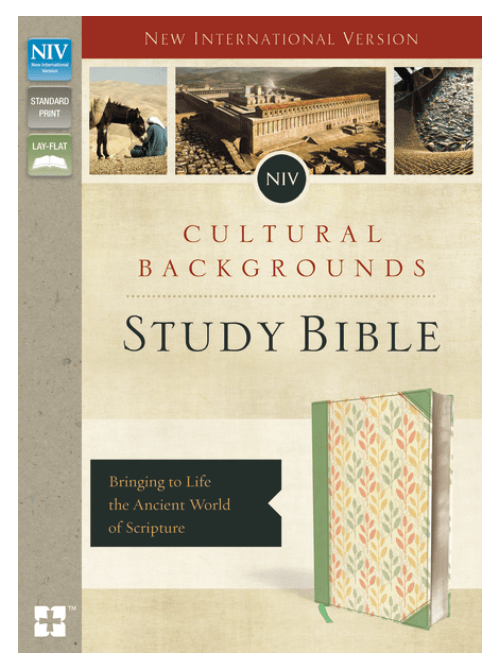
One of the great publishing delights of 2016 is the NIV Cultural Backgrounds Study Bible. Zondervan, of course, is the publishing house. The NIV 2011 is the translation employed, one that is faithful to the meaning of the Greek and Hebrew and communicates clearly to English-speakers of the 21st century. This is truly a landmark publication; the subtitle says it all: Bringing to Life the Ancient World of Scripture. The dense, nearly 2400-page Bible is packed with notes, graphs, photographs, sidebars, tables, charts, maps, and cross-references. It would be difficult to find two more qualified general editors than John Walton and Craig Keener. These two scholars live this stuff. They are giants in the field. Kudos to Zondervan for signing them on for this project. Their names alone are a solid recommendation of this Bible.

screen-shot-2016-11-05-at-3-09-19-pm

Virtually every page brings fresh illumination to the text of Holy Writ. The NIV Cultural Backgrounds Study Bible makes accessible the best of evangelical biblical scholarship.

This should make a terrific Christmas present for just about anyone on your list. You can order your copies here: http://media.harpercollinschristian.com/page/cultural-backgrounds-study-bible.