Press Release from CSNTM

Press Release (8 Nov 2013):

Debut of Chester Beatty Papyri and New User Tools at CSNTM
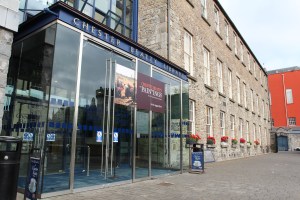
IMG_5770

The Center for the Study of New Testament Manuscripts (www.csntm.org) is well known for digitizing ancient biblical manuscripts. But the Center is not well known for having a user-friendly website. Because of a generous donation, the Center is giving a much-needed face-lift to its site. Phase I includes the following new features:

  • A basic search function now allows users to look at manuscripts by date, material, content, etc. You will notice a new search bar at the top of the manuscripts page. Simply enter in the data you’re looking for, and only those manuscripts that meet the criteria will be displayed.
  • Viewing technology has been added, allowing users to see thumbnail images instead of just a link. Simply click on the thumbnail and the high-resolution image is displayed in the viewer below. Users can now zoom in and examine manuscripts without having to open individual pages. This feature is currently available only for manuscripts digitized on the last five expeditions (Biblioteca Medicea Laurenziana in Florence; Gennadius Library in Athens; University of Athens Historical Museum; City Historical Library of Zagora, Greece; and the Chester Beatty Library in Dublin). More to come!
  • The website also provides links to the images of 29 (and growing!) significant manuscripts in various libraries throughout the world.
  • CSNTM currently has over 450 manuscripts listed in its manuscript page, with more than 1100 manuscripts in our archives. We are working on getting all 1100+ manuscripts listed on the site. As always, when the Center gets permission, the images of manuscripts become accessible to all.

The most exciting new additions to the CSNTM website are the Chester Beatty biblical manuscripts (which we digitized in the summer of 2013). These include all Old and New Testament Greek papyri, apocryphal texts, and all Greek New Testament manuscripts housed at the CBL in Dublin. Best of all, these can now be viewed on the manuscripts page. Using state-of-the-art digital equipment, the Center photographed each manuscript against white and black backgrounds. The result was stunning. The photographs reveal some text that has not been seen before.

CSNTM is grateful to the CBL for the privilege of digitizing these priceless treasures. The staff were extremely competent and a joy to work with. We are grateful to Dr. Fionnuala Croke, Director of CBL, for the opportunity to digitize their biblical texts. And we wish to thank Dr. Larry Hurtado, Edinburgh University, and the late Dr. Sean Freyne, Trinity College, Dublin, for recommending CSNTM for this important undertaking.

Daniel B. Wallace, Executive Director of CSNTM

Robert D. Marcello, Research Manager of CSNTM

The Five Countries Called Greece

I go to Greece every year, with several others from the Center for the Study of New Testament Manuscripts (www.csntm.org), to photograph biblical manuscripts. And every year, we ‘discover’ manuscripts too—that is, we inform the Institut für neutestamentliche Textforschung in Münster about New Testament manuscripts that they were unaware of, and give them the details so that they can give these manuscripts a new Gregory-Aland number.

We always spend some time in Athens, but also try to get to other places as well. In the process of canvassing the countryside, I have come to realize that Greece is five different countries, all connected by the same language, government, and the ubiquitous old men sipping their Greek καφές in outdoor cafés.

There is Athens, a typical big city with more graffiti per square kilometer than any other city in western Europe. Typical—except for the Parthenon, Areopagus, other archeological sites, and magnificent museums and libraries.

Then there is the Peloponnese—the lower half of Greece, which boasts Corinth, Olympia, Sparta, and many other historic and beautiful sites. The Mediterranean Sea outside of Corinth is as clear and blue as the Caribbean. I’ve been told that the Peloponnesians are not as friendly as the rest of the Greeks, but this tidbit came from someone far north of Athens. I’ve not experienced it for myself.

The small islands—including Patmos, Samos, Icaria, Andros, and nearly 3000 other islands—make up the third country. These are always enjoyable sites and usually out of the way places. Cruise ships port at Skala harbor in Patmos every day, with the eager travelers scurrying off the vessels to board big buses and go up the mountain to see the Monastery of St. John the Theologian and the Cave of the Apocalypse. These folks only stay for two or three hours before they are whisked away to another island, checking off their bucket list this island famous for its connection to the Bible; we usually stay for two or three weeks.

We don’t take a cruise ship to get there, but an overnight ferry. There are only 3000 residents on Patmos during the summer months; we know almost all of them. Only four are not friendly, two of whom are not Greeks (I’d tell you their nationality but they would find me out!). We’ve eaten at nearly every restaurant and traversed every dirt road. This is the “Holy Island of the Aegean” because this is where John penned the Apocalypse and therefore it is the only island in all of Greece that does not allow nude sunbathing. It may well be my favorite place in all of Greece–and certainly the one my wife approves me visiting!

The fourth country consists of big islands and famous islands—like Rhodes, Cos, Lesbos, Santorini, and Mikonos. Amazing sites, but very expensive. They know what they’ve got. I’ve never been to Santorini or Mikonos for the simple reason that they are not known to have biblical manuscripts.

Finally, there is the Greek countryside. Villages that have no names. Access lanes still not paved that lead to major highways. Mountain roads that are dotted with crosses where people have driven over the edge and lost their lives because guardrails are often non-existent in this country that is 80% mountainous. Pathways that drive the GPS crazy. And people so friendly they turn the American value-system on its head.

At first, I was taken aback by their friendliness. It seemed to be a used-car-salesman kind of friendliness. That was ten years ago. People that friendly in the States are likely to take you to the cleaners. But in Greece, money is not the driving principle, and genuine friendships are prized like fat bank accounts are in the U.S. Most rural Greeks are poor—dirt poor. Yet they share what they have with strangers and live to show hospitality to visitors. Some of the best lamb and pork chops anywhere on the planet. And a gaggle of friends we’ve made along the way. I truly love Greece and the Greek people. And I pray that this country with its rich heritage in politics, conquest, art, sports, medicine, and, of course, biblical manuscripts, will survive its current financial crisis.

In my next post I will tell about driving up to Meteora from Athens, and of a particularly interesting manuscript we examined in one of the monasteries of Meteora in 2011 and 2012. For now, I’ll simply close with this: If you ever get the opportunity to visit Greece, check out all five countries. Athens and Santorini are not the whole experience! And get to know the people. It just might change your value system.