
A recent journal article by Tel Aviv archeologists argues that camels were not domesticated until about 800 BC. If that is true, then the Genesis account of domesticated camels in the days of Abraham is wrong. One of the things that bothers me about modern-day theological liberals is that they are anything but: they tend to be very narrow-minded, truncating the evidence, and cherry-picking the data to support their agenda. This piece seems to be of that ilk. In a recent online Christianity Today post, this article is discussed by two biblical scholars, one of whom is Todd Bolen. Todd lived in Israel for over a decade and has conducted scores of tours to Israel. I was with him in 2005 for 22 days as he led a tour of 35 students from Dallas Seminary through the land. Lecturing about 8 hours a day without notes Todd demonstrated his knowledge of the archeology, geography, and history of the land. His opinion is definitely worthy of consideration.
Category: Uncategorized
The Transracial Implications of the Gospel
In honor of Martin Luther King, Jr., today being MLK day, it seems appropriate to discuss some of the implications of the gospel in terms of race relations. As shocking as it may sound, I grew up in a city that allowed no African Americans. In fact, I did not see a person of color until I was twelve years old. But in high school, when I read Black Like Me, it changed me. The gross injustices done to people just because of the color of their skin sickened me. And then I moved to the South and saw the same injustices that I had read about in this book. I was appalled that so many people could be so prejudiced. While in seminary, my wife and I bought a house for one dollar (part of the Urban Homestead Renewal Program), in one of the worst slums of Dallas. We lived in it for three and a half years. And I saw a different side of things. I saw a single mom with two young boys, working several jobs to give her sons a better chance at life. I saw people who desperately wanted to get out of their miserable state but were hardly given the chance to succeed. And I saw those who exploited them. From Newport Beach to the Oak Cliff section of Dallas was quite a shift! And so, I began a journey to understand what the New Testament taught about race relations. Below are some of my reflections.
Although Jesus was sent to the “lost sheep of the house of Israel” (Matt 10.6; 15.24), his ministry occasionally expanded beyond Jewish bloodlines. Sometimes this happened seemingly against his protests, as when he exorcized a demon possessing the daughter of a Canaanite woman at her insistence (Matt 15.21–28). At other times he was amazed at the faith of Gentiles when compared to its lack in his own people. He healed the centurion’s servant sight unseen, based on the centurion’s faith (Matt 8.5–13), hinting that such people will supersede the nation in the kingdom and “the sons of the kingdom will be thrown out” (v. 12). And he made an intentional detour to the eastern shore of the Sea of Galilee to cast out a legion of demons from a Gerasene man (Mark 5.1–20). Simeon had prophesied about the baby Jesus that he would be “a light for revelation to the Gentiles” (Luke 2.32), hinting at a transracial mission of the Messiah. When Jesus himself implied such a radical mission in his hometown, the good folk of Nazareth tried to throw him off a cliff (Luke 4.20–30)!
After his resurrection, Jesus in fact commissioned his apostles to evangelize Gentiles (Matt 28.19–20), which they then promptly neglected to do. Then Peter got a startling vision from the Lord to kill and eat unclean animals. Three times the vision and the instructions came: “What God has made clean, you must not consider unclean!” (Acts 10.15). When Peter goes to the house of the Gentile Cornelius he reiterates his Jewish scruples: “You yourselves know that it is unlawful for a Jew to associate with or to visit a Gentile,” then adds how his mind was changed: “but God has shown me that I should not call anyone profane or unclean” (Acts 10.28 [NRSV]). It seems remarkable that even after all that Peter had seen of Jesus’ ministry to Gentiles, and especially after he was commissioned by the Lord to evangelize Gentiles, he still didn’t get it. Later, when he was back in Jerusalem, he was confronted by some of the more scrupulous Jewish Christians who accused him of eating with Gentiles (Acts 11.4). Guilty as charged. So, he repeated the account of his vision and the conversion of Cornelius and his family. These Jewish Christians dropped their complaint and exclaimed, “So then, God has granted the repentance that leads to life even to the Gentiles!” (Acts 11.18). The scrupulous sect of Jewish believers had seen the light that Simeon spoke of! Or so it seemed.
Some time after this, Peter was in Antioch, eating with Gentiles. But he withdrew from such fellowship when messengers from James came from Jerusalem and spoke to him. What they said is unknown, but Peter withdrew from such fellowship with Gentiles “because he was afraid of those who were pro-circumcision” (Gal 2.13 [NET]). Paul was incensed because Peter, his Jewish Christian colleagues, and even Barnabas, “were not on the right road toward the truth of the gospel” (Gal 2.14 [translation by G. D. Kilpatrick in Rudolf Bultmann’s Festschrift (1954)]). Here we see a glimpse that, for Paul, the suspension of circumcision and dietary regulations was an essential part of “the truth of the gospel” (τὴν ἀλήθειαν τοῦ εὐαγγελίου). And it is here that we begin to see which of the apostles first grasped the transracial implications of the gospel. Even though the Eleven had been taught this by Jesus, they faltered. And even after Peter’s vision, he faltered. And the group of pro-circumcision believers back in Jerusalem, even after hearing from Peter that the gospel was now free for all, faltered. They would falter again, in Acts 15.5, prompting the Jerusalem Council that would take place sometime after the events in Antioch.
It takes little imagination to see how wrenching and disgusting that first act of obedience to the Lord would be—obedience to extend full fellowship to non-Jews. All Jews in first-century Palestine would be quite familiar with the story of heroism and sacrifice found in 2 Maccabees 7. There, seven brothers and their mother were brought before Antiochus Epiphanes who tried to force them to eat pork. One by one, the king tortured each brother, cutting out their tongues and hands. Yet none disobeyed the Law of Moses, dying with the hope of the resurrection on their lips. Finally, the mother was executed, too. In the annals of Jewish lore, no story emboldened the faithful to maintain the dietary laws like this one.
And the apostles, too, were familiar with this story. Paul especially, when he was a Pharisee, would have been the most scrupulous of all. His passion for the Law was what led him on a witch-hunt after Christ-followers. And yet Paul the Christian led the way in grounding his beliefs in the cross, recognizing that in Christ there is neither Jew nor Gentile. Just imagine the first time one of these apostles sat down at breakfast with Gentiles and was served bacon and eggs! Taking that first bite of pork would have been a sheer act of will out of obedience to their Lord.
Paul became adamant about this freedom that was rooted in the gospel. His mission was not like so many seeker-oriented pastors today; he did not make concessions on the gospel to get bigger numbers. No, he embraced the radical idea that in Christ the Law was no longer master over any believer. Christ died, in part, so that we would no longer be under the Law (Rom 6.14; 10.4; Gal 3.19–29). And this included recognizing the essential equality between Jew and Gentile.
By way of application, we can see that it is crucial—because it is an essential part of the gospel—that race should never be a roadblock to the fullest fellowship that Christians can have. In 1963, Martin Luther King complained, “It is appalling that the most segregated hour of Christian America is eleven o’clock on Sunday morning.” Over fifty years later, and that observation is sadly still true in much of the United States. I have long believed that one of the key marks of authentic Christianity is the heterogeneous nature of the body of Christ. When a black man sits next to a white woman who is next to a rich man sitting beside a poor man; when an educated white woman fellowships with a poor, uneducated immigrant; when a clean-shaven, well-dressed man sits beside a facial-pierced, tattooed girl in grunge clothes; when the fellowship of the saints cannot be attributed in any way to natural inclinations—only then will the world see that we truly love each other—and that ours is a supernatural love.
But how can we accomplish this? First, we must repent of our corporate sins. Especially those in power, those who control the church, must do this. Sin is not just individual. Americans tend to think only in individual terms, and it’s time we grow out of this myopic, narcissistic view and embrace the more biblical view of individuals in community. Second, we must reach out to those who are not like us. We must seek out folks of different ethnicity to be on the pastoral staff, on the elder board, in the classroom as instructors. Today’s take-away application of the Great Commission is surely that true evangelism means getting outside our comfort zone. But we must not stop there. We must go the extra mile and truly fellowship with those unlike us. May God help us to embrace the transracial implications of the gospel and to, once and for all, end the apartheid of Sunday mornings.
First Time to India
14 Jan 2014
I was asked by the Asia Christian Academy’s Evangelical Theological Seminary to teach some doctoral students on textual criticism for a week in January 2014. I jumped at the opportunity—in part because this would be my first trip to India, and in part because I was pretty sure these students had not had much instruction in textual criticism. Since there are no known Greek NT manuscripts in India, I had not gone before. (I did urge the students I taught to be on the lookout for them though!)
I flew out of Dallas on Friday, 3 January. The first plane was a Boeing 777. Very nice plane, going all the way to Frankfurt. Then, the real treat happened: I flew on a new 787 to Doha, Qatar. First time on one of those. Spacious, beautiful, functional. I was put in business class, which was a very rare luxury for me. There is no first class on the 787—just business and coach. I cannot imagine what first class would have been like; business class is that good. Fully reclining seats, wood-paneled storage compartments (several of them), 19” TV with zillions of movies to choose from (didn’t watch any), gourmet meals (and Rothschild cabernet and Brut champagne, among many others), plenty of privacy (you can put up a wall between yourself and the person ‘next’ to you [actually, about three feet away, already with a divider half way up]). Pampering by the attendants (with close to a 1:2 ratio, staff to customers!). Unbelievable. When we arrived in Doha, the captain apologized for the delay. We were all of five minutes late. The earlier flight, from Dallas to Frankfurt (not Qatar Airlines), took off two hours late. I had to hoof it through the Frankfurt airport to get to my connection.
When I arrived in Doha, I got to go directly to the brand new business lounge. Superb food everywhere, and free. At least, so it looked. Didn’t have time to linger. A state-of-the-art video game room. Showers. Expansive area for seating, with a view of the night sky and silhouette of the impressive, sky-scraped downtown. I had heard that Doha Airport was poorly planned, with few chairs and somewhat inhospitable. That was not my experience at all. But I had little time to enjoy it, and had to get to the gate almost immediately.
The flight from Doha to Bangalore was also on a 787. Both planes were Boeing 787-8 Dreamliners. Short flight this time, only 3.5 hours. Curiously, a few minutes before we landed, the flight attendants walked down the aisles with canisters that they sprayed high in the air. Another flight attendant was sitting up front in her jump seat, coughing up a lung. It smelled like the bug bombs that you set off in your house when the cockroaches have taken over your kitchen. The girls walked down the aisles, smiling the whole way, as if they were Vanna White hawking some goods. Surreal. My flight attendant said that the Indian government required the passengers to be subjected to a pesticide spray. (Got the same treatment when I left Bangalore on January 11.) Again, the pilot apologized for the delay: four minutes late this time.
When we touched down in Bangalore International Airport, I had now visited my 35th country. And I underwent another new-to-me experience at the airport: All of us leaving the airport, after going through customs, also went through a metal detector en route to collect our baggage. It seemed strange to have metal detectors for exiting passengers. And the security personnel also took it as a joke: the alarm went off on virtually everyone (including me), yet only a handful of people were checked (not including me).
I arrived at the airport at 4 AM. A driver picked me up and drove me to the president’s home where I would be staying for the week. As it turned out, I never saw any of India in the daylight except for the campus. I guess I need to go back to see the country someday!
The school is located just outside Bangalore, near the southern tip of India. Bangalore is one of the largest cities in the world. Sitting on 50 acres are a school (K–12) and a seminary (offering both master’s and doctoral degrees). The facilities are almost self-sufficient: they have a variety of crops growing at the compound, they collect rain water and purify it for drinking as well as having four deep wells, and they even use cow dung to create methane gas which they cook with! There is a small hospital, pharmacy, and general store on the campus, too. Quite an operation. The cost for an education is remarkably inexpensive: $800 per year, which includes tuition, room, and board. And the education the students receive is very good. Compare that to a decent degree in the States: $800 will cover two units, or roughly one-seventh of the tuition costs for a semester, with no room and board in the mix. Of course, the per capita income in India is just over $2000 a year. I found out that some students were coming from quite a distance, and it could take up to three weeks to get here. They would have to pay up to four months’ salary to be here for the week. Two students didn’t make it till the last day. We in the West often have no idea how fortunate we are!
I slept nine hours Saturday night and was refreshed. Monday morning, while I was eating breakfast with the president (Dr. Joy George, a Dallas Seminary alumnus) and his guests, I was told that I needed to get ready for chapel since I would be the chapel speaker today. This was news to me. (I found out later that this is the Indian way: outsiders are often called upon to speak at the drop of a hat.) So, I prepared the message mentally while taking my shower.
My ten 75-minute doctoral-level lectures ended up averaging almost two hours each. The Q&A took up a lot of time, but in light of the extreme sacrifices these students made to be there I couldn’t very well quit early on them. I was determined to say yes to all extra speaking engagements requested of me, as well as not miss any class unless I was on my deathbed.
Every noon meal we would eat in the cafeteria. I must confess: I am not a fan of Indian food. Not by a long shot. But eating it in India, in this place, was different. I actually found it to my liking. Two of the school’s main ingredients in their curry were ginger and garlic, not to mention the ubiquitous chili pepper. Indians do not get stomach cancer. The food is so hot that it kills off any bugs that dare call your tummy home. I suspect ulcers are another story.
Taking showers required some planning. I was in a nice-sized guest room with its own air conditioner. The remote did not have fresh batteries, which meant that the AC was either on at one temperature or off—whenever I remembered to turn it off. I would wake up at around 7, and fire up the water heater above the shower head. Go back to bed for 30 minutes, then go into the bathroom and shave with cold water (only one faucet, cold water only). While I was shaving I would turn the hot water for the shower on full blast, which meant that it drizzled out (perhaps that’s an exaggeration). Zero pressure, impossible to take a shower this way. The water would fill up half of a plastic bucket. Then, I would scoop up water as needed and pour it on my body parts, soap, rinse, repeat. The routine was not bad at all, but it wasn’t the Ritz.
One of the things I have a major phobia about is snakes. India has cobras, which can do some serious damage. And they have King Cobras, which can kill an elephant. The campus had not seen a King Cobra for awhile; I took a measure of comfort in that. I was told to bring a flashlight for walking around the campus at night, since that’s when the snakes would come out. Mine was powerful with new batteries. I didn’t want to take any chances. On Thursday night, a King Cobra had climbed up the outside wall of one of the homes and was trying to get into a child’s bedroom! When I learned about that, I decided not to sleep again till I would board the plane on Saturday morning.
Thursday night I enjoyed dinner with a former student of mine, Dr. Andrew Spurgeon. After dinner, a neighbor brought over some King Chili (a.k.a. Ghost Pepper) for me to sample. King Chili is known as one of the hottest spices in the world. The Nagaland tribes had used it to clean the heads after such were removed from unwilling bodies. Thus, it had the dual purpose of being a “condiment and an industrial solvent” (The Smithsonian Magazine). The main ingredient of the King Chili is Capsaicin; one of its uses is in a grenade to be tossed by the police at rioters. This worked well in Kashmir. Peppers are measured by Scoville Heat Units, or SHU. A jalapeño registers 4000 SHU. This means that it takes 4000 parts water to one part jalapeño juice before it can’t be tasted. The Bhut Jolokia (or King Chili) registers between 500,000 and 1.5 million SHU, or 125 to 375 times hotter than a jalapeño! The pepper was a sauce with bites of beef in it (I think the beef was from the cow that had been slain that morning). I was instructed to put a little bit of beef on a bed of rice. I could also add the sauce directly, but that would be way too hot. So, in my great wisdom, I poured some sauce on the rice as well and took a good-sized bite of sauce-dripped rice. I liked it! I ate the plateful then got seconds. My host told me that this batch was especially hot—the hottest that his neighbor had ever cooked up. I’m thinking of making a T-shirt that says, “I ate King Chili in India and survived…” and on the back “…barely!”
On Friday after I spoke in chapel, the school had a ground-breaking ceremony for the new library—a 30,000 foot three-story building. I had the great honor, along with David Fletcher (the man who invited me to speak at the school), of shoveling the first spade of dirt. First time for me to be involved in a ground-breaking ceremony. And, of course, I was asked to give a little speech afterward.
When I saw the library, though, my heart sank. Many textbooks were worn out, probably because too many students couldn’t afford to buy them and thus they relied on the library’s copies instead. I was amazed at the intelligent questions the students asked during my lectures in light of this impoverished Bibliothek. I have committed to giving the library several books. I know they will be put to good use. I figured that to be a small part of the evangelization of India is simply good stewardship. If you are interested in doing the same, please let me know.
Friday night I spoke in the auditorium before a public audience of about 400 people. This was the only lecture I gave in which the power did not go out. The school has a back-up generator for such occasions, and they need to use it several times every day.
The doctoral students gave me two gifts on Friday—first, an ornate wooden baton-like column called the Ashoka Column. It’s a replica of the emblem of India, with four lions on top of the column and other sundry animals and designs below. Second, a gold watch! The real deal from an Indian watchmaker, Titan. I could hardly believe that these students, who are in deep poverty, pooled their meager resources to get me these gifts.
The most important—and most treasured—comment I received from faculty and students was that more than learning about textual criticism, they learned to fall more deeply in love with their Lord. I was hoping that this is what they would get out of my week with them! All in all, my first trip to India was a thought-provoking, even life-changing, adventure. I don’t expect it to be my last.
An Awesome Help for Reading New Testament Greek
In 1975 giant Christian publishing house, Zondervan, released a revolutionary reader’s lexicon. Written by Sakae Kubo and titled A Reader’s Greek-English Lexicon of the Greek New Testament, this book was to have a huge influence on the reading of New Testament Greek and the learning of its vocabulary. It was called a reader’s lexicon because it was indexed to the text of the New Testament in canonical order. All the words that occurred fifty times or less were listed in the lexicon, as it marched from Matthew 1.1 through Revelation 22.20. It listed the words in their lexical form, verse by verse, and it gave the glosses found in the Greek-English Lexicon by Bauer, Arndt, and Gingrich (BAG). It also gave a very helpful word-count after each entry, listing the frequency of words in both the New Testament as a whole and the particular book that the entry was in. Thus, at a glance one could see how important such a word was in said book just by noting its frequency. For example, μονογενής occurs in the New Testament nine times, four of which are in John’s Gospel. Many theological institutes began changing the amount of vocabulary words that students needed to learn because of Kubo. Dallas Seminary was among them: instead of learning all the words that occurred ten times or more (about 1100 words), the school evolved into requiring students to learn only 50+ words (a little more than 300 words altogether).
Four years after Kubo was published, BAG was updated by Fred Danker (BAGD); Kubo was not. The third edition of BAG came out in 2000, with Danker’s name deservedly moving up the ladder (BDAG). Kubo remained unchanged. And there were still numerous errors in it—including many incorrect word-counts, omissions of words, and contextually-inappropriate glosses.
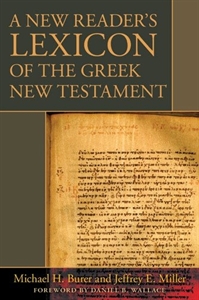
It was time for a new reader’s lexicon. Enter Michael Burer and Jeff Miller, two former students of mine. In 2008 Kregel published their A New Reader’s Lexicon of the Greek New Testament. It was a significant improvement over Kubo. Not only is it indexed to the glosses in BDAG, it also is keyed especially to the contextually-sensitive glosses. Further, it gives a threefold word-count for the entries: book, author, and NT. For a long time I wanted to see at a glance the favored lexical stock of a particular author, not only in terms of the book I was studying but also his other contributions to the canon. As well, issues related to authorship (as far as vocabulary can give us insights) have needed a ready table of information. The New Reader’s Lexicon supplies this information at a glance by listing the frequency of words according to the traditional authorship of New Testament books. Thus, for example, the corpus Paulinum includes all thirteen letters to which his name is attached.
Any tool that can simultaneously function well on multiple levels—pedagogical, reference, translation, and exegesis—is rare indeed. What Kubo did for one generation, Burer and Miller’s New Reader’s Lexicon should do for the next.
However, I have been tracking both Kubo and Burer-Miller on Amazon recently and noticed that Kubo continues to outsell Burer-Miller, even five years after the latter’s publication. Perhaps it is because it is only 2/3 the price, perhaps because Kregel is a small publishing house compared to Zondervan. But even with the higher price of Burer-Miller it is well worth the cost. It is long past the time to bid Kubo a fond farewell for the years of service it has given students of the New Testament, and say hello to Burer-Miller.
Postscript
When Burer-Miller was in the press, Kregel asked me to write the Foreword, which I was happy to do. And they asked me to be the senior editor of a new series of reader’s lexica. After nearly six years of work, the second volume in this series was published (earlier this month). The design of Burer-Miller was so good that Brittany Burnette, Terri Moore (both former interns of mine), and I adopted it when we edited the second reader’s lexicon in the series (A Reader’s Lexicon of the Apostolic Fathers). We even included word-frequencies for Ignatius’s seven letters so that one could see at a glance what words were important to that church father. We are now wrestling with what the third volume should be. Contenders are the Septuagint (four volumes—the Law, the Psalms [including all poetic and other books], the Prophets, and the Apocrypha [or, for my Roman Catholic friends, the Deutero-canonical books]), the Apologists, Philo, and Josephus. Have a suggestion? I’m all ears.
Press Release from CSNTM
Press Release (8 Nov 2013):
Debut of Chester Beatty Papyri and New User Tools at CSNTM
The Center for the Study of New Testament Manuscripts (www.csntm.org) is well known for digitizing ancient biblical manuscripts. But the Center is not well known for having a user-friendly website. Because of a generous donation, the Center is giving a much-needed face-lift to its site. Phase I includes the following new features:
- A basic search function now allows users to look at manuscripts by date, material, content, etc. You will notice a new search bar at the top of the manuscripts page. Simply enter in the data you’re looking for, and only those manuscripts that meet the criteria will be displayed.
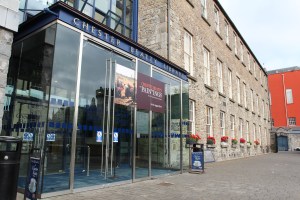
- Viewing technology has been added, allowing users to see thumbnail images instead of just a link. Simply click on the thumbnail and the high-resolution image is displayed in the viewer below. Users can now zoom in and examine manuscripts without having to open individual pages. This feature is currently available only for manuscripts digitized on the last five expeditions (Biblioteca Medicea Laurenziana in Florence; Gennadius Library in Athens; University of Athens Historical Museum; City Historical Library of Zagora, Greece; and the Chester Beatty Library in Dublin). More to come!
- The website also provides links to the images of 29 (and growing!) significant manuscripts in various libraries throughout the world.
- CSNTM currently has over 450 manuscripts listed in its manuscript page, with more than 1100 manuscripts in our archives. We are working on getting all 1100+ manuscripts listed on the site. As always, when the Center gets permission, the images of manuscripts become accessible to all.
The most exciting new additions to the CSNTM website are the Chester Beatty biblical manuscripts (which we digitized in the summer of 2013). These include all Old and New Testament Greek papyri, apocryphal texts, and all Greek New Testament manuscripts housed at the CBL in Dublin. Best of all, these can now be viewed on the manuscripts page. Using state-of-the-art digital equipment, the Center photographed each manuscript against white and black backgrounds. The result was stunning. The photographs reveal some text that has not been seen before.
CSNTM is grateful to the CBL for the privilege of digitizing these priceless treasures. The staff were extremely competent and a joy to work with. We are grateful to Dr. Fionnuala Croke, Director of CBL, for the opportunity to digitize their biblical texts. And we wish to thank Dr. Larry Hurtado, Edinburgh University, and the late Dr. Sean Freyne, Trinity College, Dublin, for recommending CSNTM for this important undertaking.
Daniel B. Wallace, Executive Director of CSNTM
Robert D. Marcello, Research Manager of CSNTM
 Daniel B. Wallace