In my last post I mentioned a newly discovered apostolos manuscript, found glued to the inside of the front and back covers of a codex (NLG 2676). This blog is about another manuscript inside another codex. This time the codex is Lectionary 1816, a 12th century parchment manuscript of the Gospels with 154 leaves. The National Library of Greece in Athens assigns it the shelf number 2711.
The new discovery, however, is not a couple of leaves glued to inside of the covers; rather, it is several reinforcing strips glued to the inner margin of bifolia (double-leaves) near the beginning of the codex.
The reinforcing strips are from a parchment manuscript which was a two-column text. It was probably written in the 12th or 13th century. The strips are found on bifolio 2a–5b, leaves 2b–3a, leaf 4a, leaves 4b–5a, and leaf 6a.
Some of the strips have only one or two letters of material per line, while others have as many as six letters per line. One of the strips is at the beginning of the line, revealing the initial letters on each line of the column.
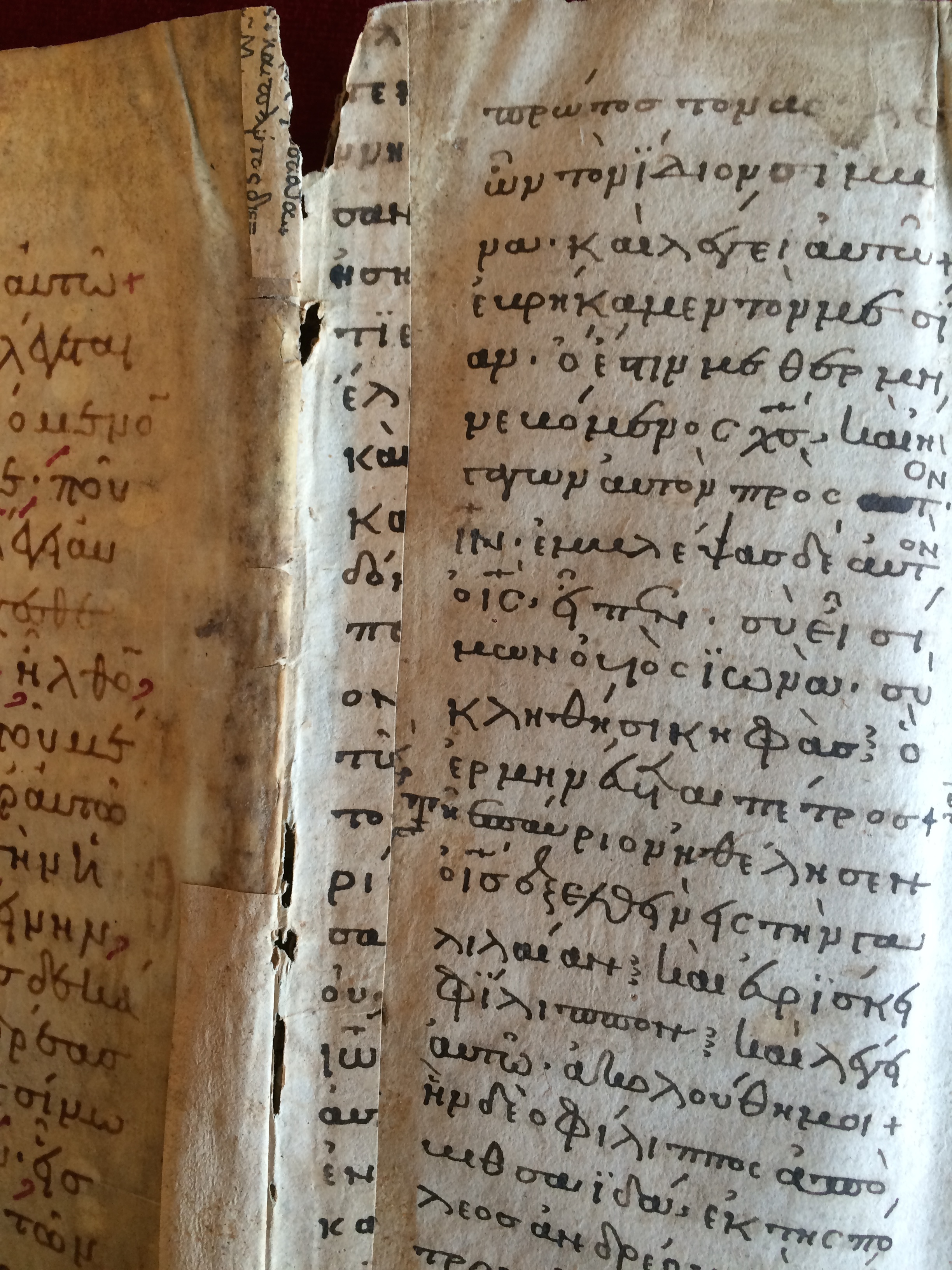
So far, sections from Luke 1 have been identified. One section is apparently from Luke 1.57–61. The image is below.
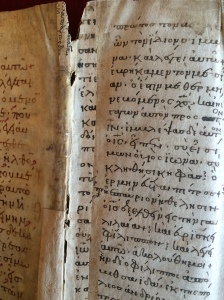
Binding strip in NLG 2711
(iPhone picture)
The text of this strip is as follows:
]λ
γει
ννη
σαν
ηση
τι ε
ελ
κα
κα
δοη
πε
ον
τω
το
ρι
σα
οὐ
ιω
αυ
εν
κα
Reconstructed with the surrounding text (with the number of letters in brackets), we get:
1) πλησθη ο χρονος του τε- [18] Luke 1.57
γειν αυτην, και εγε- [15]
ννησεν υιον. Και ηκου- [17]
σαν οι περιοικοι και [17] Luke 1.58
5) ηση [??]………….ο-
τι εμεγαλυνεν κς το [16]
ελεος αυτου μετ αυτης, [18]
και συνεχαιρον αυτη. [17]
και εγενετο εν τη ογ- [16] Luke 1.59
10) δοη ημερα, ηλθον [13?]
περιτεμειν το παιδι- [17]
ον· και εκαλουν αυτο επι [19]
τω ονοματι του πρς αυ- [17]
του Ζαχα- [7??]
15) ριαν. και αποκριθει- [16] Luke 1.60
σα η μηρ αυτου ειπεν [16]
οὐχι αλλα κληθησεται [18]
ιωαννης. και ειπον προς [19] Luke 1.61
αυτην οτι ουδεις εστιν [19]
20) εν τη συγγενεια σου ος [18]
καλειται τω ονοματι του- [—]
Please excuse the formatting of the above reconstruction. I think you can get the idea though, especially since these letters are at the beginning of a new line.
For 17 of the 21 lines, the text is clearly from Luke 1.57–61. And there is no other text that even comes close. It surely must be that this is that passage throughout the strip. The average line (not counting lines 5, 14, or 21 since their quantities are unknown) is 17 letters long, running between as low as possibly 13 up to 19 letters. But four lines are a puzzle.
Problems for Identification
First, line 2 has γειν for κειν(?)—in τεκειν, an unattested reading.
Second, line 5 begins with ἠση. Whether this is one word or two is not known, but either way it does not fit in with Luke 1.58 at all. What should be on this line is οι συγγενεις αυτης ο-. The smooth breathing (ἠ) indicates the beginning of a word, which eliminates the possibility (remote as it was anyway) that the scribe’s eye skipped over a column or two of the manuscript of his exemplar and wrote ηση (the end of κληθηση in Luke 1.76). Further, whatever he is doing, he seems to pick back up with the οτι of 1.58, since it is split over two lines with the τι beginning line 6. Another possibility that should be ruled out is a spelling change: although οι and η sounded alike in this era, as did υ and η, it would be both completely unattested and not in character with the rest of this strip for the scribe to have written ἠ σηγγενεις instead of οἱ συγγενεις—a double misspelling! This solution simply looks too convenient to be convincing. The breathing, however, is not a problem since medieval scribes routinely mixed up the smooth and rough breathings.
Third, line 10 is unusually short, with only 13 letters. Now, it is just possible that the scribe wrote εν τη ογδοη τη ημερα over the two lines. This is both unattested and a nonsense reading, but the repetition of eta in four words successively might have caused a kind of dittography. This would bring the line to 15 letters. Alternatively, the scribe might have added εις το before the infinitive on this line, thus creating an 18-letter line. But this, too, is unattested.
Fourth, the 14th line seems to have had only του Ζαχα- on it, for the ρι that begins line 15 has the acute accent, indicating that it is part of Ζαχαρίαν rather than αποκριθεισα—which in any event is unlikely both because of the disruption this would cause to the surrounding lines and because of the very unnatural word break. But if line 14 only has του Ζαχα-, it is a seven-letter line. Why so short? One could understand line 14 ending with Ζαχαριαν, since the next verse could begin a new section. But why break the last word of v. 59 over two lines?
For these four problems, I have no ready solution. I hope that one or two of the readers of this blog will be able to offer an explanation to these conundrums.
Conclusion
There are 29 extant double-column Greek New Testament manuscripts from the 12th to the 14th century with Luke in them, only five of which are lectionaries. Most likely, this is the 30th such manuscript and probably a minuscule rather than a lectionary (based strictly on statistical probability). When all the photographs of the strips in NLG 2711 are made available, surely more text will come to light. Perhaps the other strips will also resolve some of the issues we have already mentioned, and help us come to firmer conclusions about what, exactly, this manuscript is, and why especially it deviates from Luke 1.58 so radically at one point.


 Daniel B. Wallace