Reader’s Lexicon of the Apostolic Fathers

AF_LEXICON

After six years of work, Brittany Burnette, Terri Moore, and I have finally completed the second in a series of Reader’s Lexica: A Reader’s Lexicon of the Apostolic Fathers. This book, like the New Reader’s Lexicon of the New Testament by Michael Burer and Jeff Miller, will be published by Kregel. It lists all vocabulary in the Apostolic Fathers of words that occur thirty times or less in the New Testament. The New Testament was chosen as the standard because almost all those who read the Apostolic Fathers come from a background of reading the New Testament. The vocabulary is contextually defined, and the editors have made generous use of BDAG and Lampe’s Patristic Lexicon, as well as Michael Holmes’s translation in the third edition of his Greek-English diglot of the Apostolic Fathers (which we recommend as a book to be read in conjunction with this lexicon).

The book will be available on 1 November 2013. You can pre-order it at Amazon. Like Burer-Miller, this book will list the frequency of a word after each entry: how often it occurs in that book, then that author (in the case of Ignatius), and finally in the Apostolic Fathers.

Here are some endorsements of the Lexicon:

“A Reader’s Lexicon to the Apostolic Fathers is precisely the tool needed by students of Greek who want to begin reading the Apostolic Fathers in the original. . . . Highly recommended.”

—D. A. Carson, Research Professor of New Testament, Trinity Evangelical Divinity School

“Like Philip’s response to the Ethiopian eunuch—who asked, ‘How can I understand this without some help?’—Wallace has now come alongside our own chariots, our own studies of these ancient sacred texts, and provided a guide to translation and understanding.”

—Ben Witherington III, Amos Professor of the NT for Doctoral Studies, Asbury Theological Seminary

“An excellent tool that will facilitate reading and study of the Apostolic Fathers. . . . Now no one has an excuse not to read the Apostolic Fathers in Greek!”

—Craig A. Evans, Payzant Distinguished Professor of New Testament, Acadia Divinity College

All of the editors are hoping that students of the Greek New Testament will take the Apostolic Fathers more seriously and mine the riches of this body of literature for its content, theology, praxis, use of the New Testament, and devotion to the risen Lord.

Here’s the full list and text of endorsements for the book:

“A Reader’s Lexicon to the Apostolic Fathers is precisely the tool needed by students of Greek who want to begin reading the Apostolic Fathers in the original. Organized to help them as they work through these texts, students with only a year or two of Greek will begin to make headway as they read these important documents in the original. Highly recommended.” – D. A. Carson

“Dan Wallace and his editorial team have produced an exceedingly helpful reader’s lexicon on the apostolic fathers. This is a comprehensive and user-friendly resource for anyone studying early the apostolic fathers or just doing some advanced Greek study. A Reader’s Lexicon of the Apostolic Fathers is sure to be an enduring exegetical resource for future study of early Christian literature. I earnestly look forward to further volumes from Kregel publishers in this series of lexica.” – Michael F. Bird (Ph.D, University of Queensland) Lecturer in Theology at Ridley Melbourne College of Mission and Ministry.

“It is gratifying to see increasing interest in the Apostolic Fathers and more tools becoming available for the study of them. This new Reader’s Lexicon will be a very useful tool to facilitate reading what is to many Greek students an unfamiliar corpus. The Lexicon is well-conceived and has been produced with commendable attention to detail and sensitivity to the context. Even in the age of digitally tagged texts there is a secure place for a printed lexicon as a companion to Holmes’ edition of the Fathers.” – Rodney J. Decker, ThD, Professor of Greek and NT, Baptist Bible Seminary and author of the Koine Greek Reader: Selections from the NT, LXX, and Early Christian Writers and Reading Koine Greek: An Introduction (Baker, forthcoming).

“For the first time a lexicon has been specifically designed to assist readers of the texts collectively known as the Apostolic Fathers. This excellent tool will assist the fluency and speed at which these texts can be read and studied. The format and contents of the lexicon have been designed primarily as a tool that enables advanced students to widen their exposure to a greater range of early Christian Greek texts. Dan Wallace, Brittany Burnette, and Terri Moore, the editors of this volume, are to be congratulated on producing such a splendid pedagogical tool, which assists student to develop their ability in Hellenistic Greek.” – Paul Foster, Senior Lecturer in New Testament Language, Literature and Theology The School of Divinity, University of Edinburgh

“However helpful translations may be, there is no substitute for reading works in their original language. Wallace’s Lexicon provides a welcome crib to assist in the study of the Apostolic Fathers in Greek. With this uncluttered guide by their side, students should be enabled to read, the better to understand, and then to interpret these important early Christian writings with a well-informed enthusiasm.” – Keith Elliott, Emeritus Professor of New Testament Textual Criticism, The University of Leeds, UK

“The study of the Apostolic Father and their writings has become something of a growth industry in the last twenty years, with major volumes published in the Hermeneia series and elsewhere updating what we know about these writings.  I am happy to commend Daniel Wallace’s new volume, a much needed reader’s lexicon, so that students of the Greek text of the Apostolic Fathers can readily access this valuable early Christian material.  Like the Ethiopian eunuch who asked Philip ‘How can I understand this without some help’  Wallace has now come along side our own chariots, our own studies of these ancient sacred texts, and provided a guide to translation and understanding.  Highly recommended!”   – Ben Witherington, III, Amos Professor of the NT for Doctoral Studies, Asbury Theological Seminary, Doctoral Faculty, St. Andrews University, Scotland

“Scholars of the New Testament and early Christian literature are blessed to have an increasing array of textual and linguistic resources.  This book will enable rapid reading of the Apostolic Fathers for students of New Testament Greek who wish to further develop their language skills and get a broader sense of early Christian literature.  It will be a welcome addition to the toolbox of those who are building their vocabulary of Koine Greek.  The focus on words occurring fewer than thirty times in the corpus of the Apostolic Fathers keeps the book to a handy size while giving readers an easily usable tool to identify words in context.” – Roderic L. Mullen, Series Editor, SBL New Testament in the Greek Fathers

“This resource will surely be an inducement for students, from a point relatively early in their Greek studies, to take up these valuable books we call “The Apostolic Fathers” and read.  That can only be a good thing.” – Charles E. Hill, Professor of New Testament, Reformed Theological Seminary

“Daniel Wallace and his colleagues have put together an excellent tool that will facilitate reading and study of the Apostolic Fathers, a collection of writings that New Testament scholars, as well as patristics scholars, have come to appreciate much more in recent years. Thus the publication of A Reader’s Lexicon of the Apostolic Fathers is quite timely and will be welcomed by scholars and students alike. The purpose and principles of this new work are clearly explained. The layout is attractive and very user-friendly. Now no one has an excuse not to read the Apostolic Fathers in Greek!” – Craig A. Evans, Payzant Distinguished Professor of New Testament, Acadia Divinity College

“Students at evangelical seminaries receive excellent instruction in the study of the Hebrew text of the Old Testament and the Greek text of the New Testament.  But an important lacuna in their training is often the neglect of the Church Fathers, as evangelicals have tended to leap-frog from the first century to the Reformation Era, leaving the study of the Patristic texts to students from the Roman Catholic or Greek Orthodox tradition.  This neglect is lamentable as there is so much in these writings that is indispensable for our understanding of Church doctrine and practice, such as that of “clinical” baptism, e.g. Constantine’s decision to delay baptism until he was on his death bed, and the separation of the office of the bishop (episkopos) from that of the elder.

The Apostolic Fathers are the earliest and most important of the Patristic texts.  Michael W. Holmes has provided an excellent edition of the Greek text and its translation (2007).  As the result of painstaking labor, Daniel B. Wallace, Brittany C. Burnette, and Terri Darby Moore have now provided those who wish to study the Greek text with an invaluable aid, in their A Reader’s Lexicon of the Apostolic Fathers.  This should enable a new generation of evangelicals to undertake serious scholarship on these texts, the most important after the New Testament itself, for our understanding of the Early Church at the end of the first and beginning of the second century.” – Edwin M. Yamauchi, Professor of History Emeritus, Miami University, Oxford, OH

“This Lexicon offers a handy and user-friendly way into the world of the Apostolic Fathers by helping students of NT Greek use their knowledge to expand their horizons. You can never stop learning a language, and the richness of Greek is especially rewarding. This is the perfect second step for those who are ready to take it.” – Gerald Bray

“This thoughtfully designed work will be of great practical usefulness to students (and general readers) in becoming acquainted with the fascinating body of texts known as “The Apostolic Fathers”.  Intended for those who have “cut their teeth” on the language of the Greek New Testament, this lexicon should prove a very helpful assistance in widening their knowledge of early Christian writers/writings.” – L. W. Hurtado, Emeritus Professor of New Testament Language, Literature & Theology University of Edinburgh

“This book provides a useful reading aid for those beginning their study of the Apostolic Fathers and who have not had the opportunity to learn their wider and distinctive vocabulary. The glosses are generally clear and concise, organized chapter by chapter according to author, and hence allow the reader to focus upon reading the Greek text, rather than repeatedly looking up words in a lexicon.” – Stanley E. Porter, PhD, President and Dean, and Professor of New Testament, at McMaster Divinity College, Hamilton, Ontario, Canada, and author of Verbal Aspect in the Greek of the New Testament, with Reference to Tense and Mood

“With the publication of A Reader’s Lexicon of the Apostolic Fathers, access to the primary texts of this vital collection of earliest Christian writings has never been faster or easier. It’s like an expressway replacing a gravel road. I only wish this route had been available to me when I first read through the Apostolic Fathers in Greek over a decade ago.

This excellent resource efficiently and sufficiently defines vocabulary and idioms as well as periodically parses problematic grammatical forms (e.g., “aorist passive optative,” whatever that is). The definitions are selective enough so as not to be overwhelming but also present a broad enough semantic range so as to not limit the reader’s exegetical options. In short, this is a powerful tool, not a pedantic tutor.

Alphabetized lexical entries are sub-divided not only by chapter but also by section or verse. The volume is flexible enough to be used in two different ways: as a means of learning unfamiliar vocabulary prior to reading the Apostolic Fathers or as a tool for looking up vocabulary while reading.

 A Reader’s Lexicon of the Apostolic Fathers is ideal for students who have completed two years of Koine Greek. Both New Testament and Patristic scholars will find this to be a helpful resource both personally and in conjunction with instruction. I highly recommend this handbook for readers of the Apostolic Fathers and will use it in my own Apostolic Fathers course elective.” – Michael J. Svigel, Ph.D., Associate Professor of Theological Studies, Dallas Theological Seminary, and author of RetroChristianity

“One of the best ways to improve one’s understanding of the Greek of the New Testament is to read Greek outside of the NT—and the collection of early Greek texts known as the Apostolic Fathers is one of the best places to begin. A Reader’s Lexicon of the Apostolic Fathers will surely facilitate wider engagement with these important authors, as it will enable students to spend more time reading and less time thumbing through a lexicon. This thoughtfully-designed volume is a welcome addition to my Apostolic Fathers bookshelf–a great tool for students, and a welcome resource for their teachers.”  – Michael W. Holmes, University Professor of Biblical Studies & Early Christianity, Bethel University

“Clearly conceived and easy to use, A Readers Lexicon of the Apostolic Fathers will be an invaluable resource for beginning Greek students who are eager to read important Christian writings from just outside the New Testament.  For anyone who has already learned the basics of New Testament Greek, I cannot recommend it highly enough.” –Bart D. Ehrman, James A. Gray Professor, Department of Religious Studies, University of North Carolina at Chapel Hill
Wax Drippings and Favorite Passages

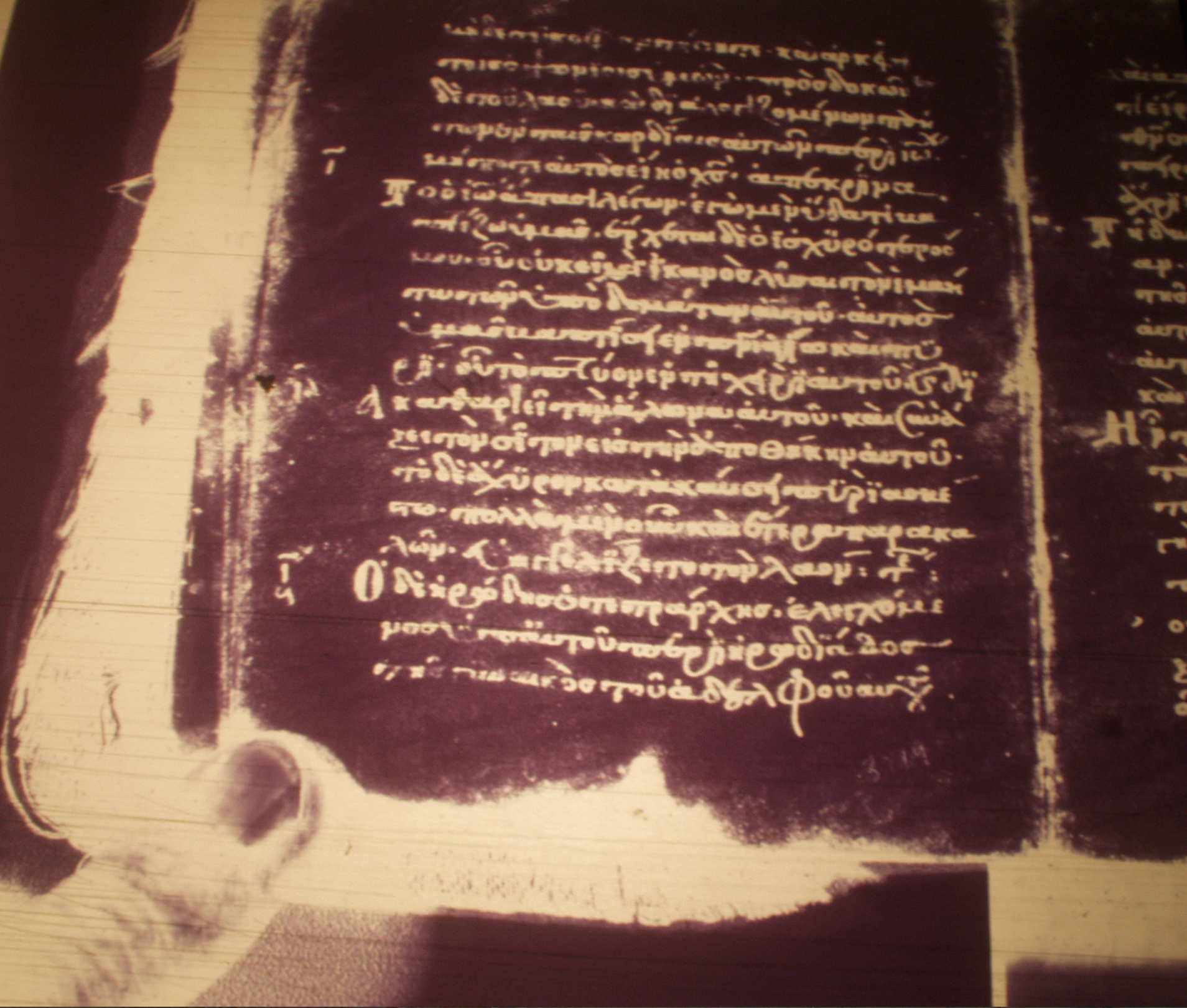
When the only access that students of the New Testament had to most images of manuscripts was through poor-quality microfilms, interpretation of the data was rather limited. The staff at the Institut für neutestamentliche Textforschung in Münster, which boasts about 90% of all NT MSS on microfilm, instructed student collators not to try to decipher the marginalia because such were virtually impossible to read. Just the text, please. And even with the text, the students had to guess at quite a bit of the letters and words because of blurred images. Below is an illustration of the kind of images they had to work with (this is codex 2813, photographed by INTF in 1989).

Screen Shot 2013-09-14 at 5.40.58 PM

Codex 2813 Microfilm Image

With digital photography, much more data can be seen and interpreted. This includes erasures, different colored ink (including the next-to-impossible-to-see-in-microfilm red and gold), smaller font, ornamentation, prickings (which are used to locate a MS’s scriptorium and age), etc. In addition, wax drippings are visible.

As innocuous as the wax drippings might seem, Henry Sanders, the editor of the editio princeps of Codex Washingtonianus, used them to show what pages were frequently on display. The reason, he argued, is that visitors would often read the pages with a candle, and less-than-careful lectors would inadvertently allow wax to drip from it onto the page.

Sanders’s comment, based on an examination of the actual MS, may have implications that go beyond codex W. With some caveats, it seems that wax drippings can be used to show what passages were favorites. If one were to examine the wax drippings seen in digital images of, say, a twelfth-century minuscule, he or she might be able to determine which passages were favorites from the twelfth century on. Of course, this kind of work would be needed to be done for a good number of manuscripts because an individual MS might be rather idiosyncratic—much the way codex W seemed to be (in that the wax drippings there, according to Sanders, only showed what passages were put on display, not what passages were otherwise favorites of readers). Lectionaries would probably be the least significant for interpreting wax drippings since they were regularly used in church services and the lector would of necessity be reading through the entire lectionary cycle, year after year. And when wax candles were used as opposed to oil lamps to read these MSS needs to be factored in as well. But MSS that were meant for study, personal use, or were otherwise not used much in public worship could contain many secrets of bygone generations of Christians.

I will offer two illustrations, one hypothetical and the other actual. John 3.16 is a favorite verse of American evangelicals today. It has even shown up on placards held by a crazed football fan wearing a multi-color afro, who would stand up in the end zone after a team scored, making sure that the TV cameras would capture the image.

 John 3.16 & multi-color doThe Gospel on the Simpsons

But was this text that well known and that well loved in ancient and medieval times? A look at digital images of MSS might reveal the answer. Of course, in order to make one’s case, a look at the entire MS’s images would be needed to see which pages had the most wax drippings. Another caveat: if the text on a given page was reworked, scraped, or had extensive marginalia, that might be the reason for extra wax drippings, produced in this case by the scribe him/herself.

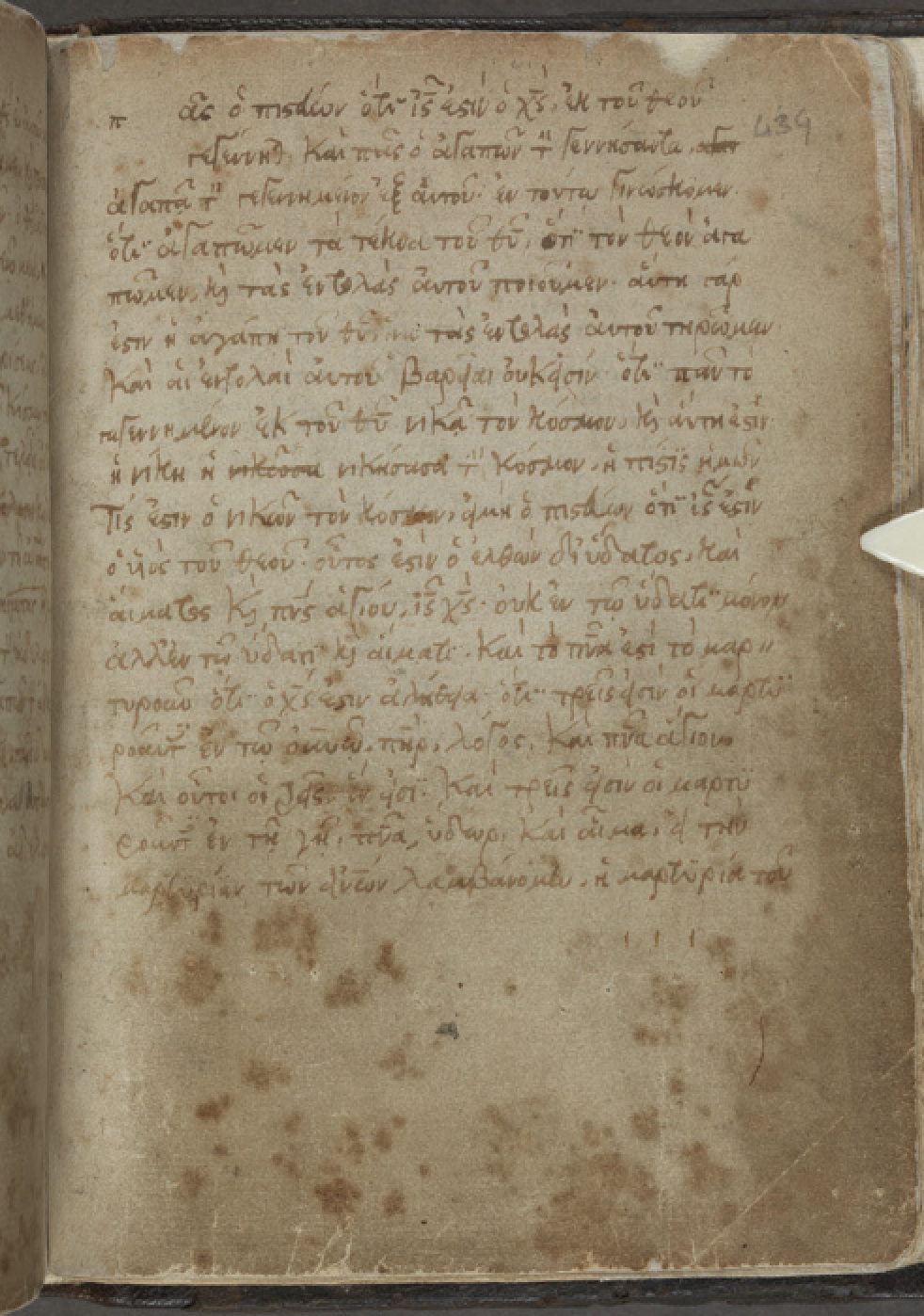
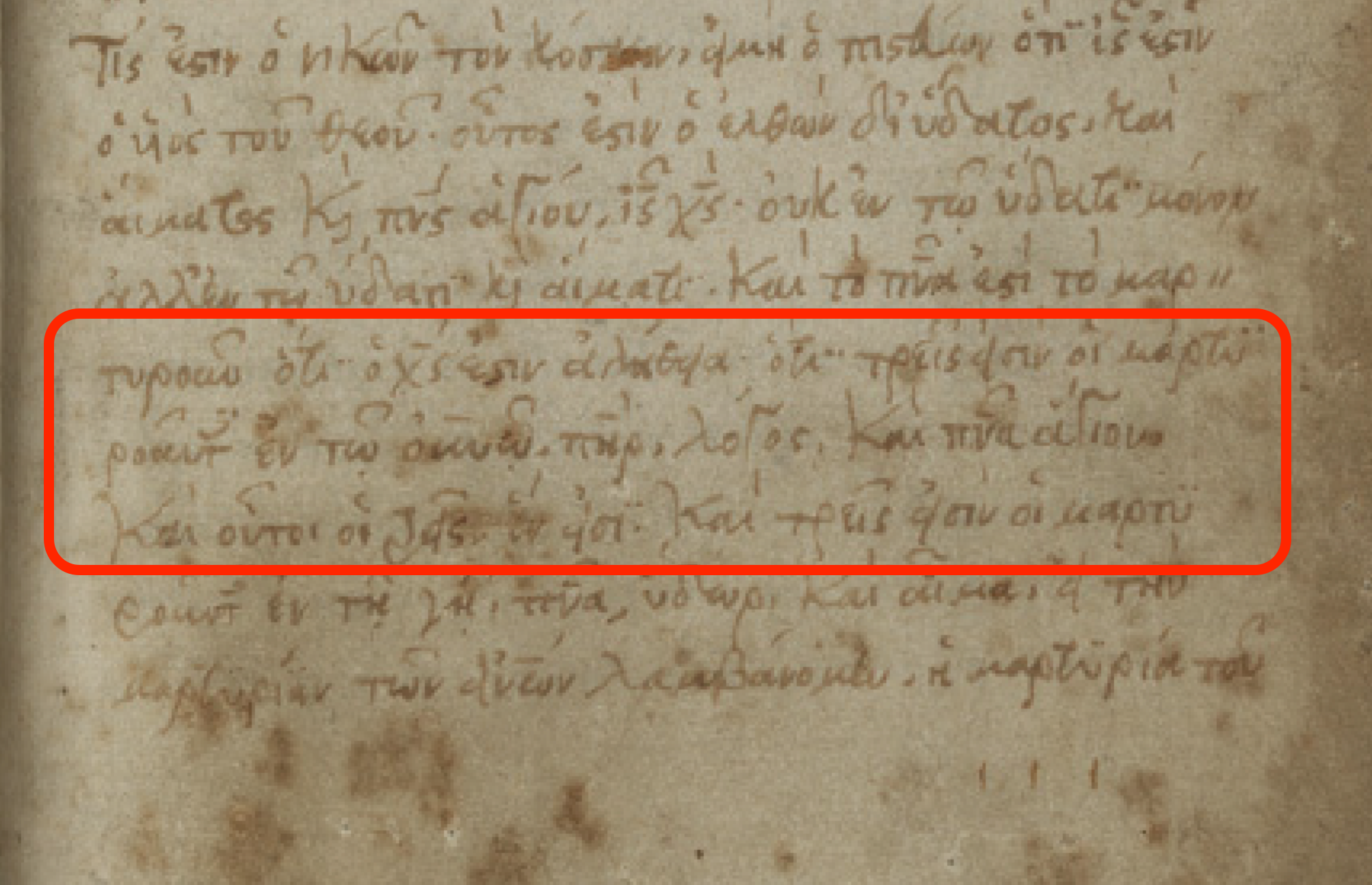
An actual illustration can be seen in codex 61, also known as Codex Montfortianus. This is the MS that was produced by a scribe in Oxford named (F)roy in 1520, which included the comma Johanneum (the Trinitarian formula at 1 John 5.7) that made its way into Erasmus’s third edition of the NT (1522). Now housed at Trinity College, Dublin, it is reported to have almost naturally fallen open to 1 John 5 because of the frequent consulting of this passage by researchers over the years. The MS nowadays is no longer available for direct consultation, but the library has produced some adequate digital images of it. And the page which contains the comma has more wax drippings by far than any other. It is also significantly dirtier than any other page, due to the constant handling of the page.

Screen Shot 2013-09-14 at 5.16.19 PM Codex 61: Two Pages before 1 John 5

 Screen Shot 2013-09-14 at 5.16.03 PMCodex 61 at 1 John 5

Screen Shot 2013-09-14 at 5.20.06 PM The Comma Johanneum in Codex 61

In the least, examining the wax drippings of digital images in continuous text MSS century by century and production-location by production-location (when known) could produce some interesting results. As these begin to be examined, certain guidelines should emerge on how to interpret the data. The necessary caveats may temper otherwise robust claims, but these should not keep students from examining the data.

The Number of Textual Variants: An Evangelical Miscalculation

In the Baker Encyclopedia of Christian Apologetics, by Norm Geisler (Grand Rapids: Baker, 1998; p. 532), there is a comment about the number of textual variants among New Testament manuscripts:

“Some have estimated there are about 200,000 of them. First of all, these are not ‘errors’ but variant readings, the vast majority of which are strictly grammatical. Second, these readings are spread throughout more than 5300 manuscripts, so that a variant spelling of one letter of one word in one verse in 2000 manuscripts is counted as 2000 ‘errors.'”

There are several problems with this paragraph, one of which is this: to say that variant readings are not errors is an odd way of putting things. If the primary goal of NT textual criticism is to recover the wording of the autographa (i.e., the texts as they left the apostles’ hands), then any deviation from that wording is, indeed, an error. It may well be a rather minor error (as the vast majority of them are)—in fact, something that cannot even translated it is so trivial—but it is an error nevertheless. The author, however, is most likely equating error with some reading that would render the Bible errant and fallible. It is quite true that (virtually) no viable variants are major threats to inerrancy; the major problems that the doctrine of inerrancy faces are essentially never found in textually disputed passages in which one reading creates the problem and another erases it.

The larger issue, however is how the number of variants was arrived at. Geisler got his information (directly or indirectly) from Neil R. Lightfoot’s How We Got the Bible (Grand Rapids: Baker, 1963), a book now fifty years old. Lightfoot says (53-54):

“From one point of view it may be said that there are 200,000 scribal errors in the manuscripts, but it is wholly misleading and untrue to say that there are 200,000 errors in the text of the New Testament. This large number is gained by counting all the variations in all of the manuscripts (about 4,500). This means that if, for example, one word is misspelled in 4,000 different manuscripts, it amounts to 4,000 ‘errors.’ Actually in a case of this kind only one slight error has been made and it has been copied 4,000 times. But this is the procedure which is followed in arriving at the large number of 200,000 ‘errors.'”

In other words, Lightfoot was claiming that textual variants are counted by the number of manuscripts that support such variants, rather than by the wording of the variants. His method was to count the number of manuscripts times the wording error. This book has been widely influential in evangelical circles. I believe over a million copies of it have been sold. And this particular definition of textual variants has found its way into countless apologetic works.

The problem is, the definition is wrong. Terribly wrong. A textual variant is simply any difference from a standard text (e.g., a printed text, a particular manuscript, etc.) that involves spelling, word order, omission, addition, substitution, or a total rewrite of the text. No textual critic defines a textual variant the way that Lightfoot and those who have followed him have done. Yet, the number of textual variants comes from textual critics. Shouldn’t they be the ones to define what this means since they’re the ones doing the counting?

Let me demonstrate how Lightfoot’s definition is way off. Today we know of more than 5600 Greek NT manuscripts. Among these, we know of about 2000–3000 Gospels manuscripts, 800 Pauline manuscripts, 700 manuscripts of Acts and the general letters, and about 325 manuscripts of Revelation. These numbers do not include the lectionaries, over 2000 of them, that are mostly of the Gospels. At the same time, not all the manuscripts are complete copies. The earlier manuscripts are fragmentary, sometimes covering only a few verses. The later manuscripts, however, generally include at least all four Gospels or Acts and the general letters or Paul’s letters or Revelation. But an average estimate is that for any given textual problem (more in the Gospels, less elsewhere), there are a thousand Greek manuscripts (this assumes that less than 20% of all the Greek manuscripts “read” in any given passage, probably a conservative estimate).

Putting all this together, we can assume an average of 1000 Greek manuscripts being involved in any textual problem. Now, assume that we start with the modern critical text of the Greek New Testament (the Nestle-Aland28). Most today would say that that text is based largely on a minority of manuscripts that constitute no more than 20% (a generous estimate) of all manuscripts. So, on average, if there are 1000 manuscripts that have a particular verse, the Nestle-Aland text is supported by 200 of them. This would mean that for every textual problem, the variant(s) is/are found in an average of 800 manuscripts. But, in reality, the wording of the Nestle-Aland text is often found in the majority of manuscripts. So, we need a more precise way to define things. That has been provided for us in The Greek New Testament according to the Majority Text by Hodges and Farstad. They listed in the footnotes all the places where the majority of manuscripts disagreed with the Nestle-Aland text. The total came to 6577.

OK, so now we have enough data to make some general estimates. Even if we assumed that these 6577 places were the only textual problems in the New Testament (a demonstrably false assumption, by the way), the definition of Lightfoot could be shown to be palpably false. 6577 x 800 = 5,261,600. That’s more than five million, just in case you didn’t notice all the commas. Based on Lightfoot’s definition of textual variants, this is how many we would actually have, conservatively estimated. Obviously, that’s a far cry from 200,000!

Or, to put this another way: this errant definition requires that there be no more than about 250 textual problems in the whole New Testament (250 textual variants x 800 manuscripts that disagree with the printed text = 200,000). (It should be noted that, for simplicity’s sake, I am counting a textual problem as having only one variant from the base text, even though this is frequently not the case). If that is the case, how can the United Bible Societies’ Greek New Testament list over 1400 textual problems? And how can the Nestle-Aland text list over 10,000?

And again, this five million is not even close to the actual number. I took a very conservative approach by only looking at the differences from the majority of manuscripts. But if one started as his base text Codex Bezae for the Gospels and Acts and Codex Claromontanus for the letters, the number of variants (counted Lightfoot’s way) from these two would be astronomical. My guess is that it would be well over 20 million. Or if one started with Codex Sinaiticus, the only complete New Testament written with capital (or uncial) letters, the numbers would probably exceed 30 million—largely because Sinaiticus spells words in some strange ways that are not shared by very many other manuscripts. You can see that the definition of a textual variant as a combination of wording differences times manuscripts is rather faulty. Counting this way results in tens of millions of textual variants, when the actual number is miniscule by comparison. And that’s because we only count differences in wording, regardless of how many manuscripts attest to it.

All this is to say: a variant is simply the difference in wording found in a single manuscript or a group of manuscripts (either way, it’s still only one variant) that disagrees with a base text. Further, there aren’t only 200,000. That may have been the best estimate in 1963, when we knew of  fewer manuscripts. But with the work done on Luke’s Gospel by the International Greek New Testament Project, Tommy Wasserman’s work on Jude, and Münster’s work on James and 1-2 Peter, the estimates today are closer to 400,000. Some even claim half a million. In short, as Bart Ehrman has so eloquently yet simply put it, there are more variants among the manuscripts than there are words in the NT.

Although this may leave some feeling uneasy, it is imperative that Christians and non-Christians be honest with the data. I would urge those who have used Lightfoot’s errant definition to abandon it. It’s demonstrably wrong, and citing it reveals a fundamental ignorance about textual criticism. And I would hope that the publishers of numerous apologetics books would get the data right. The last thing that Christians should be doing is to latch on to some spurious ‘fact’ in defense of the faith.

Postscript

I have recently been in correspondence with some apologists (including Geisler), and I am happy to report that they are revising their definition of what constitutes a textual variant. Two or three of them have appealed to their publishers to correct the data in later printings.

Some Notes on the Earliest Manuscript of Paul’s Letters

The publication of P46 in 1935–37––then, and now, the oldest extant manuscript of Paul’s epistles––has not ceased to pique the interest of biblical scholars. Beginning with the plates and text published by Kenyon (1936, 1937), and continuing with the virtual birth of reasoned eclecticism with Zuntz’s magisterial The Text of the Epistles: A Disquisition on the Corpus Paulinum (1953), and reconsiderations of its date (Young Kyu Kim, “Palaeographical Dating of P46 to the Later First Century,” Biblica 69 [1988] 248–57), this priceless document has made its way to the front lines of biblical scholarship for a long time. Though Kim’s suggestion that Chester Beatty Biblical Papyrus II was written before the reign of Domitian (81–96 CE) has been refuted, the consensus continues that it was produced c. 200 CE.

Where Are the Pastoral Epistles?
One curiosity of this papyrus is that, in its current state, it lacks the pastoral letters. With 86 of the original 104 leaves still extant, scholars have a good amount of material to work with as to whether it would have originally contained the pastorals.

How do they know that it originally contained 104 leaves? Two features are used to infer this. First, the manuscript is a single quire codex. This means that all the double leaves (or bifolia) were laid down on top of each other, then folded and sewn into the binding. The fact that it was a single-quire codex can be detected by size of the pages: moving from the beginning to leaf 52, the pages get increasingly narrower. Then, from leaf 53 to the end, the pages get increasingly wider. This can only mean that all the bifolia were laid down in one stack, folded, then trimmed on the outside so that all the leaves were relatively flush. (The later, standard quire was eight leaves [or four double leaves], used throughout the early to middle ages.)

Second, each page is numbered by the original scribe. This is unusual for manuscripts of any age. Usually the quires are numbered, and frequently the leaves were numbered (on the front page), but not the pages. Since the first extant page is numbered 17 (folio 8), and starts with Romans 5.17, we can extrapolate that the manuscript began with Romans 1 and is missing the outer seven double leaves.

What is extant are nine ‘Pauline’ letters: Romans, Hebrews (almost always included in the Pauline corpus as far as ancient manuscripts are concerned), 1 Corinthians, 2 Corinthians, Ephesians, Galatians, Philippians, Colossians, and 1 Thessalonians. Missing are 2 Thessalonians, Philemon, and the pastoral letters.

Almost surely 2 Thessalonians followed 1 Thessalonians, as it does in all other manuscripts which have both letters. But what about Philemon? Most scholars are of the opinion that Philemon was also included in this codex.

But the pastorals? This is where opinions have varied. Kenyon started the ball rolling with the suggestion that the last five leaves were left blank and did not include the pastorals. The argument is that there was simply not enough room to include the pastorals and Philemon, which would require about twice as many leaves. Why would this be the case? Was the scribe unaware of them? If he was, this might suggest that they are not authentic.

Although Kenyon’s view held sway for many decades, and is even now occasionally affirmed, Jeremy Duff’s article in New Testament Studies 44 (1998), “P46 and the Pastorals: A Misleading Consensus?” challenged this hypothesis.

One of the points made by Duff is that the letters are more compressed at the end of the codex than in the middle. He noted that there are half again as many letters per page in the last leaves than in the middle leaves. But this is partially due to the fact that the outer leaves are wider than the inner leaves. Nevertheless, there are more letters in the back outer leaves than the front outer leaves, showing that at least some compression did take place. And this seems to suggest that the scribe was aware of the problem he had created for including the pastorals and he began to compensate upon realizing his mistake.

There are problems with Duff’s analysis, however. The scribe seemed to understand to some extent how much space it would require to produce his codex. This is seen in his notes at the end of each book of how many lines he wrote. This was customary for professional scribes; it was in essence a bill for services, since they were paid by the line. He may have been working from a manuscript that had already indicated the number of lines, and thus would have known how many leaves he needed for his manuscript. Of course, the fact that his words were more compressed at the end of the codex seems to show that as careful as he was in his calligraphy (and he was), this tells us nothing about his math skills.

A Fresh Examination of the Codex
This week I had the privilege of examining P46 in the flesh. Fifty-six of the 86 leaves are housed at the Chester Beatty Library in Dublin. I have spent the last three days examining them in some detail, comparing them to the editio princeps by Kenyon. Sir Frederic Kenyon produced the plates of this famous papyrus in 1937. Each image has been assumed to be exactly the same size as the actual leaf it represents. I measured each leaf against Kenyon’s plates and noticed some interesting phenomena.

Of the 88 plates (44 leaves) I was able to measure, the plates in Kenyon’s volume are off at least 61 times. Most of these are within 1 mm or so, but a few are fairly significant. At least three are off by 3 mm, and one is off by as much as 5 mm.

In addition, I noticed a curiosity: some of the plates in Kenyon’s volume were photographed without the lens plane exactly parallel to the leaf. For example, the photograph of folio 39 verso (1 Cor 1.14–23) is slightly wider than the actual leaf on the bottom, while the top of the leaf is the same size in both the photograph and actual manuscript. And leaves 49 recto (1 Cor 10.1–10), 50 recto (1 Cor 10.21–30), and 51 verso (1 Cor 10.31–11.6) are also somewhat trapezoidal. This suggests that the camera got cocked, or the tape around the plates (for Kenyon’s photographs were of the papyrus under glass) got doubled up, creating the trapezoidal effect.

How much the incorrect sizes of the leaves in Kenyon’s volume impact the discussion of whether P46 originally contained the pastorals is yet to be seen. But in the least, this anomaly needs to be factored into the discussion. Much can still be learned from this renowned papyrus.

The Authenticity of the Gospel of Judas

Katherine Weber of the Christian Post asked me some questions this week about the recent revelation that the Gospel of Judas had been authenticated by a number of means. See http://science.nbcnews.com/_news/2013/04/08/17656331-scholars-reveal-how-they-scrambled-to-authenticate-gospel-of-judas for the news report, and http://www.christianpost.com/news/gospel-of-judas-free-of-forgeries-but-still-fake-heretical-says-new-testament-scholar-93781/ for Katherine’s article (published 11 April 2013).

Below are her questions and my responses. This will also be published in the Christian Post later this week.

1) What are your thoughts on the authenticity of the Gospel of Judas? Is ink testing and comparison, in your opinion, an adequate method of determining the validity of an ancient text?

Paleography—the discipline of analyzing, deciphering, and dating ancient manuscripts—is little known outside of specialized circles. Traditionally, scholars especially use handwriting analysis to date manuscripts. Handwriting changes over time, and ancient Greek papyri, of which there are hundreds of thousands still in existence, give us plenty of illustrations of these changes. Actual dated papyri give us concrete evidence for when a particular style of writing was used. Of course, the manuscripts do not use our modern dating system. Instead, they are indexed to the reigns of the Caesars, mention a known person in an official capacity whose dates are known, or speak of astronomical events. For example, a petition to a government official written in “the 25th year of Marcus Aurelius Severus Antoninus Caesar” was penned in AD 216. By such fixed dates on some of the papyri, scholars can fix the patterns of handwriting of other papyri to a range of dates. On such undated papyri, the range can be as short as fifty years.

But Coptic manuscripts are notoriously difficult to date because the handwriting was more stable than Greek manuscripts. Pinpointing the date to within one hundred years is difficult, if not impossible, in most cases. Ink analysis is important because of the shifts in ancient technology and methods that can be located in time. Radiocarbon dating is not usually used on ancient manuscripts because, until recently, it necessarily destroyed part of the document being analyzed. Apparently, radiocarbon dating was used on the Gospel of Judas, however. (There is a relatively new method for dating manuscripts that is non-destructive. I did not see any discussion of this in the report. Developed by Dr. Marvin Rowe of Texas A & M University and his doctoral assistant, Professor Karen Steelman, the method uses a plasma chamber that does not damage the artifact. See Marvin W. Rowe and Karen L. Steelman, “Non-destructive 14C Dating: Plasma-Chemistry and Supercritical Fluid Extraction,” March 2010, ACS National Meeting 2010. So it would indeed have been possible to get a relatively firm date on this fragment without destroying any text.) One problem with all kinds of radiocarbon dating, however, is that this too cannot give a precise date. Depending on the age of the artifact, the range can vary widely.

The recent revelations by Joseph Barabe indicate a date of “approximately A.D. 280,” but this seems to be more precise than the technology would suggest. Most likely, the confluence of ink analysis and radiocarbon dating have both legitimately authenticated this codex and fixed the date to the late third to early fourth century.

2) What criticisms do you have of the Gospel of Judas’ authenticity?

It is important to distinguish two concepts regarding its authenticity. First, there is the issue of whether this document is a modern forgery or a bona fide ancient text. The evidence seems to be quite strong that this is the latter. Second, when we hear the word ‘authentic’ regarding an early sub-Christian writing it is natural to conclude that authentic = true as regards the historicity of the Christian faith. This is not the case in this instance. All that is being claimed is that the manuscript really was produced in the late third century.

3) If it became a fact that the Gospel of Judas were real, how would this change the study of the New Testament?

Most likely, the original Gospel of Judas was written in the second half of the second century. Irenaeus, writing in about AD 180, condemned a gospel by this name as a fake, and described its contents as revealing that Judas “alone, who knew the truth as no one else did, accomplished the mystery of the betrayal” of Jesus. This fits well with the contents of the codex, in which Jesus praises Judas as the one who will set his spirit free from the bonds of his physical body. This is vintage Gnosticism, which made a hard distinction between the spiritual and material world, branding the one good and the other bad. But does this mean that there is any historical truth to the Gospel of Judas, that it actually tells us the real story about the relation of Jesus to Judas? Hardly. Not a single scholar thinks that this conversation has any historical credibility. Irenaeus was right: this is a fake gospel which promotes a heretical idea about Jesus of Nazareth. The discovery and authentication of the Judas codex does nothing to disturb that assessment.