There Were Giants in Those Days: Codex Robertsonianus, Part 2

In my previous post about the correspondence between Adolf Deissmann and A. T. Robertson concerning a Greek Gospels manuscript, I showed the pictures of Deissmann’s first letter, along with a transcription of it.

This is the second of four parts of that correspondence. These letters constitute the A. T. Robertson Papers, Box 7, Folder 3, Archives and Special Collections, James P. Boyce Centennial Library, The Southern Baptist Theological Seminary, Louisville, Kentucky. I am grateful to Adam Winters, archivist at SBTS, who provided the photographs. They are used with permission of the SBTS Archives & Special Collections.

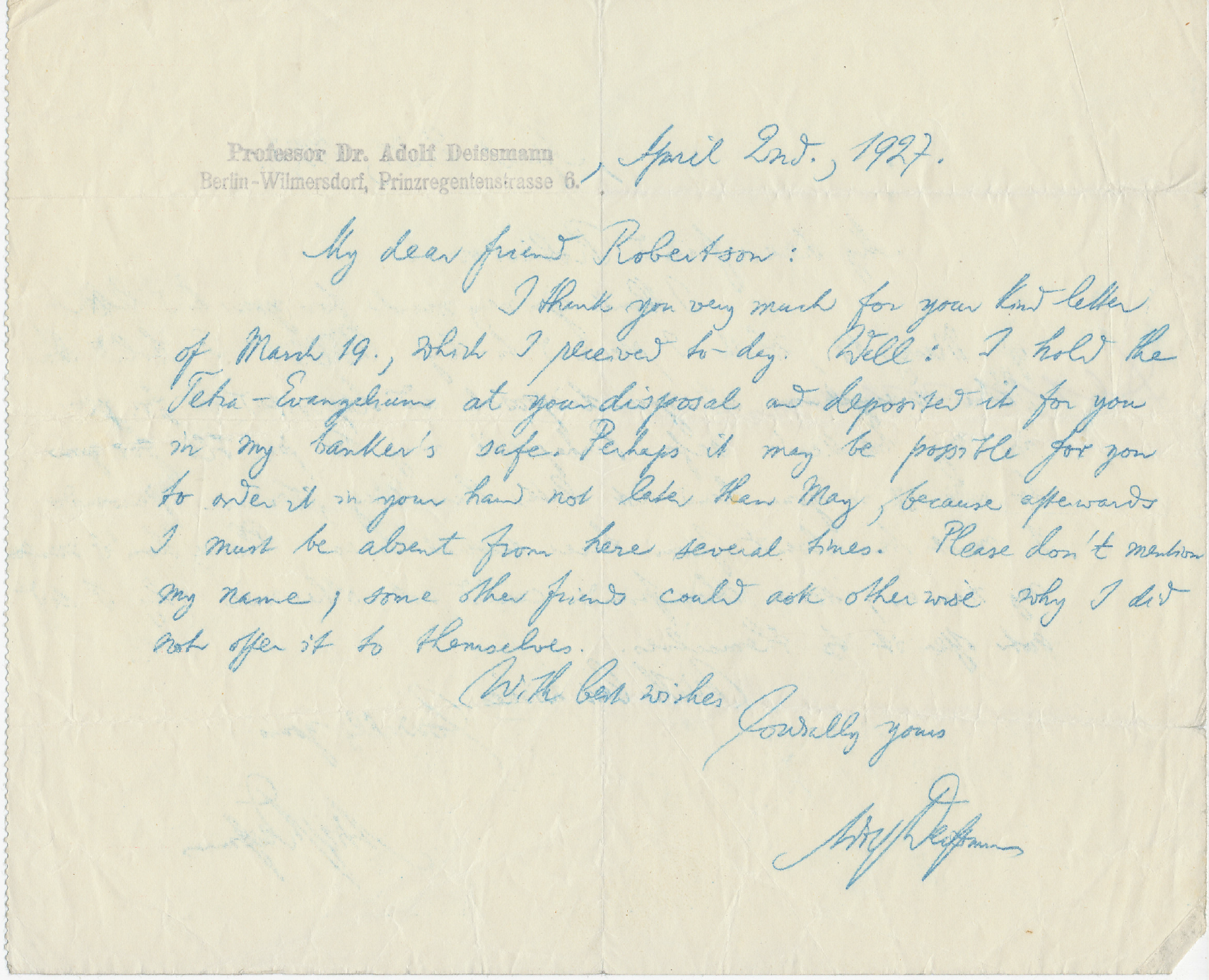
Deissmann to Robertson_2 Apr 1927

Professor Dr. Adolf Deissmann
Berlin-Wilmersdorf, Prinzregentenstrasse 6., April 2nd., 1927.

My dear friend Robertson:

I thank you very much for your kind letter of March 19., which I received to-day. Well: I hold the Tetra-Evangelium at your disposal and deposited it for you in my banker’s safe. Perhaps it may be possible for you to order it in your hand not later than May, because afterwards I must be absent from here several times. Please don’t mention my name; some other friends could ask otherwise why I did not offer it to themselves.

With best wishes
Cordially yours
Adolf Deissmann

There Were Giants in Those Days: Codex Robertsonianus (Gregory-Aland 2358), Part 1

In 1927, Adolf Deissmann began a correspondence with A. T. Robertson that led to the purchase of a Greek Gospels manuscript by Southern Baptist Theological Seminary. Some of the story of this manuscript’s travels and text is told by John W. Bowman in his 23-page booklet (with four plates), The Robertson Codex (Allahabad, India: Mission Press, 1928). The booklet was a reprinting of articles in The Indian Standard 139, nos. 8 and 9 (August and September, 1928). Bowman had been a student of Robertson’s at Southern and later became professor of New Testament and Church History at North India United Theological College in Saharanpur, India.

In Bowman’s booklet are two chapters, which correspond to the two articles in The Indian Standard. The first chapter addresses the process of photographing the manuscript, and is a window on the difficulties that attended such labors in the 1920s. It took the author nearly three months to photograph it! Today, with digital photography, the Center for the Study of New Testament Manuscripts normally photographs a 350-page manuscript (the size of Codex Robertsonianus) in less than a day. In this chapter he mentions the rarity of photographs of New Testament manuscripts: “Very few complete MSS of the N.T. or portions thereof have hitherto been photographed: I am personally aware of only five such” (5). Bowman’s second chapter discusses many fascinating details of the manuscript.

One thing is largely missing, however, from the book: except for small snippets here and there, the correspondence between Deissmann and Robertson is not mentioned. This blog thus supplements Bowman’s pamphlet with Deissmann’s letters to Robertson concerning the codex (I do not have access to Robertson’s responses to Deissmann).

Below are photographs of the first letter (along with the text printed beneath each one), which was obtained from Southern Baptist Seminary. In later blogs, I will post the rest of the letters and text. These letters constitute the A. T. Robertson Papers, Box 7, Folder 3, Archives and Special Collections, James P. Boyce Centennial Library, The Southern Baptist Theological Seminary, Louisville, Kentucky. I am grateful to Adam Winters, archivist at SBTS, who provided the photographs. They are used with permission of the SBTS Archives & Special Collections.

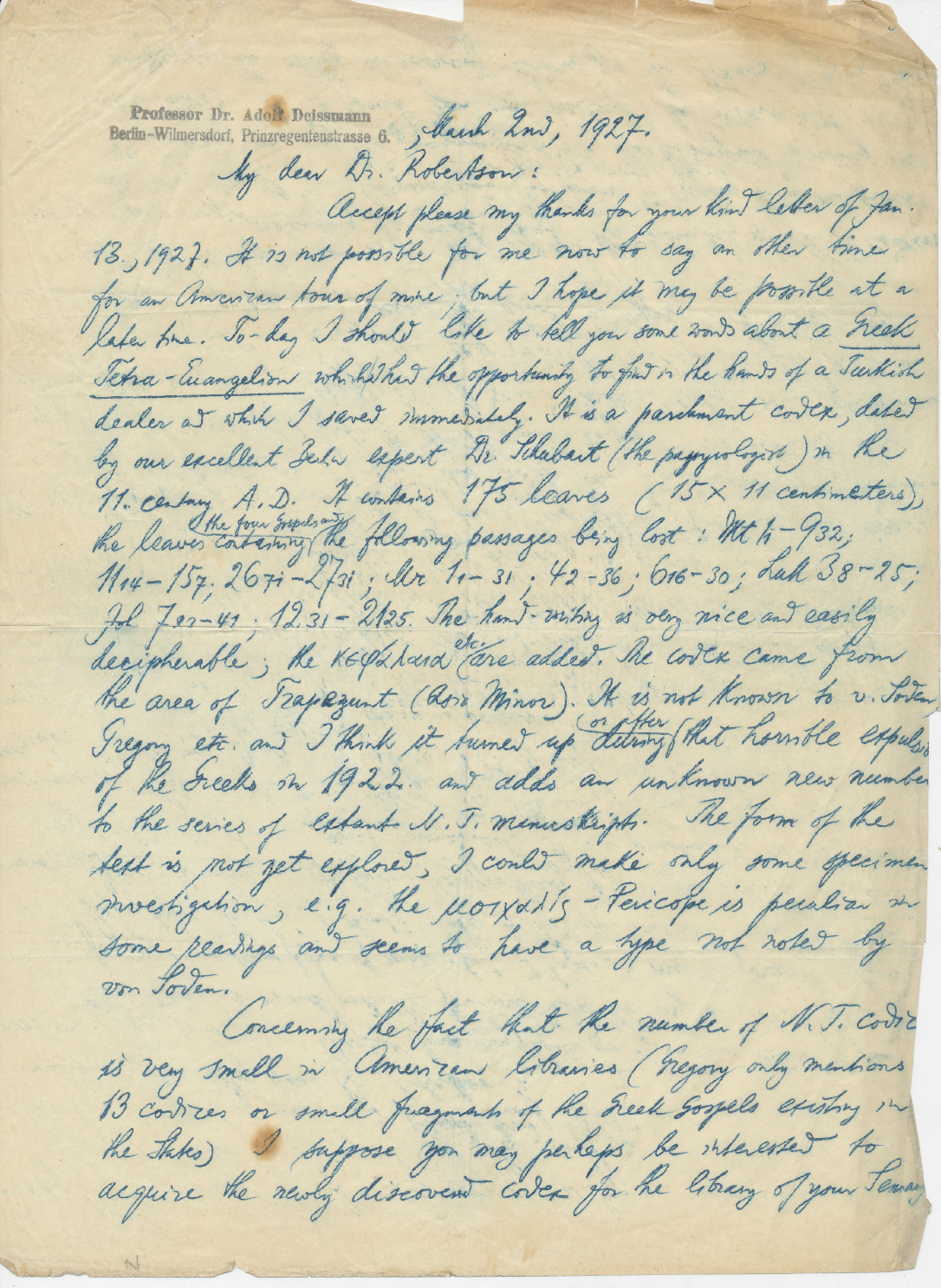
Deissmann to Robertson_2 Mar 1927_page 1 of 2

Professor Dr. Adolf Deissmann
Berlin-Wilmersdorf, Prinzregentenstrasse 6., March 2nd, 1927.

My dear Dr. Robertson:

Accept please my thanks for your kind letter of Jan. 13, 1927. It is not possible for me now to say an other time for an American tour of mine; but I hope it may be possible at a later date. To-day I should like to tell you some words about a Greek Tetra-Euangelion which I had the opportunity to find in the hands of a Turkish dealer and which I saved immediately. It is a parchment codex, dated by our excellent Berlin expert Dr. Schubart (the papyrologist) in the 11. century A.D. It contains 175 leaves (15 x 11 centimeters), the leaves containing the four Gospels and the following passages being lost: Mt 11–932; 1114–157; 2671–2731; Mr 11–31; 42–36; 616–30; Luk 38–25; Joh 723–41; 1231–2125. The hand-writing is very nice and easily decipherable; the κεφάλαια etc. are added. The codex came from the area of Trapezunt (Asia Minor). It is not known to v. Soden, Gregory etc. and I think it turned up during or after that horrible expulsio[n] of the Greeks in 1922. and adds an unknown new number to the series of extant N.T. manuscripts. The form of the text is not yet explored, I could make only some specimen investigation, e.g. the μοιχαλίς-Pericope is peculiar in some readings and seems to have a type not noted by von Soden.

Concerning the fact that the number of N.T. codic[es] is very small in American libraries (Gregory only mentions 13 codices or small fragments of the Greek Gospels existing in the States) I suppose you may perhaps be interested to acquire the newly discovered codex for the library of your Seminary[.]

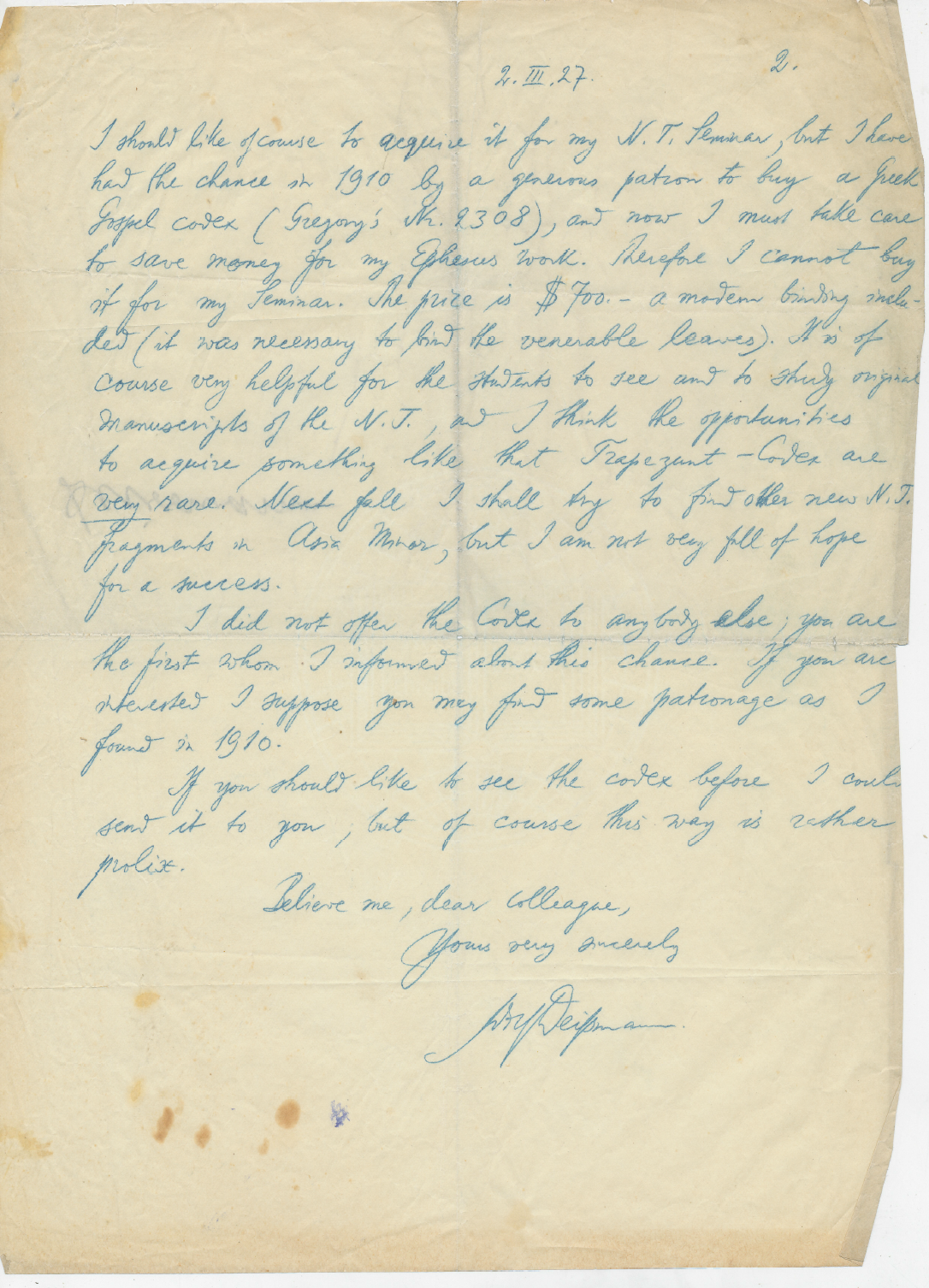
Deissmann to Robertson_2 Mar 1927_page 2

I should like of course to acquire it for my N.T. Seminar, but I have had the chance in 1910 by a generous patron to buy a Greek Gospel codex (Gregory’s Nr. 2308), and now I must take care to save money for my Ephesus work. Therefore I cannot buy it for my Seminar. The price is $700.—a modern binding included (it was necessary to bind the venerable leaves). It is of course very helpful for the students to see and to study original manuscripts of the N.T., and I think the opportunities to acquire something like that Trapezunt-Codex are very rare. Next fall I shall try to find other new N.T. fragments in Asia Minor, but I am not very full of hope for a success.

I did not offer the Codex to anybody else; you are the first whom I informed about this chance. If you are interested I suppose you may find some patronage as I found in 1910.

If you should like to see the codex before I could send it to you, but of course this way is rather prolix.

Believe me, dear colleague,

Yours very sincerely

Adolf Deissmann.

The Textual Reliability of the New Testament

I was interviewed by Nick Peters on his Deeper Waters podcast today. Two-hour, live program. He’s going to interview Craig Blomberg next week about his new book. Nick is doing a terrific ministry. I encourage you to give a listen:

http://www.blogtalkradio.com/grok558/2014/04/19/the-textual-reliability-of-the-new-testament

Review of Trobisch’s User’s Guide to the Nestle-Aland 28

users_guide

Review of David Trobisch, A User’s Guide to the Nestle-Aland 28 Greek New Testament,
SBLTC 9 (Atlanta: Society of Biblical Literature, 2013). Pp. viii + 69; $25.95.

The much-anticipated publication of the Nestle-Aland Novum Testamentum Graece, 28th edition, in December 2012, instantly created a need for a user’s guide similar to what Kurt Aland and Barbara Aland’s The Text of the New Testament, 2nd edition (Eerdmans, 1989), pp. 232–60 and passim, did for the Nestle-Aland 26th edition. David Trobisch answered the call with his User’s Guide to the 28th edition, which appeared in November of 2013.

This User’s Guide however, is significantly different from the material in Aland-Aland’s Text. Whereas the latter is a scholarly introduction to (and unashamedly a promotion of) the NA26, Trobisch’s User’s Guide is significantly simpler and has only 14 pages devoted to the scholarly use of this handbook edition of the NT. The User’s Guide has three chapters (1–54) and three sections of supporting material at the end (55–69). The chapters progress in intended readership from those who have had little or no Greek (chapter 1: “Structure and Intention of the Edition,” 1–25), to graduate students who have learned Greek and have some comprehension of biblical studies (chapter 2: “Exercises and Learning Aids,” 27–39), to a brief chapter intended for use by “researchers and teachers who interpret the New Testament professionally” (viii), presumably including professors and advanced students (chapter 3: “NA28 as an Edition for Scholars,” 41–54).

Although the second chapter is useful for students, the rationale for the first chapter is puzzling. Why would someone without knowledge of Greek want to use a Greek text at all, especially one as concise (due to the myriad abbreviations, sigla, etc.) and scholarly as the Nestle-Aland? And this being the longest of the three chapters, complete with the Greek alphabet, diphthongs, and other elementary material needed to pronounce ancient Greek, it seems to be a waste of space to some degree. Even in this introductory chapter, Trobisch got some facts wrong. For example, he says that γχ is pronounced ‘nch’ as in ‘anchovies’ (9); the text of the NA28 was produced by “an international editorial committee” (2 [italics added]; see also 49), when the title page indicates only that the Münster institute produced this particular edition; and the canon of the shorter reading or lectio brevior “only applies to two readings that are superficially combined” (24), when the consensus among textual critics is that this rule applies to those variants that have more words than the alternative, whether they are a combination of older readings or not (cf. the variants in John 3:13 and Rom 8:1, for example). Nevertheless, some of the material in the first chapter is helpful for students of Greek. I would recommend eliminating this chapter and combining the best features with what is already in chapter 2.

The second chapter includes helpful information about some of the changes between NA27 and NA28, including the dropping of consistently cited witnesses of the second order, how to use the distinct apparatus for the Catholic Epistles, and a discussion on the Eusebian Canons for the Gospels. On this last item, it should be noted that the Nestle-Aland tradition continues to list the numbers in the Canons as Arabic and Roman numbers. Although this is useful as a tool for the modern student in comparing the Gospels, it is unhelpful for those who spend time on the actual manuscripts, since the Eusebian Canons are found in manuscripts entirely by Greek letters (see https://danielbwallace.com/2014/04/13/conversion-table-for-the-eusebian-canons to download the PDF of a conversion table). This chapter takes the student through the NA28 Introduction, Apparatus, marginalia, and various other features of the book, with exercises sprinkled throughout.

Chapter 3 is a useful introduction to a behind-the-scenes look at the decisions made in Münster concerning the format, text-critical decisions and approach, and differences from the previous edition of the Nestle-Aland text. But Trobisch overstates things when he calls this new edition a “thoroughly revised edition” (vii). To be sure, the apparatus has been thoroughly updated, but the only textual differences are in the Catholic Epistles. Trobisch makes both commendations and criticisms of the 28th edition. In the first section which systematically goes through differences between this and NA27, some of the negative features of the 28th come to light—even though Trobisch explicitly addresses limitations of this new edition in the second section, “Limitations of the NA28.”

Gone are any explicit conjectural emendations, whereas the NA27 listed over 100 of them (one of which was followed [Acts 16:12], though both Bruce Metzger and Kurt Aland disagreed with the rest of the committee), and NA28 adds one more to the text (2 Peter 3:10). (At the same time, neither of the variants in these two passages is a true conjecture since there are versions that have these readings. Bruce Metzger and Bart Ehrman, The Text of the New Testament, 4th ed. [Oxford: OUP, 2005] 230, implicitly define a conjecture as having no support in Greek manuscripts, versions, or fathers: the need for conjectural emendation for the New Testament is “reduced to the smallest dimensions” because “the amount of evidence for the text of the New Testament, whether derived from manuscripts, early versions, or patristic quotations, is so much greater than that available for any ancient classical author…”)

NA28 also eliminated the useful subscriptions for the NT books found in previous editions, a most unfortunate decision. They have however retained the inscriptions, though Trobisch says that these, too, got the ax (43).

The number of witnesses cited in the apparatus is significantly reduced, and any comparison with previous editions of the Greek NT by Tischendorf, Westcott-Hort, von Soden, and others is eliminated.

The lack of such valuable features means that students and scholars will need to continue using their NA27 in conjunction with NA28. Trobisch notes that 33 textual changes occurred in the Catholic Epistles (44), though there are actually 34 (see NA28, 50*–51* for the list). A brief discussion of the sea-change in Münster from the “local-genealogical method” (which Barbara Aland once told me was not within the bounds of reasoned eclecticism) to the “Coherence-Based Genealogical Method” or CBGM concludes the chapter.

A final criticism of this booklet is that although the author provides links to several sites which host images of NT manuscripts, he overlooks the website for the Center for the Study of New Testament Manuscripts (www.csntm.org), which has one of the largest collections of high-resolution digital images of Greek NT manuscripts on the Internet, most of which have been photographed by CSNTM in the last twelve years. Included on this site are images of the Chester Beatty papyri, which CSNTM digitized in the summer of 2013, working with the papyri at the Chester Beatty Library in Dublin.

In sum, I anticipated that this work would be useful for students learning the ropes of NT textual criticism, but the gaps, errata, and proportion leave me somewhat disappointed. Even though there are many helpful features, the work is overall quite uneven. I hope that a second edition which corrects these deficiencies will soon be forthcoming (some of these deficiencies have been corrected in the second German edition of this book), since such a volume is needed for anyone using the Nestle-Aland 28th edition of Novum Testamentum Graece.

Daniel B. Wallace

Conversion Table for the Eusebian Canons

For several years now, the staff at the Center for the Study of New Testament Manuscripts (www.csntm.org) have utilized the Eusebian Canons to quickly find their place in Gospel manuscripts. These Canons are found in the inner margin of the Nestle-Aland, Novum Testamentum Graece, 28th edition (as well as earlier editions). They are written in Arabic numbers over Roman numerals. As helpful as this is for those working in the printed text of the Gospels, it is difficult to use when examining manuscripts precisely because one has to convert on the fly numbers to letters if he or she needs to locate where they are in the text efficiently. Of course, determining what passage one is reading is usually fairly easy by simply keying in a few Greek words in sequence and checking what the manuscript says against a printed text in a Bible software program. But at times this can be tricky. For example, if the text is difficult to read or has variant spellings, finding one’s place may require several attempts on the computer. Codex 0322, a two-leaf palimpsest that CSNTM discovered in 2004, yields only a few letters on each page to the eye. But the Eusebian Canons are still completely intact and guided us to recognize the text as Mark 3.17–4.1; and 6.10–22. With that to guide us we were able to discern two or three ‘Western’ readings in this majuscule.

For others who are interested in the Eusebian Canons, I am attaching the document (Eusebian Canons conversion table) that we use when examining Gospel manuscripts. There are three columns for each canon: arabic number, Greek letter, and scriptural reference. I am sure a few errata have made their way into this conversion table, and would invite corrections so that we can improve on it.