
As would be expected from anything produced by Steven Runge, this is a most useful tool. It is intended to help readers understand why an author chooses the forms he does to convey meaning. Discourse grammar has become an increasingly helpful approach in the last few years to supplement standard grammars. It does not replace traditional grammars, but supplements them. Occasionally, discourse grammars, including this one from Logos, will see meaning in the wrong places. For example, the illustration of the use of the participle like an indicative verb conveying some meaning that is somehow different from an indicative may be overplayed (repeatedly mentioned in the Introduction). The participle used as an indicative verb is quite rare in the NT, never seems to occur in classical Greek, and is most likely due to Semitic influence. Most of the NT examples occur in the Apocalypse, a book whose author R. H. Charles famously described as “thinking in Hebrew but writing in Greek.” Whether there is any meaning beyond revealing the author’s linguistic capacity is not a given. The same can be said for countless other grammatical phenomena in the NT (e.g., paratactic structure in Mark, anacolutha in Paul, redundant pronouns in John). Nevertheless, used with caution, discourse grammar can be extremely valuable.
On the BDF revision committee (now defunct due to the deaths of Robert W. Funk and Daryl D. Schmidt [chairman of the committee]), the team of scholars discussed for many years how best to approach the revision. One of the approaches was to include a section on semantics as a cross-reference tool so that the user could learn about the features of the Greek NT through two routes: (1) textual route, in which the student reads the text and then uses the grammar to determine meaning of the syntactical phenomena; (2) meaning route, in which the student inquires about things like how to express purpose, possession, commands, etc. This comes close to what discourse grammar does, though discourse grammar has made quite a few advances over the narrowly-defined categories of meaning that grammarians typically work with.
The main body of the six-volume work is discourse analysis of the Greek NT, seriatim from Matthew 1 through Revelation 22. There’s also a helpful introductory volume and a glossary.
Below are illustrated some of the features.
 Definitions in Introduction
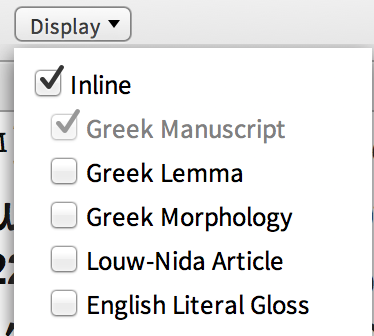 Display feature—minimal

Rom 3.21-26 with minimal display features
A few limitations of this approach should be noticed. For example, although μαρτυρουμένη in Rom 3.21 is mentioned as an elaboration, the user is not told what kind of participle it is. Whether it’s adjectival ([the righteousness of God…] which is being witnessed), adverbial (being witnessed), or more particularly concessive (although it is witnessed), is not discussed. Yet how this participle is taken affects the exegesis of the text. Notice that what πάντες in 3.22 and 23 relates to is not mentioned; this requires careful exegesis and a good understanding of Greek syntax to figure out.

Highlighting feature in Rom 3.22
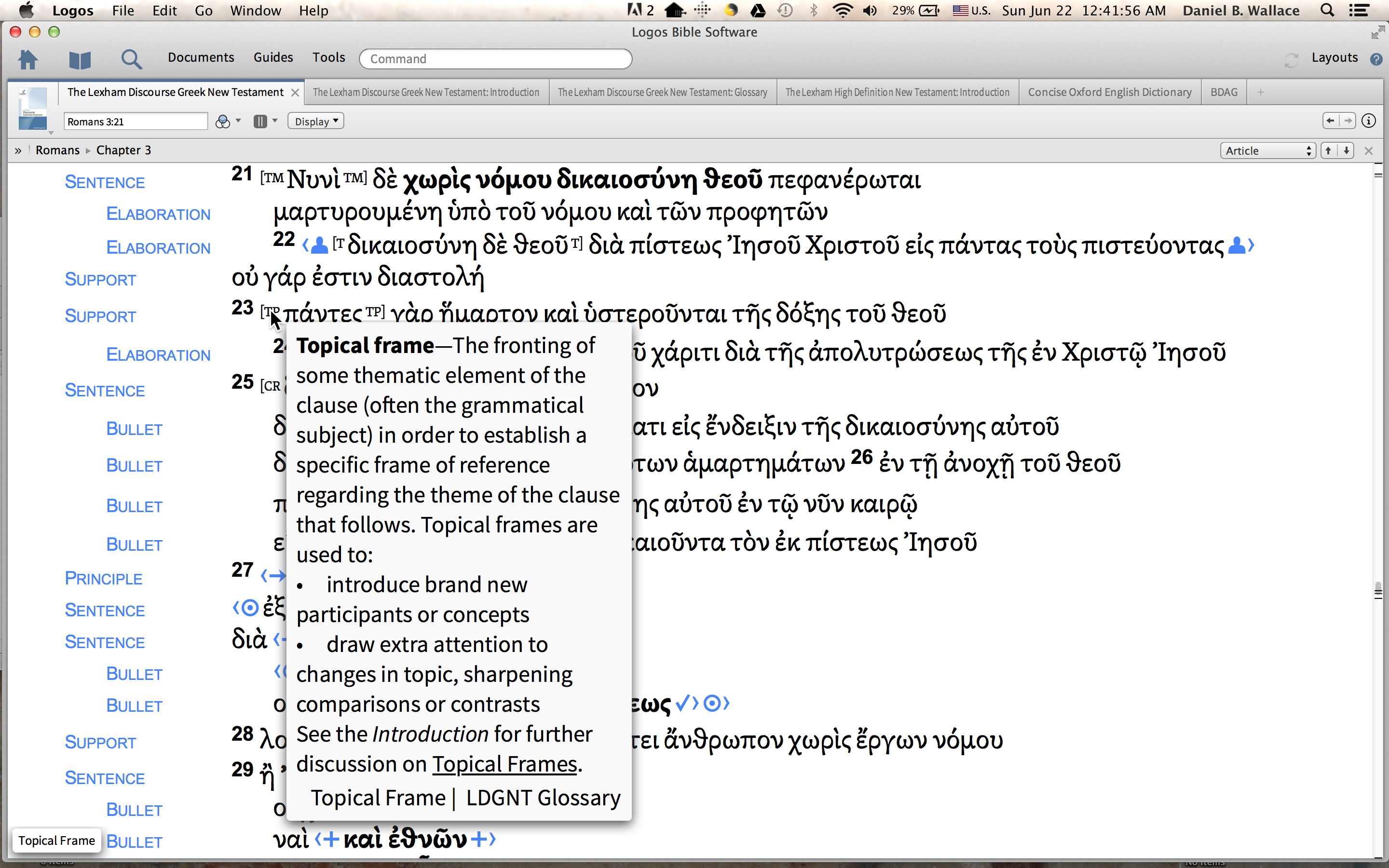
Highlighting feature in Rom 3.23
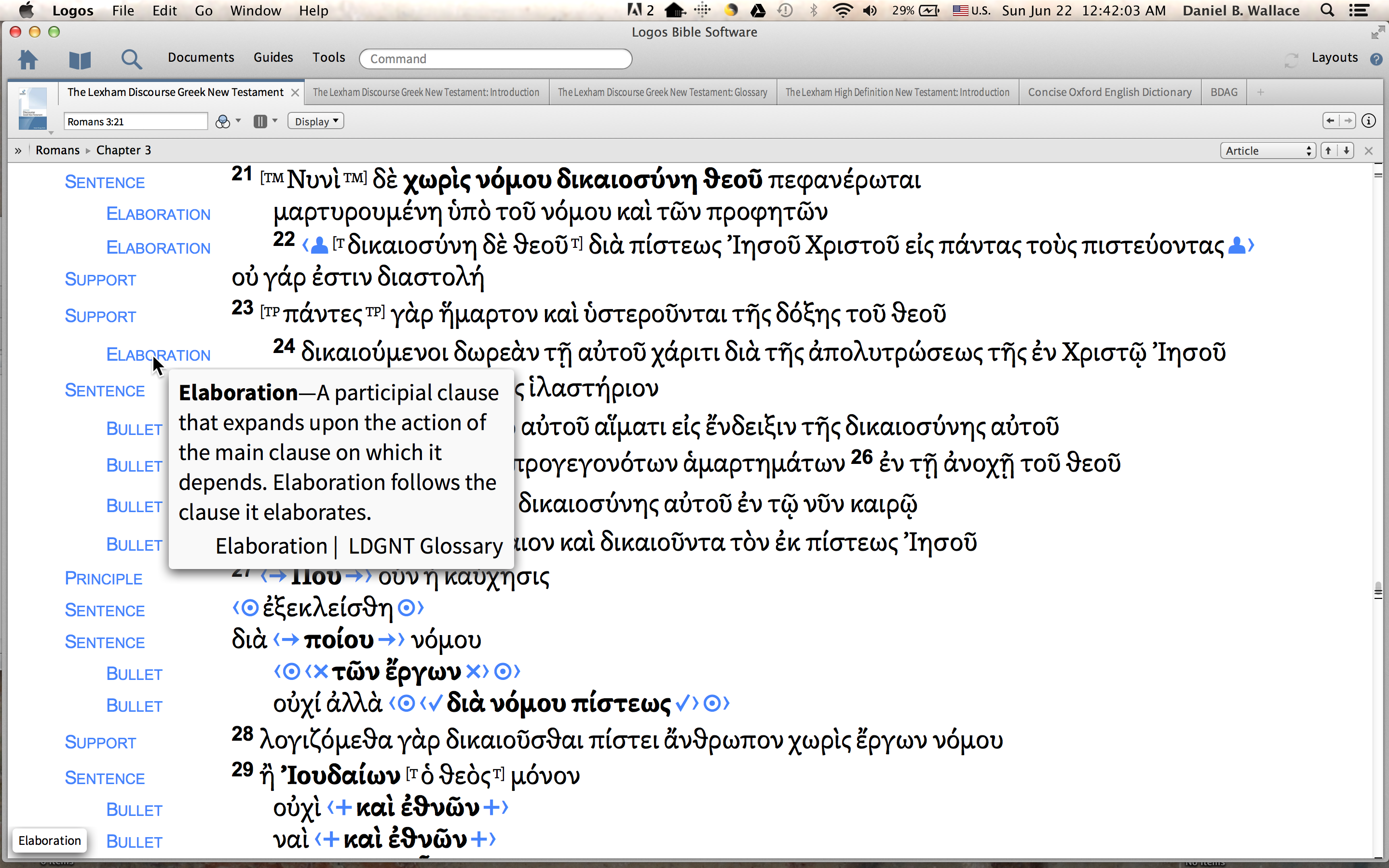
Rom 3.24—’elaboration’ explained
The problem with this explanation is that not everyone sees the participle as subordinate and thus fitting into ‘elaboration’ (most, in fact, take it as an indicative participle), although see J. Will Johnston, “Which ‘All’ Sinned? Rom 3:23–24 Reconsidered,” Novum Testamentum 52 (2010) 1–12.

Display feature with everything checked
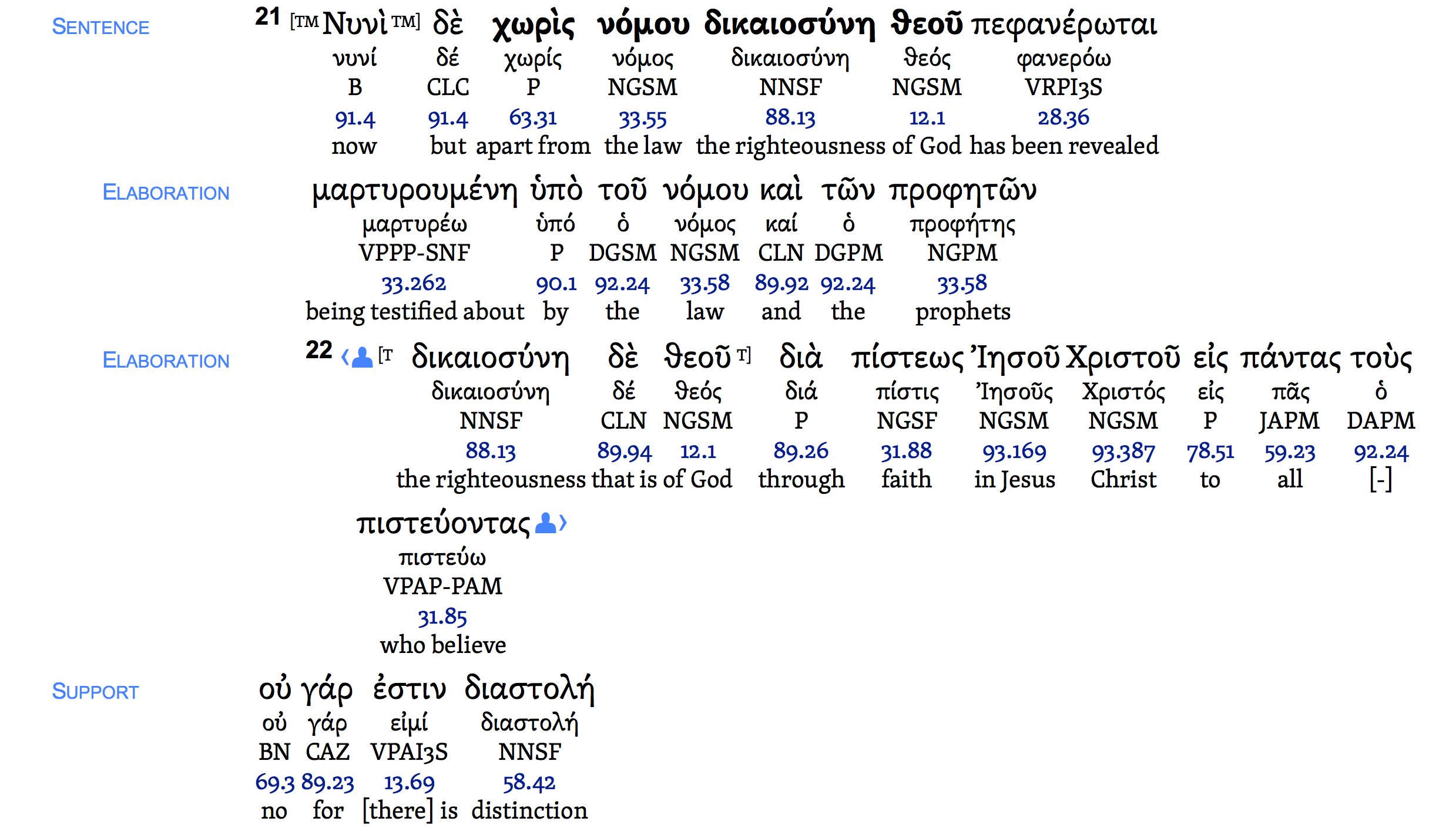
Rom 3.21–22 with maximum features displayed
A wealth of data is here—either visually or at a click of the mouse.
In short, the Lexham Discourse Greek New Testament is a tool whose time has come. Used in conjunction with traditional grammars, it can only strengthen one’s understanding of Hellenistic Greek and how the NT authors communicate meaning—every exegete’s dream!
It can be purchased here.
 Daniel B. Wallace