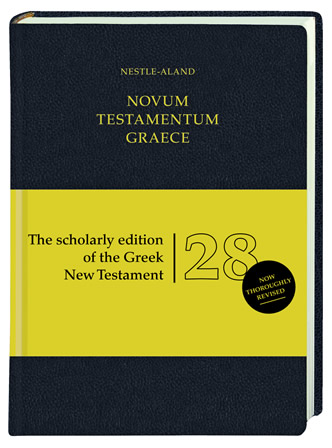
Nestle-Aland 28: The New Standard in Critical Texts of the Greek New Testament

Overview

At the annual Society of Biblical Literature conference held in Chicago last month, the latest edition of the Novum Testamentum Graece, or the Nestle-Aland Greek New Testament, was unveiled. This has been a long time coming—nineteen years to be exact. The Institut für neutestamentliche Textforschung (INTF) in Münster is behind this production, and deserves accolades for its fine accomplishment. This is the first new edition of the Nestle-Aland text since the death of Kurt Aland, the founder of the INTF.
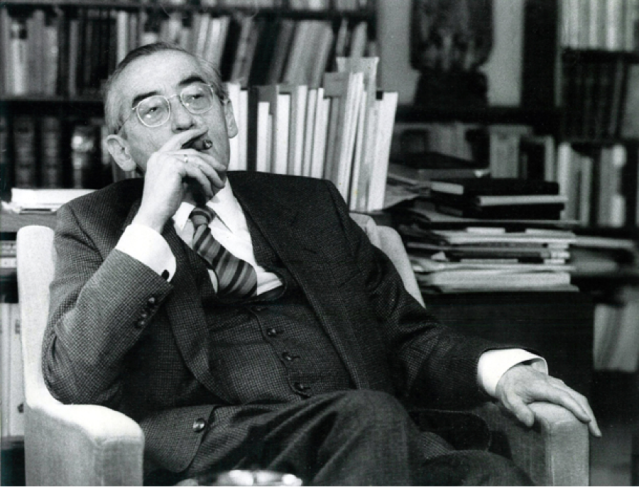
Kurt_Aland

Inexplicably, even though the new text was available at SBL—both as just the Greek text and in diglot with English translations—it could not be acquired through Amazon until later. I pre-ordered a couple copies last April; the diglot arrived in November but the Greek-only text will not be released until January!

Several gave presentations on the new Nestle-Aland text at SBL. Klaus Wachtel of INTF gave an overview of NA28. In his lecture, he noted, inter alia, the following:

  • The textual differences from the previous edition only occur in the Catholic Epistles. This is due to the fact that behind the scenes INTF has been doing exhaustive research on many variants in these letters and has produced the impressive Editio Critica Maior (ECM) series. These are the only books that have been thoroughly examined; hence, the changes to the text are only in these books. A total of 34 textual changes have been made.
  • In these letters, the siglum Byz is used instead of the gothic M (M).
  • As INTF worked through the Catholic letters, they came to see much greater value of the Byzantine manuscripts than they had previously. In Wachtel’s presentation, he noted that the NA27 displayed “prejudice against the Byzantine tradition” while the NA28 recognized the “reliability of the mainstream tradition.” This is a welcome change in perspective, made possible because of exhaustive collations.
  • For the entire New Testament, the apparatus functions now as “a gateway to the sources” instead of the more restricted purpose of the previous edition “as a repository of variants.”

The Introduction to the new work adds much more information. Among these consider the following:

  • “from now on, the Nestle-Aland will not appear only as a printed book, but also in digital form” (48*). This is more than what is already available in the digital copies of the NA27 that are part of the Accordance and Logos Bible software packages. For example, “Abbreviations, sigla and short Latin phrases in the apparatus are explained in pop-up windows. Above all, the digital apparatus becomes a portal opening up the sources of the tradition, as it provides links to full transcriptions and, as far as possible, to images of the manuscripts included” (48*).
  • Gone are the “consistently cited witnesses of the second order”—that is, those witnesses that comprised the gothic M (M) in NA27. Although this siglum is still used, its meaning has changed. Individual non-Byzantine witnesses that are part of the ‘majority text’ (a term that means more than just the Byzantine witnesses in NA27; it is unclear exactly what this siglum means in NA28) are now apparently cited explicitly, even if they agree with the Byzantine minuscules.
  • Conjectures are no longer to be found in the Nestle-Aland apparatus. There were nearly 120 conjectures listed in the previous edition. Nevertheless, at Acts 16.12 the editors still print as the text a reading that is not found in any Greek manuscripts (Φιλίππους, ἥτις ἐστὶν πρώτης μερίδος τῆς Μακεδονίας πόλις). Continue reading “Nestle-Aland 28: The New Standard in Critical Texts of the Greek New Testament”

The Five Countries Called Greece

I go to Greece every year, with several others from the Center for the Study of New Testament Manuscripts (www.csntm.org), to photograph biblical manuscripts. And every year, we ‘discover’ manuscripts too—that is, we inform the Institut für neutestamentliche Textforschung in Münster about New Testament manuscripts that they were unaware of, and give them the details so that they can give these manuscripts a new Gregory-Aland number.

We always spend some time in Athens, but also try to get to other places as well. In the process of canvassing the countryside, I have come to realize that Greece is five different countries, all connected by the same language, government, and the ubiquitous old men sipping their Greek καφές in outdoor cafés.

There is Athens, a typical big city with more graffiti per square kilometer than any other city in western Europe. Typical—except for the Parthenon, Areopagus, other archeological sites, and magnificent museums and libraries.

Then there is the Peloponnese—the lower half of Greece, which boasts Corinth, Olympia, Sparta, and many other historic and beautiful sites. The Mediterranean Sea outside of Corinth is as clear and blue as the Caribbean. I’ve been told that the Peloponnesians are not as friendly as the rest of the Greeks, but this tidbit came from someone far north of Athens. I’ve not experienced it for myself.

The small islands—including Patmos, Samos, Icaria, Andros, and nearly 3000 other islands—make up the third country. These are always enjoyable sites and usually out of the way places. Cruise ships port at Skala harbor in Patmos every day, with the eager travelers scurrying off the vessels to board big buses and go up the mountain to see the Monastery of St. John the Theologian and the Cave of the Apocalypse. These folks only stay for two or three hours before they are whisked away to another island, checking off their bucket list this island famous for its connection to the Bible; we usually stay for two or three weeks.

We don’t take a cruise ship to get there, but an overnight ferry. There are only 3000 residents on Patmos during the summer months; we know almost all of them. Only four are not friendly, two of whom are not Greeks (I’d tell you their nationality but they would find me out!). We’ve eaten at nearly every restaurant and traversed every dirt road. This is the “Holy Island of the Aegean” because this is where John penned the Apocalypse and therefore it is the only island in all of Greece that does not allow nude sunbathing. It may well be my favorite place in all of Greece–and certainly the one my wife approves me visiting!

The fourth country consists of big islands and famous islands—like Rhodes, Cos, Lesbos, Santorini, and Mikonos. Amazing sites, but very expensive. They know what they’ve got. I’ve never been to Santorini or Mikonos for the simple reason that they are not known to have biblical manuscripts.

Finally, there is the Greek countryside. Villages that have no names. Access lanes still not paved that lead to major highways. Mountain roads that are dotted with crosses where people have driven over the edge and lost their lives because guardrails are often non-existent in this country that is 80% mountainous. Pathways that drive the GPS crazy. And people so friendly they turn the American value-system on its head.

At first, I was taken aback by their friendliness. It seemed to be a used-car-salesman kind of friendliness. That was ten years ago. People that friendly in the States are likely to take you to the cleaners. But in Greece, money is not the driving principle, and genuine friendships are prized like fat bank accounts are in the U.S. Most rural Greeks are poor—dirt poor. Yet they share what they have with strangers and live to show hospitality to visitors. Some of the best lamb and pork chops anywhere on the planet. And a gaggle of friends we’ve made along the way. I truly love Greece and the Greek people. And I pray that this country with its rich heritage in politics, conquest, art, sports, medicine, and, of course, biblical manuscripts, will survive its current financial crisis.

In my next post I will tell about driving up to Meteora from Athens, and of a particularly interesting manuscript we examined in one of the monasteries of Meteora in 2011 and 2012. For now, I’ll simply close with this: If you ever get the opportunity to visit Greece, check out all five countries. Athens and Santorini are not the whole experience! And get to know the people. It just might change your value system.