Do Manuscripts of Q Still Exist?

A favorite argument against the existence of Q is simply that no manuscripts of Q have ever been discovered. No more than this bare assertion is usually made. But a little probing shows that this argument has some serious weaknesses to it. In particular, three come to mind: (1) If Matthew and Luke swallowed up Q in their writings, why would we expect to find any copies of Q? Or to put this another way, Luke says that he used more than one source, presumably more than one written source. If so, why haven’t we found it/them? The fact that we haven’t surely doesn’t mean that Luke was not shooting straight with us, does it? (2) Even the Gospel of Mark has few copies in the early centuries, yet it was endorsed as an official Gospel by Ireneaus. Yet this is a canonical Gospel, which apparently was regarded in some sense as authoritative before the end of the first century, or at the latest in the first decade or two of the second century, because of its association with Peter. Yet if there are only two copies of Mark in Greek before the fourth century still in existence (at least as far as what has been published to date), what chance do we have of finding a non-canonical gospel-source in the early centuries? And as the centuries roll on, the likelihood that such a document would continue to be copied becomes increasingly remote. (3) Apart from having the text of Q, as it has been reconstructed, what other criteria should scholars demand of such an alleged discovery? Do they expect the document to have a title such as “The Gospel according to Q”? That neologism won’t wash. Perhaps just such manuscripts have been discovered but were mislabeled. The burden of this short essay is to examine that possibility.

Eight papyri are known to exist that contain portions from only the Gospel of Luke. On the assumption that Luke is closer to the wording of Q than Matthew is (an assumption that all two-source theorists embrace, I believe), it is at least hypothetically possible that one or two of these papyri are actually manuscripts of Q rather than of Luke. A closer examination, however, severely limits this possibility. The eight papyri are:

P3 (VI/VII): L 7.36–45; 10.38–42

P4 (III): L 1.58–59; 1.62–2.1; 2.6–7; 3.8–4.2; 4.29–32, 34–35; 5.3–8; 5.30–6.16

P7 (III–IV?): L 4.1–3

P42 (VII/VIII): L 1.54–55; 2.29–32

P69 (III): L 22.41, 45–48, 58–61

P82 (IV/V): L 7.32–34, 37–38

P97 (VI/VII): L 14.7–14

P111 (III): L 17.11–13; 17.22–23

In order for these to be manuscripts of Q, we might expect the following: (1) an early date, probably no later than the fourth century; (2) exclusively double-tradition (with Matthew) material; (3) no original-hand markings that identify the text as from Luke (e.g., title, Eusebian canons); (4) the order of the material might be other than what we see in Luke or (a) at least each fragment involves only intra-pericope material rather than inter-pericope material, or (b) the inter-pericope fragments of a single manuscript do not have the same order as is found in Luke; (5) perhaps some slight differences between Luke and this papyrus, with this manuscript displaying a somewhat more primitive text.

In reality, almost none of these expectations is a requirement, though if all are present in a manuscript they increase the positive identification of that manuscript as from Q. The reasons these expectations are not ex hypothesi necessary are as follows:

(1) There is the possibility that Q was copied for centuries; we have some evidence of ‘The Gospel of the Hebrews’—a first-century gospel, most likely (it’s mentioned by Papias)—existing for centuries, judging by patristic comments (see James Edwards’ The Hebrew Gospel and the Development of the Synoptic Tradition [Grand Rapids, Eerdmans, 2009]). If that document can exist, why not Q?

(2) Q can conceivably be found only in Luke rather than in Luke and Matthew. That there are 235 verses found in both Matthew and Luke but not found in Mark gives a solid basis for the existence of Q, but it does not equally argue that Q is no more and no less than these 235 verses. Such a conclusion would, in fact, be bizarre. Analogously, if the only way we could tell if Mark existed was its use by Matthew and Luke in double-tradition material, we would have to say that Mark was about half as long as it really is! Further, we would expect there to be some overlap between Q and Mark, so it can also be found in triple tradition material (the ‘blessed overlap’).

(3) Original-hand markings that identify the papyrus as from Luke is the one piece of evidence that would exclude a particular manuscript. The reason is simple: the original scribe of such a manuscript would have copied out the whole of Luke rather than writing fragments. Of course, if the text is an amulet or some other snippet from the Gospels, the scribe may have claimed that such a text was from Luke mistakenly.

(4) We really have no idea what the order of pericopae in Q was—assuming that it was a single written document (an assumption that has not yet been satisfactorily demonstrated). Thus, if parts of two or more pericopae are found in sequence in a given papyrus, this does not necessarily rule out that the manuscript is a copy of Q. But if multiple fragments from one Luke papyrus seem to be rearranged from the order found in Luke, this could argue for such a document being a copy of Q.

(5) Textual differences, especially if the papyrus in question displayed a more primitive form of text than that found in Luke, would signal the possibility of the papyrus being a copy of Q. But if Luke did not alter the text of Q in a given pericope, then we would expect to see no differences, apart from the usual corruptions, between the established text of Luke and the text of the papyrus in question.

In light of all these points and counterpoints, we would nevertheless conclude that the surest way for scholars to detect a fragment from Q would be for the five guidelines to be in place. Thus, of the eight Lukan papyri listed above, do any meet most or all of these qualifications? The five guidelines will again be enumerated, but this time with the best candidates for each category.

(1) Date: five of the papyri are from the fourth century or earlier: P4, P7, P69, P82 (fourth or fifth), and P111. The rest of the criteria will be examined only for these candidates.

(2) and (4) Of the five earliest Luke papyri, P4 is not restricted to double-tradition material and it also has fragments that encompass more than one pericope (at one point it has text in sequence covering five pericopae in Luke); P69 involves more than one pericope and has parallels in both Matthew and Mark (thus, triple-tradition); P82 involves two pericopae, with the second being in the triple tradition; P111 has one single-tradition pericope followed by a triple-tradition pericope.

The best candidate is P7, which has only Luke 4.1–3, one of the double-tradition texts. Of course, with only three verses, to claim that we have found one of the copies of Q is far more weight than this slender evidence can bear—unless there were strong corroborative evidence.

(3) I have not yet examined P7 to see if there are telltale signs that the original scribe thought that he was copying Luke.

(5) According to the Nestle apparatus, there is nothing out of the ordinary in the text of P7 for Luke 4.1–3.

Altogether, the evidence thus far presented can hardly be said to build confidence that any missing Q fragments have actually been discovered. But at least, ex hypothesi, such a discovery has some reasonable expectations laid on it so that papyrus discoveries yet to come may be examined for whether they supply any evidence of being copies of Q. Still, I’m not holding my breath.

For further reading:

Kurt Aland, Synopsis Quattuor Evangeliorum, 15th edition (Deutsche Bibelgesellschaft, 2007)

Mark Goodacre, The Case Against Q: Studies in Markan Priority and the Synoptic Problem (T & T Clark, 2002)

John Kloppenborg, Q, the Earliest Gospel: An Introduction to the Original Stories and Sayings of Jesus (John Knox Westminster, 2008)

John Kloppenborg, et al., editors, The Critical Edition of Q (Fortress, 2000)

Robert Stein, Studying the Synoptic Gospels: Origin and Interpretation, 2nd edition (Baker, 2001)

Five More Myths about Bible Translations and the Transmission of the Text

There’s an old Italian proverb that warns translators about jumping in to the task: “Traduttori? Traditori!” Translation: “Translators? Traitors!” The English proverb, “Something’s always lost in the translation,” is clearly illustrated in this instance. In Italian the two words are virtually identical, both in spelling and pronunciation. They thus involve a play on words. But when translated into other languages, the word-play vanishes. The meaning, on one level, is the same, but on another level it is quite different. Precisely because it is no longer a word-play, the translation doesn’t linger in the mind as much as it does in Italian. There’s always something lost in translation. It’s like saying in French, “don’t eat the fish; it’s poison.” The word ‘fish’ in French is poisson, while the word ‘poison’ is, well, poison. There’s always something lost in translation.

But how much is lost? Here I want to explore five more myths about Bible translation.

Myth 1: The Bible has been translated so many times we can’t possibly get back to the original.

This myth involves a naïve understanding of what Bible translators actually did. It’s as if once they translated the text, they destroyed their exemplar! Sometimes folks think that translators who were following a tradition (such as the KJV and its descendants, the RV, ASV, RSV, NASB, NKJB, NRSV, and ESV) really did not translate at all but just tweaked the English. Or that somehow the manuscripts that the translators used are now lost entirely.

The reality is that we have almost no record of Christians destroying biblical manuscripts throughout the entire history of the Church. And those who translated in a tradition both examined the English and the original tongues. Decent scholars improved on the text as they compared notes and manuscripts. Finally, we still have almost all of the manuscripts that earlier English translators used. And we have many, many more as well. The KJV New Testament, for example, was essentially based on seven Greek manuscripts, dating no earlier than the eleventh century. Today we have about 5800 Greek manuscripts of the New Testament, including those that the KJV translators used. And they date as early as the second century. So, as time goes on, we are actually getting closer to the originals, not farther away.

Myth 2: Words in red indicate the exact words spoken by Jesus of Nazareth.

Scholars have for a long time recognized that the Gospel writers shape their narratives, including the sayings of Jesus. A comparison of the Synoptics reveals this on almost every page. Matthew quotes Jesus differently than Mark does who quotes Jesus differently than Luke does. And John’s Jesus speaks significantly differentyly than the Synoptic Jesus does. Just consider the key theme of Jesus’ ministry in the Synoptics: ‘the kingdom of God’ (or, in Matthew’s rendering, often ‘the kingdom of heaven’). Yet this phrase occurs only twice in John, being replaced usually by ‘eternal life.’ (“Kingdom of Continue reading “Five More Myths about Bible Translations and the Transmission of the Text”

Nestle-Aland 28: The New Standard in Critical Texts of the Greek New Testament

Overview

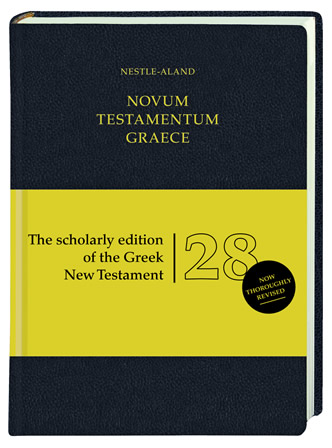
At the annual Society of Biblical Literature conference held in Chicago last month, the latest edition of the Novum Testamentum Graece, or the Nestle-Aland Greek New Testament, was unveiled. This has been a long time coming—nineteen years to be exact. The Institut für neutestamentliche Textforschung (INTF) in Münster is behind this production, and deserves accolades for its fine accomplishment. This is the first new edition of the Nestle-Aland text since the death of Kurt Aland, the founder of the INTF.

Kurt_Aland

Inexplicably, even though the new text was available at SBL—both as just the Greek text and in diglot with English translations—it could not be acquired through Amazon until later. I pre-ordered a couple copies last April; the diglot arrived in November but the Greek-only text will not be released until January!

Several gave presentations on the new Nestle-Aland text at SBL. Klaus Wachtel of INTF gave an overview of NA28. In his lecture, he noted, inter alia, the following:

  • The textual differences from the previous edition only occur in the Catholic Epistles. This is due to the fact that behind the scenes INTF has been doing exhaustive research on many variants in these letters and has produced the impressive Editio Critica Maior (ECM) series. These are the only books that have been thoroughly examined; hence, the changes to the text are only in these books. A total of 34 textual changes have been made.
  • In these letters, the siglum Byz is used instead of the gothic M (M).
  • As INTF worked through the Catholic letters, they came to see much greater value of the Byzantine manuscripts than they had previously. In Wachtel’s presentation, he noted that the NA27 displayed “prejudice against the Byzantine tradition” while the NA28 recognized the “reliability of the mainstream tradition.” This is a welcome change in perspective, made possible because of exhaustive collations.
  • For the entire New Testament, the apparatus functions now as “a gateway to the sources” instead of the more restricted purpose of the previous edition “as a repository of variants.”

The Introduction to the new work adds much more information. Among these consider the following:

  • “from now on, the Nestle-Aland will not appear only as a printed book, but also in digital form” (48*). This is more than what is already available in the digital copies of the NA27 that are part of the Accordance and Logos Bible software packages. For example, “Abbreviations, sigla and short Latin phrases in the apparatus are explained in pop-up windows. Above all, the digital apparatus becomes a portal opening up the sources of the tradition, as it provides links to full transcriptions and, as far as possible, to images of the manuscripts included” (48*).
  • Gone are the “consistently cited witnesses of the second order”—that is, those witnesses that comprised the gothic M (M) in NA27. Although this siglum is still used, its meaning has changed. Individual non-Byzantine witnesses that are part of the ‘majority text’ (a term that means more than just the Byzantine witnesses in NA27; it is unclear exactly what this siglum means in NA28) are now apparently cited explicitly, even if they agree with the Byzantine minuscules.
  • Conjectures are no longer to be found in the Nestle-Aland apparatus. There were nearly 120 conjectures listed in the previous edition. Nevertheless, at Acts 16.12 the editors still print as the text a reading that is not found in any Greek manuscripts (Φιλίππους, ἥτις ἐστὶν πρώτης μερίδος τῆς Μακεδονίας πόλις). Continue reading “Nestle-Aland 28: The New Standard in Critical Texts of the Greek New Testament”

New Early Fragment of Romans

At the Society of Biblical Literature’s annual conference in Chicago last week (17–20 Nov 2012), Grant Edwards and Nick Zola presented papers on a new papyrus fragment from Romans. They have dated it to the (early) third century, which makes this perhaps only the fifth manuscript of Romans prior to the fourth (though a couple of others are usually thought to also be from the third century). This manuscript is part of the Green Collection (inventory #425). It will be published in the first volume of a new series by the Dutch academic publishing house, E. J. Brill. The series, edited by Dirk Obbink and Jerry Pattengale, is called the Green Scholars Initiative: Papyrus Series. Volume one is edited by Jeff Fish of Baylor University.

The text of the fragment is from Rom 9.18–21 and small portions of Rom 10. Edwards presented information about the paleography and provenance of the fragment, while Zola presented his findings on the textual affinities of the papyrus.

The papyrus was written on a codex rather than a roll, as is customary for even the oldest Christian documents. What these two scholars could determine is that the original size of each leaf of this papyrus would have been a little larger than that of P66—18 cm x 16 cm for this fragment compared to 16.2 cm x 14.2 cm for P66.

The dating of the manuscript was done rather prudently by comparing it to fixed-date manuscripts. Paleographically, the fragment was found to be close to POxy 1016 (a mid-third century papyrus), POxy 2703 (late second/early third), and POxy 2341 (208 CE).

Regarding the specific text, among early papyri of the corpus Paulinum, only P46 covers the same passage. But because of the lacunose state of P46, sixteen letters of text that are missing from the Beatty papyrus are found in the Green papyrus. Zola selected four textual problems for our consideration (are these all or does the fragment read for others?). In all four, it agrees with other manuscripts, chiefly Alexandrian. The certain readings all agree with the text of NA28. In the gaps, reconstructions were necessary and there Green 425 agrees with the main Alexandrian witnesses where they are united, with a portion of them when they split.

In 9.19, it has μοι ουν, in agreement with the Alexandrians, instead of ουν μοι found in the Western and Byzantine witnesses. The second ουν of v. 19 is apparently omitted in this fragment, in agreement with א A 1739 Byz, against P46 B D F G. In 9.20 Green 425 apparently omitted μενουνγε, agreeing with P46 D F G. In 10.1 the fragment agrees with the Alexandrian and Western witnesses in reading αυτων instead of the Byzantine reading, του Ισραηλ.

Edwards and Zola are to be thanked for making a fine presentation on the data of this new find. In keeping with other early papyri, its readings are no surprise: largely Alexandrian, with some Western strains also seen.

As an addendum, you can see images of this fragment (upside down!) on CNN in an interview that Steve Green did regarding its discovery which was made earlier this year: http://edition.cnn.com/video/?/video/bestoftv/2012/01/18/nr-hobby-lobby-religious-artifacts.cnn


The Demise of Codex 1799

A graduate of Princeton University in the early nineteenth century, Robert Garrett, acquired a medieval copy of Paul’s letters, Hebrews, Acts, and the Catholic letters from Mt. Athos in 1830. His estate later donated this manuscript to Princeton University. The manuscript was produced in the twelfth or thirteenth century on parchment. It was meant as something of a pocket Bible, measuring only 13.9 x 10.3 centimeters. The leaves are very fine vellum, extraordinarily thin. Housed in the Special Collections room of the Princeton University’s Firestone Library with the shelf number Garrett 8, it had only briefly been mentioned in works dealing with New Testament manuscripts.

According to J. K. Elliott’s Bibliography of New Testament Manuscripts, 2nd edition (Cambridge, 2005), the latest published discussions of this manuscript was in Kenneth W. Clark’s Eight American Praxapostoloi in 1941.

Kurt Aland’s Kurzgefasste Liste des griechischen Handschriften der Neuen Testaments, 2nd edition (Berlin: Walter de Gruyter, 1994), the standard tool that indicates the location, contents, date, and other pertinent information of all known Greek New Testament manuscripts, put the location in parentheses and said that the manuscript was “verbrannt” or burnt. The Internet update to the Kurzgefasste Liste claims that the manuscript is now “zerstört”—destroyed. But just as when Mark Twain presumably proclaimed, after reading his obituary in a newspaper, “Reports of my demise have been greatly exaggerated,” so too the demise of codex 1799 is exaggerated. (Twain actually wrote, “This report of my death was an exaggeration.”)

I examined the manuscript on Thursday, 16 August 2012 for about an hour. It is true that the manuscript has been burned. It is also true that many of the leaves stick together, most likely from the heat melting the ink. But it is still completely intact. It needs to be restored, but it is not gone forever—not by a long shot. In fact, it is mentioned in some detail in Greek Manuscripts at Princeton: Sixth to Nineteenth Century, by Sofia Kotzabassi and Nancy Patterson Ševčenko, with the collaboration of Don Skemer (Princeton University Press, 2010). Mr. Skemer in fact wrote to me and said he had no idea why anyone would ever think the manuscript had been destroyed.

I am grateful to Mr. Skemer, the Curator of Manuscripts at the Firestone Library, and his assistant, Charles Greene, for granting us access to this and other manuscripts in the Special Collection. And I am thrilled that a presumably dead manuscript has come back to life!