Five More Myths about Bible Translations and the Transmission of the Text

There’s an old Italian proverb that warns translators about jumping in to the task: “Traduttori? Traditori!” Translation: “Translators? Traitors!” The English proverb, “Something’s always lost in the translation,” is clearly illustrated in this instance. In Italian the two words are virtually identical, both in spelling and pronunciation. They thus involve a play on words. But when translated into other languages, the word-play vanishes. The meaning, on one level, is the same, but on another level it is quite different. Precisely because it is no longer a word-play, the translation doesn’t linger in the mind as much as it does in Italian. There’s always something lost in translation. It’s like saying in French, “don’t eat the fish; it’s poison.” The word ‘fish’ in French is poisson, while the word ‘poison’ is, well, poison. There’s always something lost in translation.

But how much is lost? Here I want to explore five more myths about Bible translation.

Myth 1: The Bible has been translated so many times we can’t possibly get back to the original.

This myth involves a naïve understanding of what Bible translators actually did. It’s as if once they translated the text, they destroyed their exemplar! Sometimes folks think that translators who were following a tradition (such as the KJV and its descendants, the RV, ASV, RSV, NASB, NKJB, NRSV, and ESV) really did not translate at all but just tweaked the English. Or that somehow the manuscripts that the translators used are now lost entirely.

The reality is that we have almost no record of Christians destroying biblical manuscripts throughout the entire history of the Church. And those who translated in a tradition both examined the English and the original tongues. Decent scholars improved on the text as they compared notes and manuscripts. Finally, we still have almost all of the manuscripts that earlier English translators used. And we have many, many more as well. The KJV New Testament, for example, was essentially based on seven Greek manuscripts, dating no earlier than the eleventh century. Today we have about 5800 Greek manuscripts of the New Testament, including those that the KJV translators used. And they date as early as the second century. So, as time goes on, we are actually getting closer to the originals, not farther away.

Myth 2: Words in red indicate the exact words spoken by Jesus of Nazareth.

Scholars have for a long time recognized that the Gospel writers shape their narratives, including the sayings of Jesus. A comparison of the Synoptics reveals this on almost every page. Matthew quotes Jesus differently than Mark does who quotes Jesus differently than Luke does. And John’s Jesus speaks significantly differentyly than the Synoptic Jesus does. Just consider the key theme of Jesus’ ministry in the Synoptics: ‘the kingdom of God’ (or, in Matthew’s rendering, often ‘the kingdom of heaven’). Yet this phrase occurs only twice in John, being replaced usually by ‘eternal life.’ (“Kingdom of Continue reading “Five More Myths about Bible Translations and the Transmission of the Text”

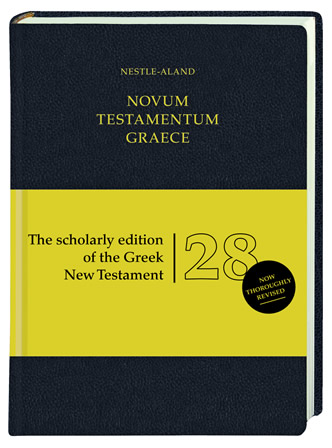
Nestle-Aland 28: The New Standard in Critical Texts of the Greek New Testament

Overview

At the annual Society of Biblical Literature conference held in Chicago last month, the latest edition of the Novum Testamentum Graece, or the Nestle-Aland Greek New Testament, was unveiled. This has been a long time coming—nineteen years to be exact. The Institut für neutestamentliche Textforschung (INTF) in Münster is behind this production, and deserves accolades for its fine accomplishment. This is the first new edition of the Nestle-Aland text since the death of Kurt Aland, the founder of the INTF.

Kurt_Aland

Inexplicably, even though the new text was available at SBL—both as just the Greek text and in diglot with English translations—it could not be acquired through Amazon until later. I pre-ordered a couple copies last April; the diglot arrived in November but the Greek-only text will not be released until January!

Several gave presentations on the new Nestle-Aland text at SBL. Klaus Wachtel of INTF gave an overview of NA28. In his lecture, he noted, inter alia, the following:

  • The textual differences from the previous edition only occur in the Catholic Epistles. This is due to the fact that behind the scenes INTF has been doing exhaustive research on many variants in these letters and has produced the impressive Editio Critica Maior (ECM) series. These are the only books that have been thoroughly examined; hence, the changes to the text are only in these books. A total of 34 textual changes have been made.
  • In these letters, the siglum Byz is used instead of the gothic M (M).
  • As INTF worked through the Catholic letters, they came to see much greater value of the Byzantine manuscripts than they had previously. In Wachtel’s presentation, he noted that the NA27 displayed “prejudice against the Byzantine tradition” while the NA28 recognized the “reliability of the mainstream tradition.” This is a welcome change in perspective, made possible because of exhaustive collations.
  • For the entire New Testament, the apparatus functions now as “a gateway to the sources” instead of the more restricted purpose of the previous edition “as a repository of variants.”

The Introduction to the new work adds much more information. Among these consider the following:

  • “from now on, the Nestle-Aland will not appear only as a printed book, but also in digital form” (48*). This is more than what is already available in the digital copies of the NA27 that are part of the Accordance and Logos Bible software packages. For example, “Abbreviations, sigla and short Latin phrases in the apparatus are explained in pop-up windows. Above all, the digital apparatus becomes a portal opening up the sources of the tradition, as it provides links to full transcriptions and, as far as possible, to images of the manuscripts included” (48*).
  • Gone are the “consistently cited witnesses of the second order”—that is, those witnesses that comprised the gothic M (M) in NA27. Although this siglum is still used, its meaning has changed. Individual non-Byzantine witnesses that are part of the ‘majority text’ (a term that means more than just the Byzantine witnesses in NA27; it is unclear exactly what this siglum means in NA28) are now apparently cited explicitly, even if they agree with the Byzantine minuscules.
  • Conjectures are no longer to be found in the Nestle-Aland apparatus. There were nearly 120 conjectures listed in the previous edition. Nevertheless, at Acts 16.12 the editors still print as the text a reading that is not found in any Greek manuscripts (Φιλίππους, ἥτις ἐστὶν πρώτης μερίδος τῆς Μακεδονίας πόλις). Continue reading “Nestle-Aland 28: The New Standard in Critical Texts of the Greek New Testament”

New Early Fragment of Romans

At the Society of Biblical Literature’s annual conference in Chicago last week (17–20 Nov 2012), Grant Edwards and Nick Zola presented papers on a new papyrus fragment from Romans. They have dated it to the (early) third century, which makes this perhaps only the fifth manuscript of Romans prior to the fourth (though a couple of others are usually thought to also be from the third century). This manuscript is part of the Green Collection (inventory #425). It will be published in the first volume of a new series by the Dutch academic publishing house, E. J. Brill. The series, edited by Dirk Obbink and Jerry Pattengale, is called the Green Scholars Initiative: Papyrus Series. Volume one is edited by Jeff Fish of Baylor University.

The text of the fragment is from Rom 9.18–21 and small portions of Rom 10. Edwards presented information about the paleography and provenance of the fragment, while Zola presented his findings on the textual affinities of the papyrus.

The papyrus was written on a codex rather than a roll, as is customary for even the oldest Christian documents. What these two scholars could determine is that the original size of each leaf of this papyrus would have been a little larger than that of P66—18 cm x 16 cm for this fragment compared to 16.2 cm x 14.2 cm for P66.

The dating of the manuscript was done rather prudently by comparing it to fixed-date manuscripts. Paleographically, the fragment was found to be close to POxy 1016 (a mid-third century papyrus), POxy 2703 (late second/early third), and POxy 2341 (208 CE).

Regarding the specific text, among early papyri of the corpus Paulinum, only P46 covers the same passage. But because of the lacunose state of P46, sixteen letters of text that are missing from the Beatty papyrus are found in the Green papyrus. Zola selected four textual problems for our consideration (are these all or does the fragment read for others?). In all four, it agrees with other manuscripts, chiefly Alexandrian. The certain readings all agree with the text of NA28. In the gaps, reconstructions were necessary and there Green 425 agrees with the main Alexandrian witnesses where they are united, with a portion of them when they split.

In 9.19, it has μοι ουν, in agreement with the Alexandrians, instead of ουν μοι found in the Western and Byzantine witnesses. The second ουν of v. 19 is apparently omitted in this fragment, in agreement with א A 1739 Byz, against P46 B D F G. In 9.20 Green 425 apparently omitted μενουνγε, agreeing with P46 D F G. In 10.1 the fragment agrees with the Alexandrian and Western witnesses in reading αυτων instead of the Byzantine reading, του Ισραηλ.

Edwards and Zola are to be thanked for making a fine presentation on the data of this new find. In keeping with other early papyri, its readings are no surprise: largely Alexandrian, with some Western strains also seen.

As an addendum, you can see images of this fragment (upside down!) on CNN in an interview that Steve Green did regarding its discovery which was made earlier this year: http://edition.cnn.com/video/?/video/bestoftv/2012/01/18/nr-hobby-lobby-religious-artifacts.cnn


The Demise of Codex 1799

A graduate of Princeton University in the early nineteenth century, Robert Garrett, acquired a medieval copy of Paul’s letters, Hebrews, Acts, and the Catholic letters from Mt. Athos in 1830. His estate later donated this manuscript to Princeton University. The manuscript was produced in the twelfth or thirteenth century on parchment. It was meant as something of a pocket Bible, measuring only 13.9 x 10.3 centimeters. The leaves are very fine vellum, extraordinarily thin. Housed in the Special Collections room of the Princeton University’s Firestone Library with the shelf number Garrett 8, it had only briefly been mentioned in works dealing with New Testament manuscripts.

According to J. K. Elliott’s Bibliography of New Testament Manuscripts, 2nd edition (Cambridge, 2005), the latest published discussions of this manuscript was in Kenneth W. Clark’s Eight American Praxapostoloi in 1941.

Kurt Aland’s Kurzgefasste Liste des griechischen Handschriften der Neuen Testaments, 2nd edition (Berlin: Walter de Gruyter, 1994), the standard tool that indicates the location, contents, date, and other pertinent information of all known Greek New Testament manuscripts, put the location in parentheses and said that the manuscript was “verbrannt” or burnt. The Internet update to the Kurzgefasste Liste claims that the manuscript is now “zerstört”—destroyed. But just as when Mark Twain presumably proclaimed, after reading his obituary in a newspaper, “Reports of my demise have been greatly exaggerated,” so too the demise of codex 1799 is exaggerated. (Twain actually wrote, “This report of my death was an exaggeration.”)

I examined the manuscript on Thursday, 16 August 2012 for about an hour. It is true that the manuscript has been burned. It is also true that many of the leaves stick together, most likely from the heat melting the ink. But it is still completely intact. It needs to be restored, but it is not gone forever—not by a long shot. In fact, it is mentioned in some detail in Greek Manuscripts at Princeton: Sixth to Nineteenth Century, by Sofia Kotzabassi and Nancy Patterson Ševčenko, with the collaboration of Don Skemer (Princeton University Press, 2010). Mr. Skemer in fact wrote to me and said he had no idea why anyone would ever think the manuscript had been destroyed.

I am grateful to Mr. Skemer, the Curator of Manuscripts at the Firestone Library, and his assistant, Charles Greene, for granting us access to this and other manuscripts in the Special Collection. And I am thrilled that a presumably dead manuscript has come back to life!

Lectionary 2258—-A Most Unusual Manuscript

Meteora is one of the most stunningly beautiful and other-worldly places on earth. Nearly a millennium ago, monks traveled throughout Greece in search of a place where they could get close to God and spend their days praying in undiluted solitude. Ultimately, six monasteries were established there, all but one perched atop stone pillars rising hundreds of feet above the plain below.

Metéora (Greek: Μετέωρα, ‘suspended rocks,’ ‘suspended in the air’ or ‘in the heavens above’) is one of the largest and most important complexes of Eastern Orthodox monasteries in Greece, second only to Mount Athos. The six monasteries are built on natural sandstone rock pillars, at the northwestern edge of the Plain of Thessaly near the Pineios River and Pindus Mountains, in central Greece. The nearest town is Kalambaka. The Metéora is included on the UNESCO World Heritage List.”

OK, I confess. The previous paragraph is lifted verbatim out of Wikipedia. But it’s a decent geographical description of the place. But nothing quite prepares you for Meteora’s rock formations that tower over the town below, the monasteries that melt into the sandstone pillars effortlessly, flush with the edges of the majestic columns, the eerie view of the ever-changing scenery as you drive on the perilous mountain switchbacks.

But I’m getting ahead of myself. It’s just a few hours to get to this unique place from Athens. You get on National Highway 1 and travel up the eastern coastline, stopping to see where King Leonidas and 300 Spartans held off the original Million-Man March at Thermopylae. Then, the road begins to wind inland until you arrive at Kalambaka, where you must find lodging if you are to visit the monasteries that tower above the town. Kalambaka strikes me as a town that grew up around the convents, bringing visitors to the brick and stone cloisters that were built and inhabited for seclusion. For centuries, the only way to the top was via a basket attached to a line that must have been cranked for hours before unloading its cargo of personnel and necessities. When asked how one would know when to change the cables, the priests drolly replied, “God lets us know.” Beginning in the early twentieth century, pathways from adjacent mountains were built for the many visitors. One too many ropes had snapped, leaving those in the baskets barely enough time to collect their thoughts and offer a final prayer to God.

In this place are scores of biblical manuscripts. As the only nunnery among the abbeys, St. Stephen (or Μονὴ Ἁγίου Στεφάνου) has a small collection of fascinating handwritten scriptures. But one in particular caught my attention—lectionary 2258.

The manuscript is a 230-leaf paper codex with parchment covers glued to cardboard. The parchment jackets have minuscule handwriting, with a majuscule text previously glued on top of them, both for the front and back covers. It is these covers that are of interest to us, since just the majuscule writing is the lectionary.

At first glance, the manuscript appeared to be a palimpsest—a text that was scraped over and reused in later centuries for writing. By the middle ages, the practice of reusing vellum was so ubiquitous that Charlemagne had ordered an empire-wide order to cease and desist. This codex looked to be one such palimpsest, produced by some recalcitrant scribe who scoffed at the Carolingian edict. By definition, the under-text of a palimpsest is older than the upper-text. And majuscule handwriting was exclusively used for the first eight hundred years AD in biblical manuscripts, with minuscule codices coming into play beginning in the ninth century. The minuscule text was obviously later than eleventh century, the date that scholars had determined for the majuscule lectionary. But the majuscule text looked to be on top of the minuscule text. How could this be? It was impossible, of course, but there it was, staring us in the face, mocking us with its mysteries.

We looked closer at the text, hoping against hope that it would somehow reveal its secrets to us by some mystical union between man and manuscript. We tried to read the text, and this proved impossible as well. Although it had Greek letters, they did not form Greek words.

Typing out each letter, there was nothing unusual about the Α, Δ, Η, Θ, Ι, Λ, Μ, Ν, Ο, Π, Τ, Υ, Φ, Χ, or Ω. But the other letters were different: they actually were written backwards. Because in majuscule script most of the letters look the same whether forward or backward, it took us some time to unlock the secret of this document. How did such a reverse image happen? That took some noodling, but the mirror image provided a sufficient clue. A majuscule text was apparently pressed against the minuscule text cover, got damp, and left a residue of letters. The majuscule leaf then vanished, but a shadow of its letters as a mirror image remained. For part of the majuscule handwriting, the outer layer of skin had completely peeled off, adhering to the paper below. We were reading the backside of the top layer of parchment, as though we were the parchment looking out as the scribe penned his words.

As we followed this hunch, a text emerged. On the recto, we could make out the following letters:

λεια (in the first column, about four lines down)

κνα και παντα οσα (second column, about half way down)
εν και αποδοθη (the underscoring = underdots, the traditional way to indicate uncertain letters)

The only text that fit this was Matthew 18.23, 25. The reconstructed lines thus read:
βασιλεια
τεκνα και παντα οσα
ειχεν και αποδοθη

The verso had the following (with brackets indicating our educated guess as to what was in the gaps):
ν]ηανι
σκος το]ν λο[γον
απη]λθεν λυπου
μενος ην γ]αρ εχ[ων
κτ]ηματα πολλα

This was Matthew 19.22, with the variant spelling νηανισκος for νεανισκος. This confirmed that we were dealing with a lectionary. Before the lines that contained βασιλεια on the recto, there must have been the previous lection as well. The lections thus detected were:
Unconfirmed since no letters could be detected
Lection κυριακη ια (12th week) for Sunday: Matt 18.23–35
Lection κυριακη ιβ (13th week), Sunday: Matt 19.16–26.

So, here was a manuscript that technically has no material on which it is written (except for the thin layer of skin for a small portion), because the material has vanished. All that is left is the shadow of letters, in mirror image, on another manuscript. I hesitate to call this unique; there may be other manuscripts that went through a similar process. But of the hundreds of biblical codices I have examined, this was a first for me.