Snoopy Seminar coming on Feb 22–23, 2013

On February 22 and 23, I will be conducting a “Snoopy Seminar” at the Hope Center in Plano, Texas (2001 W. Plano Parkway). This seminar is a fun, interactive, and challenging exercise about textual criticism. Enrollment is limited to 60 people. Intended audience: motivated laypeople, though we are not limiting it to them (seminary students may also come, for example).

Here’s the basic idea: On Friday night I will teach some of the basics of New Testament textual criticism. Then, I ask for 22 people to volunteer to be scribes. They go into a separate room and copy out a short text (in English), each with specific instructions designed to increase errors in the copying process and corrupt the text. The text goes through six generations of copying. Meanwhile, the rest of the people (the “textual critics”) are trying to reconstruct the genealogy of the transmission of the text (namely, which scribe copied from whom) and think through what kinds of skills and biases the scribes would have brought to their tasks.

On Saturday morning, we will all get together and the textual critics get busy working on the remaining manuscripts that the scribes produced. Unfortunately, most of the earliest manuscripts have strangely disappeared overnight (including all first-generation copies). The textual critics do the best they can with the manuscripts they’ve got to work with.

They record all the variants and there are always more variants than words in the original text. But unlike New Testament textual criticism, the variants are usually meaningful (the vast bulk of New Testament textual variants are not). The textual critics work in small groups for about three hours. They debate, wrestle with a variety of possibilities about corruption (and which manuscripts are more corrupt than others; all of them are corrupt to some degree), and try to determine the wording of the original “Gospel According to Snoopy.”

Then, all the groups get together and I function as secretary. I write down the major variants on a white board and list what the whole group thinks is the original wording in each place. When I get done posting the variants, the white board is a mess! No one is confident that they have reconstructed the text of Snoopy exactly. Then, a miracle happens: The original text of Snoopy is discovered and they can compare how they did. How close do they get? Well, I’ll leave that for the seminar. I’ve done this 70 times since 1979—in churches, seminaries, colleges, etc. It takes concentrated brain power, a desire to engage verbally with others, and a Sherlock Holmes mindset.

Once we’re finished with the exercise, I show the relevance to New Testament textual criticism. The Snoopy manuscripts and groups of manuscripts actually correspond to known New Testament manuscripts and groups. And this year, we are adding a packet of materials that has notes on some of the most important textual problems in the New Testament.

If you’re interested in joining us, please visit the website for more information or contact Dana Cooper at danacooper@csntm.org —and soon! It’s a great confidence-builder about scripture, suitable for high school students on up. We hope to do this a couple of times a year at the Hope Center, so if you miss out on this one there’s always another one coming down the pike.

Do Manuscripts of Q Still Exist?

A favorite argument against the existence of Q is simply that no manuscripts of Q have ever been discovered. No more than this bare assertion is usually made. But a little probing shows that this argument has some serious weaknesses to it. In particular, three come to mind: (1) If Matthew and Luke swallowed up Q in their writings, why would we expect to find any copies of Q? Or to put this another way, Luke says that he used more than one source, presumably more than one written source. If so, why haven’t we found it/them? The fact that we haven’t surely doesn’t mean that Luke was not shooting straight with us, does it? (2) Even the Gospel of Mark has few copies in the early centuries, yet it was endorsed as an official Gospel by Ireneaus. Yet this is a canonical Gospel, which apparently was regarded in some sense as authoritative before the end of the first century, or at the latest in the first decade or two of the second century, because of its association with Peter. Yet if there are only two copies of Mark in Greek before the fourth century still in existence (at least as far as what has been published to date), what chance do we have of finding a non-canonical gospel-source in the early centuries? And as the centuries roll on, the likelihood that such a document would continue to be copied becomes increasingly remote. (3) Apart from having the text of Q, as it has been reconstructed, what other criteria should scholars demand of such an alleged discovery? Do they expect the document to have a title such as “The Gospel according to Q”? That neologism won’t wash. Perhaps just such manuscripts have been discovered but were mislabeled. The burden of this short essay is to examine that possibility.

Eight papyri are known to exist that contain portions from only the Gospel of Luke. On the assumption that Luke is closer to the wording of Q than Matthew is (an assumption that all two-source theorists embrace, I believe), it is at least hypothetically possible that one or two of these papyri are actually manuscripts of Q rather than of Luke. A closer examination, however, severely limits this possibility. The eight papyri are:

P3 (VI/VII): L 7.36–45; 10.38–42

P4 (III): L 1.58–59; 1.62–2.1; 2.6–7; 3.8–4.2; 4.29–32, 34–35; 5.3–8; 5.30–6.16

P7 (III–IV?): L 4.1–3

P42 (VII/VIII): L 1.54–55; 2.29–32

P69 (III): L 22.41, 45–48, 58–61

P82 (IV/V): L 7.32–34, 37–38

P97 (VI/VII): L 14.7–14

P111 (III): L 17.11–13; 17.22–23

In order for these to be manuscripts of Q, we might expect the following: (1) an early date, probably no later than the fourth century; (2) exclusively double-tradition (with Matthew) material; (3) no original-hand markings that identify the text as from Luke (e.g., title, Eusebian canons); (4) the order of the material might be other than what we see in Luke or (a) at least each fragment involves only intra-pericope material rather than inter-pericope material, or (b) the inter-pericope fragments of a single manuscript do not have the same order as is found in Luke; (5) perhaps some slight differences between Luke and this papyrus, with this manuscript displaying a somewhat more primitive text.

In reality, almost none of these expectations is a requirement, though if all are present in a manuscript they increase the positive identification of that manuscript as from Q. The reasons these expectations are not ex hypothesi necessary are as follows:

(1) There is the possibility that Q was copied for centuries; we have some evidence of ‘The Gospel of the Hebrews’—a first-century gospel, most likely (it’s mentioned by Papias)—existing for centuries, judging by patristic comments (see James Edwards’ The Hebrew Gospel and the Development of the Synoptic Tradition [Grand Rapids, Eerdmans, 2009]). If that document can exist, why not Q?

(2) Q can conceivably be found only in Luke rather than in Luke and Matthew. That there are 235 verses found in both Matthew and Luke but not found in Mark gives a solid basis for the existence of Q, but it does not equally argue that Q is no more and no less than these 235 verses. Such a conclusion would, in fact, be bizarre. Analogously, if the only way we could tell if Mark existed was its use by Matthew and Luke in double-tradition material, we would have to say that Mark was about half as long as it really is! Further, we would expect there to be some overlap between Q and Mark, so it can also be found in triple tradition material (the ‘blessed overlap’).

(3) Original-hand markings that identify the papyrus as from Luke is the one piece of evidence that would exclude a particular manuscript. The reason is simple: the original scribe of such a manuscript would have copied out the whole of Luke rather than writing fragments. Of course, if the text is an amulet or some other snippet from the Gospels, the scribe may have claimed that such a text was from Luke mistakenly.

(4) We really have no idea what the order of pericopae in Q was—assuming that it was a single written document (an assumption that has not yet been satisfactorily demonstrated). Thus, if parts of two or more pericopae are found in sequence in a given papyrus, this does not necessarily rule out that the manuscript is a copy of Q. But if multiple fragments from one Luke papyrus seem to be rearranged from the order found in Luke, this could argue for such a document being a copy of Q.

(5) Textual differences, especially if the papyrus in question displayed a more primitive form of text than that found in Luke, would signal the possibility of the papyrus being a copy of Q. But if Luke did not alter the text of Q in a given pericope, then we would expect to see no differences, apart from the usual corruptions, between the established text of Luke and the text of the papyrus in question.

In light of all these points and counterpoints, we would nevertheless conclude that the surest way for scholars to detect a fragment from Q would be for the five guidelines to be in place. Thus, of the eight Lukan papyri listed above, do any meet most or all of these qualifications? The five guidelines will again be enumerated, but this time with the best candidates for each category.

(1) Date: five of the papyri are from the fourth century or earlier: P4, P7, P69, P82 (fourth or fifth), and P111. The rest of the criteria will be examined only for these candidates.

(2) and (4) Of the five earliest Luke papyri, P4 is not restricted to double-tradition material and it also has fragments that encompass more than one pericope (at one point it has text in sequence covering five pericopae in Luke); P69 involves more than one pericope and has parallels in both Matthew and Mark (thus, triple-tradition); P82 involves two pericopae, with the second being in the triple tradition; P111 has one single-tradition pericope followed by a triple-tradition pericope.

The best candidate is P7, which has only Luke 4.1–3, one of the double-tradition texts. Of course, with only three verses, to claim that we have found one of the copies of Q is far more weight than this slender evidence can bear—unless there were strong corroborative evidence.

(3) I have not yet examined P7 to see if there are telltale signs that the original scribe thought that he was copying Luke.

(5) According to the Nestle apparatus, there is nothing out of the ordinary in the text of P7 for Luke 4.1–3.

Altogether, the evidence thus far presented can hardly be said to build confidence that any missing Q fragments have actually been discovered. But at least, ex hypothesi, such a discovery has some reasonable expectations laid on it so that papyrus discoveries yet to come may be examined for whether they supply any evidence of being copies of Q. Still, I’m not holding my breath.

For further reading:

Kurt Aland, Synopsis Quattuor Evangeliorum, 15th edition (Deutsche Bibelgesellschaft, 2007)

Mark Goodacre, The Case Against Q: Studies in Markan Priority and the Synoptic Problem (T & T Clark, 2002)

John Kloppenborg, Q, the Earliest Gospel: An Introduction to the Original Stories and Sayings of Jesus (John Knox Westminster, 2008)

John Kloppenborg, et al., editors, The Critical Edition of Q (Fortress, 2000)

Robert Stein, Studying the Synoptic Gospels: Origin and Interpretation, 2nd edition (Baker, 2001)

Paul and Justification by Faith: The Real Jewish Evidence

The New Perspective on Paul (NPP) has argued that Paul didn’t really disagree with Judaism in terms of what it meant to be justified by God, but rather disagreed on whether Gentiles were included in that justification. NPPers have charged the ‘old perspective’ folks (viz., the Reformers) with misreading the Judaism of Paul’s day.

At the Evangelical Theological Society meeting in Milwaukee last November, I heard a very stimulating paper by Preston Sprinkle (a recent PhD grad from Aberdeen) contesting this view. Entitled, “Way Outside the Box: Why Paul’s Doctrine of Justification Was Risky, Offensive, and Unparalleled in Early Judaism,” Sprinkle argued, like his title suggests, that “Paul’s assertion that ‘God justifies the wicked’ would have been seen as risky, offensive, and is actually unparalleled in the world of early Judaism—yes, even among the Dead Sea Scrolls.” What a bold statement! He backs it up with some impressive evidence, too.

The paper that Sprinkle read is part of his forthcoming book, Paul and Judaism Revisited: A Study in Divine and Human Agency (Downers Grove, IL: IVP Academic, 2013).

Among his many points, Sprinkle notes that in the OT God did not justify wicked people, citing, inter alia, Exod 23.7 and Isa 5.23. In my class on the exegesis of Romans, which I have taught at Dallas Seminary for the past seven years, I have argued that these two texts are key to Paul’s thinking and that the Jews of his day would have realized this. Exodus 23.7 clearly involves legal language. It is this language which lies behind Paul’s points in Rom 3.23–24 and 4.4–5. In v. 7 we see δικαιόω used with ἀσεβής: ‘you shall not justify the ungodly for a bribe’ (οὐ δικαιώσεις τὸν ἀσεβῆ ἕνεκεν δώρων). This can only mean ‘you shall not declare innocent the ungodly for a bribe.’ Three things are significant here: (1) δικαιόω means, in this legal context, ‘declare righteous/innocent’; it does not mean ‘make righteous.’ (2) The person who might be declared innocent is in fact guilty (ἀσεβῆ), precisely the situation we have in Rom 3:23–24. (3) The word for bribe is δῶρον, a cognate of δωρεάν found in Rom 3:24. It would of course not do for Paul to say that God declares sinners righteous ‘for a bribe,’ so an appropriate substitute is needed—one that is a cognate of δῶρον, but does not use ἕνεκεν or imply anything except that God acts freely when he justifies sinners. δωρεάν is the accusative singular of δωρεά; as such, it is adverbial (always so in the NT) and means ‘freely.’ It is not insignificant that we again see in the LXX of Isa 5.23 the collocation of δικαιόω with ἀσεβής and δῶρον. And again, we see that δικαιόω must almost surely mean ‘declare innocent’ since the pronouncement is made on the ungodly who do not deserve it.

Sprinkle does not develop the points of contact between these two OT passages and Romans, but he does bring in other significant texts from Second Temple Judaism to show that the OT view has continuity into the time of Paul. In particular, he interacts with the Dead Sea Scrolls. Among the texts he discusses are CD 1.18–21; 4.6–7 (the Damascus Document), 4QMMT 26–32 (the Halakhic Letter), and 1QS 10–11 (Community Rule). It is this latter passage that is sometimes seen as in line with Paul’s view of justification. Sprinkle gives a penetrating analysis of the text, noting major differences that have been overlooked. In particular, Paul focuses on initial justification while 1QS focuses on final justification. It is a point not to be missed. Sprinkle began the section on 1QS by asking, “does Qumran anywhere affirm that God’s initial declaration of righteousness is unilateral—based on no measure of human goodness, obedience, or godly potential?” He answers with a resounding no.

In the conclusion to Sprinkle’s paper he states plainly: “The assertion that ‘Paul’s doctrine has exactly the same shape as that of MMT’ or other documents from Qumran, as N.T. Wright thinks, simply cannot be sustained.”

It will be interesting to see the responses to Sprinkle’s forthcoming book. The debate will surely continue for some time. Meanwhile, N. T. Wright is busy producing yet another work on Paul’s understanding of justification (Paul and the Faithfulness of God). Whether evangelicals need to jettison the old perspective on Paul in toto, as if the Reformation got it all wrong as Wright seems to affirm, is still an open question for many. But Sprinkle’s treatment of the Jewish materials will surely have to be wrestled with. Perhaps Luther and the Reformers got it right after all.

Five More Myths about Bible Translations and the Transmission of the Text

There’s an old Italian proverb that warns translators about jumping in to the task: “Traduttori? Traditori!” Translation: “Translators? Traitors!” The English proverb, “Something’s always lost in the translation,” is clearly illustrated in this instance. In Italian the two words are virtually identical, both in spelling and pronunciation. They thus involve a play on words. But when translated into other languages, the word-play vanishes. The meaning, on one level, is the same, but on another level it is quite different. Precisely because it is no longer a word-play, the translation doesn’t linger in the mind as much as it does in Italian. There’s always something lost in translation. It’s like saying in French, “don’t eat the fish; it’s poison.” The word ‘fish’ in French is poisson, while the word ‘poison’ is, well, poison. There’s always something lost in translation.

But how much is lost? Here I want to explore five more myths about Bible translation.

Myth 1: The Bible has been translated so many times we can’t possibly get back to the original.

This myth involves a naïve understanding of what Bible translators actually did. It’s as if once they translated the text, they destroyed their exemplar! Sometimes folks think that translators who were following a tradition (such as the KJV and its descendants, the RV, ASV, RSV, NASB, NKJB, NRSV, and ESV) really did not translate at all but just tweaked the English. Or that somehow the manuscripts that the translators used are now lost entirely.

The reality is that we have almost no record of Christians destroying biblical manuscripts throughout the entire history of the Church. And those who translated in a tradition both examined the English and the original tongues. Decent scholars improved on the text as they compared notes and manuscripts. Finally, we still have almost all of the manuscripts that earlier English translators used. And we have many, many more as well. The KJV New Testament, for example, was essentially based on seven Greek manuscripts, dating no earlier than the eleventh century. Today we have about 5800 Greek manuscripts of the New Testament, including those that the KJV translators used. And they date as early as the second century. So, as time goes on, we are actually getting closer to the originals, not farther away.

Myth 2: Words in red indicate the exact words spoken by Jesus of Nazareth.

Scholars have for a long time recognized that the Gospel writers shape their narratives, including the sayings of Jesus. A comparison of the Synoptics reveals this on almost every page. Matthew quotes Jesus differently than Mark does who quotes Jesus differently than Luke does. And John’s Jesus speaks significantly differentyly than the Synoptic Jesus does. Just consider the key theme of Jesus’ ministry in the Synoptics: ‘the kingdom of God’ (or, in Matthew’s rendering, often ‘the kingdom of heaven’). Yet this phrase occurs only twice in John, being replaced usually by ‘eternal life.’ (“Kingdom of Continue reading “Five More Myths about Bible Translations and the Transmission of the Text”

Nestle-Aland 28: The New Standard in Critical Texts of the Greek New Testament

Overview

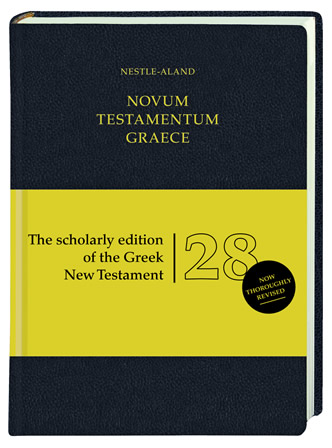
At the annual Society of Biblical Literature conference held in Chicago last month, the latest edition of the Novum Testamentum Graece, or the Nestle-Aland Greek New Testament, was unveiled. This has been a long time coming—nineteen years to be exact. The Institut für neutestamentliche Textforschung (INTF) in Münster is behind this production, and deserves accolades for its fine accomplishment. This is the first new edition of the Nestle-Aland text since the death of Kurt Aland, the founder of the INTF.

Kurt_Aland

Inexplicably, even though the new text was available at SBL—both as just the Greek text and in diglot with English translations—it could not be acquired through Amazon until later. I pre-ordered a couple copies last April; the diglot arrived in November but the Greek-only text will not be released until January!

Several gave presentations on the new Nestle-Aland text at SBL. Klaus Wachtel of INTF gave an overview of NA28. In his lecture, he noted, inter alia, the following:

  • The textual differences from the previous edition only occur in the Catholic Epistles. This is due to the fact that behind the scenes INTF has been doing exhaustive research on many variants in these letters and has produced the impressive Editio Critica Maior (ECM) series. These are the only books that have been thoroughly examined; hence, the changes to the text are only in these books. A total of 34 textual changes have been made.
  • In these letters, the siglum Byz is used instead of the gothic M (M).
  • As INTF worked through the Catholic letters, they came to see much greater value of the Byzantine manuscripts than they had previously. In Wachtel’s presentation, he noted that the NA27 displayed “prejudice against the Byzantine tradition” while the NA28 recognized the “reliability of the mainstream tradition.” This is a welcome change in perspective, made possible because of exhaustive collations.
  • For the entire New Testament, the apparatus functions now as “a gateway to the sources” instead of the more restricted purpose of the previous edition “as a repository of variants.”

The Introduction to the new work adds much more information. Among these consider the following:

  • “from now on, the Nestle-Aland will not appear only as a printed book, but also in digital form” (48*). This is more than what is already available in the digital copies of the NA27 that are part of the Accordance and Logos Bible software packages. For example, “Abbreviations, sigla and short Latin phrases in the apparatus are explained in pop-up windows. Above all, the digital apparatus becomes a portal opening up the sources of the tradition, as it provides links to full transcriptions and, as far as possible, to images of the manuscripts included” (48*).
  • Gone are the “consistently cited witnesses of the second order”—that is, those witnesses that comprised the gothic M (M) in NA27. Although this siglum is still used, its meaning has changed. Individual non-Byzantine witnesses that are part of the ‘majority text’ (a term that means more than just the Byzantine witnesses in NA27; it is unclear exactly what this siglum means in NA28) are now apparently cited explicitly, even if they agree with the Byzantine minuscules.
  • Conjectures are no longer to be found in the Nestle-Aland apparatus. There were nearly 120 conjectures listed in the previous edition. Nevertheless, at Acts 16.12 the editors still print as the text a reading that is not found in any Greek manuscripts (Φιλίππους, ἥτις ἐστὶν πρώτης μερίδος τῆς Μακεδονίας πόλις). Continue reading “Nestle-Aland 28: The New Standard in Critical Texts of the Greek New Testament”