Reality Check: The “Jesus’ Wife” Coptic Fragment

21 September 2012

There has been an unbelievable torrent of hoopla over a newly discovered—or rather, recently announced—Coptic fragment that speaks of Jesus as being married. The news of this small, business-card-sized fragment has gone mainstream, so much so that even David Letterman got into the act. On Thursday evening (20 September), just a couple of days after the story broke in the New York Times, he had a telephone interview with the most important guest he’s ever had: Jesus Christ. This ‘Jesus’ was married and his wife was nagging him in the background. Anything for a laugh, it seems.

But when the circus leaves town, what have we got? Below are some facts, some probabilities, and some possibilities.

The Facts:
1. Professor Karen King of Harvard Divinity School presented a paper at the International Association of Coptic Studies in Rome on Tuesday, September 18, making public a fragment of papyrus that explicitly claimed that Jesus had a wife. She gained access to this fragment via an anonymous owner who has permitted her to publish the text.
2. The fragment is written in Sahidic Coptic, an ancient language that has roots in the third century CE. Sahidic is the oldest dialect of the Coptic language.
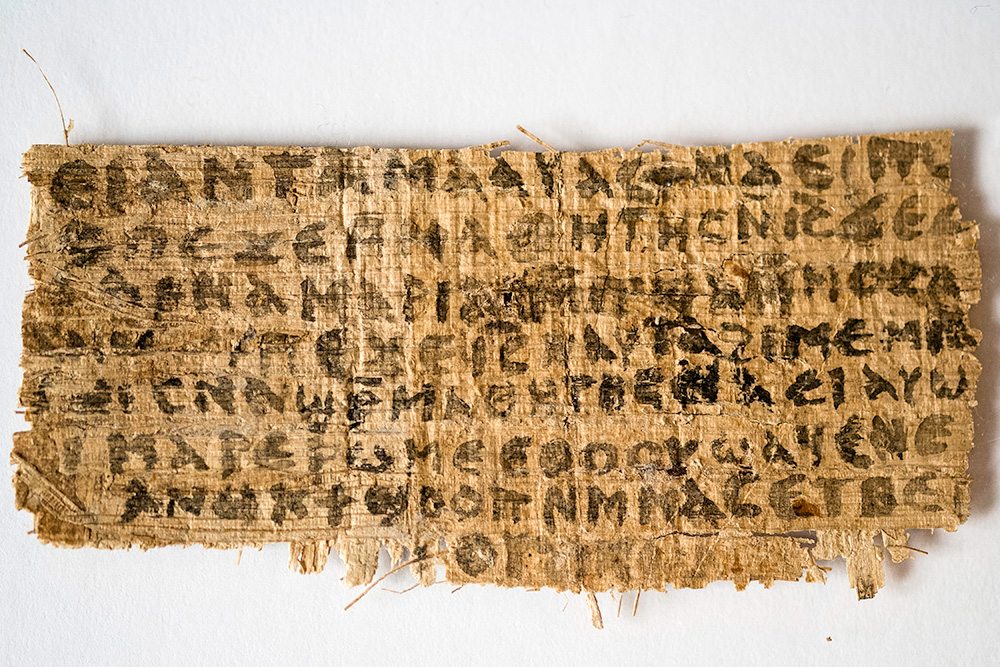
3. Papyrus was used as a medium for writing until the seventh century CE, so if genuine, this fragment must be dated between the third and seventh century CE.

4. It specifically mentions ‘Jesus’ by name twice, and does so in a way that shows that it is Jesus of Nazareth who is in view. This is evident by the fact that the name ‘Jesus’ is written as a nomen sacrum—or sacred name—in the manner of all Greek New Testament manuscripts, as an abbreviation. On the second line on the right and the fourth line down, in the middle of the line, we see what appear to be ‘IC’ in capital letters. These are the letters iota and sigma. There is a line above the letters, indicating a sacred name. This supralinear line indicates that the reader should not interpret this as a word but rather as an abbreviation. This was done for about 15 different words in NT manuscripts, with ‘Jesus’ being one of the earliest words so abbreviated.
5. The fragment is a fairly clean rectangle, with text missing on all four sides. The top of the fragment looks especially clean cut, being almost a straight line. This is rather atypical for ancient papyri and may play a role in how we should view it.
6. Jesus definitely says ‘my wife’ in the fragment. He also says “My mother gave life to me” and “she will be able to be my disciple.” The antecedent of “she” is not clear, but presumably it’s his wife.
7. Although Professor King has dubbed the fragment, The Gospel of Jesus’ Wife, this is intentionally provocative. There is simply not enough material here (eight lines on the recto, a few words visible on the verso) to call it a gospel at all, let alone the gospel of Jesus’ wife! It would be more accurate to call it The Fragment about Jesus’ Relations (so the anonymous comment Posted at the Tyndale House [Cambridge] website, on Wednesday, 19 September 2012), since there is no evidence that it is a gospel and at least two family members are mentioned (Jesus’ wife and Jesus’ mother).
8. The hand is neither literary (done by a professional scribe), nor even documentary. It doesn’t even look like it was penned with a stylus because the writing is so blunt. Rather, it looks like it was brushed on. Parallels to this are not easily forthcoming in Coptic writings of any period.
9. Does this fragment prove that Jesus was married? The answer is an emphatic no. At most, it can only tell us what one group of ‘Christians’ in the middle of the second century thought. But it says nothing about true history, about Jesus of Nazareth.
10. The fragment has similarities with the Gospel of Thomas, which most scholars date to the middle of the second century. Saying 114 is especially similar, as is Saying 101. Saying 101: “My true mother gave me life”; fragment, recto, line 1: “my mother gave me life.” Saying 114: “Simon Peter said to them, ‘Let Mary go out from among us, because women are not worthy of the Life”; fragment, recto, line 3: “Mary is worthy of it.” But what must be kept in mind is that Thomas 114 has Jesus continue: “See, I shall lead her, so that I will make her male, that she too might become a living spirit, resembling you males.” Whatever this means, it is unlikely to be an endorsement of marriage or even of women as women. Gospel of Thomas Saying 114 is, in fact, a politically incorrect statement that none should embrace today as representative of the true Christian faith.
11. The provenance, history, and ownership of the fragment are unknown. This creates a good deal of suspicion on the part of the scholarly community as to the fragment’s authenticity.
12. Here’s what the text says (King’s translation, with lacuna in brackets]):
Recto:
1 ] “not [to] me. My mother gave to me li[fe…”
2 ] The disciples said to Jesus, “[
3 ] deny. Mary is worthy of it[
4 ]……” Jesus said to them, “My wife . .[
5 ]… she will be able to be my disciple . . [
6 ] Let wicked people swell up … [
7] As for me, I dwell with her in order to . [
8] an image [”

Verso:
1 ] “my moth[er
2 ] three [
3 ] … [
4 ] forth which … [”
5 ] (illegible)

13. Although Mary (Magdalene) is mentioned in line 3 and Jesus speaks of ‘my wife’ in line 4, because of the fragmented nature of the MS it cannot be positively determined that Jesus is saying that Mary was his wife. This is an inference and a likely one, but without proof. The proof is in the portions of text that have either not been preserved or, more likely, have been cut out by a modern dealer. Why they were cut out must remain speculative (see below).

The Likelihoods:
1. The fragment’s four edges suggest that it was cut this way in modern times, probably by the dealer of the fragment in order to get more money out of several fragments so cut. This is the conclusion that Roger Bagnall of New York University came to. But it raises the question: Was this fragment cut because of the rest of the text that may have given a context in which the controversial phrase spoke of Jesus’ wife as other than a literal woman? Dirk Jongkind of Cambridge University used this analogy as a possibility: “We all have our favourite examples of the enticing brochures advertising our perfect holiday homes, which fortuitously manage to miss the oil refinery on the horizon, the overhead power lines, or the motorway at the back of the property. Here we have a fragment which has been deliberately altered, ‘most likely’ by a modern dealer seeking to maximize profit, who gets rid of ‘something.’ And this ‘something’ might well be in the same league as the oil refinery—it might be a spoiler that affected the value of this fragment negatively. The fragment may have been torn in the shape it is now in order to coax the reader into a certain interpretation” (Posted at the evangelical textual criticism website on Thursday, 20 September 2012).
2. The date assigned to it—fourth century—is largely an educated guess. Coptic manuscripts are notoriously difficult to date. Roger Bagnall of New York University and AnneMarie Luijendijk (pronounced ‘Lion Dike’) of Princeton University have argued for its authenticity and date. Scott Carroll of Oxford University dates it to the first half of the fifth century—if it’s genuine at all. There has been talk about using Carbon-14 to date the fragment more accurately, but since this would destroy some of the text it has been discouraged.

However, there is a relatively new method for dating manuscripts that is non-destructive. I did not see any discussion of this in the reports. Developed by Dr. Marvin Rowe of Texas A & M University and his doctoral assistant, Professor Karen Steelman, the method uses a plasma chamber that does not damage the artifact. (See Marvin W. Rowe and Karen L. Steelman, “Non-destructive 14C Dating: Plasma-Chemistry and Supercritical Fluid Extraction,” March 2010, ACS National Meeting 2010.) So it would indeed be possible to get a firm date on this fragment without destroying any text. It would be interesting to see if Professor King and the anonymous owner would permit this method for getting a better fix on the date and especially to dispel any suggestions of its inauthenticity.
3. Karen King has said that although the fragment is from the fourth century, the text is most likely from the middle of the second century, on the basis of similar ideas floating around in Gnostic and other texts. But this is difficult to assess, especially since almost no context is given for Jesus’ words, and nothing is known about the fragment’s provenance or what other manuscripts were found with it.

The Possibilities:
1. This manuscript is a fake. Dr. Christian Askeland, in attendance at the International Association of Coptic Studies conference in Rome, noted that about two thirds of those in attendance were very skeptical of its authenticity, while one third were “essentially convinced that the fragment is a fake.” Askeland said he did not meet anyone at the conference who thought it was authentic (posted at the evangelical textual criticism website on Wednesday, 19 September 2012). This presumably does not include Professor King. A number of noted coptologists have pronounced it a fake or have expressed strong reservations, including Alin Suciu of the University of Hamburg, Stephen Emmel of the University of Münster, Wolf-Peter Funk of l’Université Laval in Quebec, Hany Sadak the director general of the Coptic Museum in Cairo, Scott Carroll, Senior Scholar at the Oxford Manuscript Research Group, and David Gill of the University of Suffolk.
2. If genuine, the text is either (a) not Gnostic (since it contradicts the basic Gnostic view of the material world); (b) Gnostic though with an interpretation of marriage as other than the physical bond between a man and a woman (in the Gospel of Philip “the relationship between Jesus and Mary [Magdalene] is an allegory of the soul’s meeting with God in the bridal chamber, i.e. salvation” ; similarly, the Gospel of Mary [Simon Gathercole of Cambridge University, interviewed on the Tyndale House [Cambridge] website, on Wednesday, 19 September 2012]); (c) orthodox but metaphorically referring to the church as the wife of Jesus (a view already attested in the New Testament—implicit in Eph 5.23–27 and explicit in Rev 19.7); (d) a derivative Christian group that gave some push-back against the growing asceticism of the orthodox in the late second century, when marriage was somewhat frowned upon; or (e) parabolic or metaphorical with some other referent in mind.
3. Even Professor King did not suggest that this fragment means that Jesus had a wife (and she is not known for her conservative views!): “its possible date of composition in the second half of the second century argues against its value as evidence for the life of the historical Jesus.” If it goes back to a second-century tradition, we must keep in mind that there is a world of difference between first-century, apostolic Christianity and the various spin-off groups that rose after that early period.

New Coptic Fragment Says Jesus was Married

Reported by the New York Times, Professor Karen King of Harvard University has unveiled a fourth-century Sahidic Coptic fragment in which Jesus speaks of “my wife”: http://www.nytimes.com/2012/09/19/us/historian-says-piece-of-papyrus-refers-to-jesus-wife.html?_r=2. Let the debates begin!


Is Erasmian Pronunciation Ugly?

I recently wrote an essay in partial defense of Erasmian pronunciation that will be published in a book (no title yet) which offers essays in defense of different phonological systems for Koine Greek. All the papers were originally read at the annual Society of Biblical Literature conference held in San Francisco in November 2011. In my paper I laid out four basic arguments: historical, pragmatic, philological, and aesthetic. Yes, aesthetic. But rather than offer an argument at SBL, I played a tune which I am making available here. More on that in a moment.

I noted in my presentation that whenever I travel to Greece (which I do every year to photograph New Testament manuscripts with CSNTM) I leave Erasmus behind. I drop him like a bad habit once I board the plane and don’t renew my acquaintance with the Dutch humanist until I return to the States.

Regarding the aesthetic argument, Erasmian pronunciation is often considered cumbersome, unnatural, stilted, and ugly. The implication sometimes is that it must not have been the way Greek ever sounded; it is too harsh on the ears for that. Perhaps images of Jim Caviezel torturing our auditory senses with unnatural Aramaic in The Passion of the Christ come to mind. Or any scholar’s attempt to read Coptic gracefully! This argument fails to recognize that even though, to some degree, beauty may be in the ear of the listener, some languages actually do sound harsh. In order to maintain political correctness, I will not mention any, and simply let your own unbridled imagination run where it wishes. I do not think, however, that Erasmian Greek is among them. To be sure, our execution of the language may falter, but that does not mean that the sound of the language is ugly.

Along these lines, Friedrich Blass long ago offered this insightful comment:

“I am perfectly convinced, that, if an ancient Athenian were to rise from his grave and hear one of us speak Greek, on the basis of the best scientific enquiry and with the most delicate and practiced organs, he would think the pronunciation horribly barbarous.”

Blass went on to say, “But if he heard a modern Greek, he would not indeed be so loud in his censure, simply because he [would have] failed to observe that this is supposed to be his own language.”

Blass’s modesty aside, not everyone who enunciates Erasmian Greek butchers the language. For a demonstration of this, consider the Chalcedonian Creed sung with Erasmian pronunciation. The music and lyrics were produced by one of my first-year Greek students, Kit Bogan, who sang all four parts a capella. One of the students in the class, Trace Bailey, who had spent years as a disc jockey, exclaimed, “This may be the most beautiful piece of music I’ve ever heard!”

It takes a few minutes to hear the whole thing. So, grab a cup of joe, plug in your 200-watt speakers to the computer, and enjoy the sound of pure worship.

Symbolon ten Chalkedonas, lyrics, music, and song by Kit Bogan.

Update: This is now on Youtube! http://www.youtube.com/watch?v=8dyZyYqESKk&feature=youtu.be

The Demise of Codex 1799

A graduate of Princeton University in the early nineteenth century, Robert Garrett, acquired a medieval copy of Paul’s letters, Hebrews, Acts, and the Catholic letters from Mt. Athos in 1830. His estate later donated this manuscript to Princeton University. The manuscript was produced in the twelfth or thirteenth century on parchment. It was meant as something of a pocket Bible, measuring only 13.9 x 10.3 centimeters. The leaves are very fine vellum, extraordinarily thin. Housed in the Special Collections room of the Princeton University’s Firestone Library with the shelf number Garrett 8, it had only briefly been mentioned in works dealing with New Testament manuscripts.

According to J. K. Elliott’s Bibliography of New Testament Manuscripts, 2nd edition (Cambridge, 2005), the latest published discussions of this manuscript was in Kenneth W. Clark’s Eight American Praxapostoloi in 1941.

Kurt Aland’s Kurzgefasste Liste des griechischen Handschriften der Neuen Testaments, 2nd edition (Berlin: Walter de Gruyter, 1994), the standard tool that indicates the location, contents, date, and other pertinent information of all known Greek New Testament manuscripts, put the location in parentheses and said that the manuscript was “verbrannt” or burnt. The Internet update to the Kurzgefasste Liste claims that the manuscript is now “zerstört”—destroyed. But just as when Mark Twain presumably proclaimed, after reading his obituary in a newspaper, “Reports of my demise have been greatly exaggerated,” so too the demise of codex 1799 is exaggerated. (Twain actually wrote, “This report of my death was an exaggeration.”)

I examined the manuscript on Thursday, 16 August 2012 for about an hour. It is true that the manuscript has been burned. It is also true that many of the leaves stick together, most likely from the heat melting the ink. But it is still completely intact. It needs to be restored, but it is not gone forever—not by a long shot. In fact, it is mentioned in some detail in Greek Manuscripts at Princeton: Sixth to Nineteenth Century, by Sofia Kotzabassi and Nancy Patterson Ševčenko, with the collaboration of Don Skemer (Princeton University Press, 2010). Mr. Skemer in fact wrote to me and said he had no idea why anyone would ever think the manuscript had been destroyed.

I am grateful to Mr. Skemer, the Curator of Manuscripts at the Firestone Library, and his assistant, Charles Greene, for granting us access to this and other manuscripts in the Special Collection. And I am thrilled that a presumably dead manuscript has come back to life!

Lectionary 2258—-A Most Unusual Manuscript

Meteora is one of the most stunningly beautiful and other-worldly places on earth. Nearly a millennium ago, monks traveled throughout Greece in search of a place where they could get close to God and spend their days praying in undiluted solitude. Ultimately, six monasteries were established there, all but one perched atop stone pillars rising hundreds of feet above the plain below.

Metéora (Greek: Μετέωρα, ‘suspended rocks,’ ‘suspended in the air’ or ‘in the heavens above’) is one of the largest and most important complexes of Eastern Orthodox monasteries in Greece, second only to Mount Athos. The six monasteries are built on natural sandstone rock pillars, at the northwestern edge of the Plain of Thessaly near the Pineios River and Pindus Mountains, in central Greece. The nearest town is Kalambaka. The Metéora is included on the UNESCO World Heritage List.”

OK, I confess. The previous paragraph is lifted verbatim out of Wikipedia. But it’s a decent geographical description of the place. But nothing quite prepares you for Meteora’s rock formations that tower over the town below, the monasteries that melt into the sandstone pillars effortlessly, flush with the edges of the majestic columns, the eerie view of the ever-changing scenery as you drive on the perilous mountain switchbacks.

But I’m getting ahead of myself. It’s just a few hours to get to this unique place from Athens. You get on National Highway 1 and travel up the eastern coastline, stopping to see where King Leonidas and 300 Spartans held off the original Million-Man March at Thermopylae. Then, the road begins to wind inland until you arrive at Kalambaka, where you must find lodging if you are to visit the monasteries that tower above the town. Kalambaka strikes me as a town that grew up around the convents, bringing visitors to the brick and stone cloisters that were built and inhabited for seclusion. For centuries, the only way to the top was via a basket attached to a line that must have been cranked for hours before unloading its cargo of personnel and necessities. When asked how one would know when to change the cables, the priests drolly replied, “God lets us know.” Beginning in the early twentieth century, pathways from adjacent mountains were built for the many visitors. One too many ropes had snapped, leaving those in the baskets barely enough time to collect their thoughts and offer a final prayer to God.

In this place are scores of biblical manuscripts. As the only nunnery among the abbeys, St. Stephen (or Μονὴ Ἁγίου Στεφάνου) has a small collection of fascinating handwritten scriptures. But one in particular caught my attention—lectionary 2258.

The manuscript is a 230-leaf paper codex with parchment covers glued to cardboard. The parchment jackets have minuscule handwriting, with a majuscule text previously glued on top of them, both for the front and back covers. It is these covers that are of interest to us, since just the majuscule writing is the lectionary.

At first glance, the manuscript appeared to be a palimpsest—a text that was scraped over and reused in later centuries for writing. By the middle ages, the practice of reusing vellum was so ubiquitous that Charlemagne had ordered an empire-wide order to cease and desist. This codex looked to be one such palimpsest, produced by some recalcitrant scribe who scoffed at the Carolingian edict. By definition, the under-text of a palimpsest is older than the upper-text. And majuscule handwriting was exclusively used for the first eight hundred years AD in biblical manuscripts, with minuscule codices coming into play beginning in the ninth century. The minuscule text was obviously later than eleventh century, the date that scholars had determined for the majuscule lectionary. But the majuscule text looked to be on top of the minuscule text. How could this be? It was impossible, of course, but there it was, staring us in the face, mocking us with its mysteries.

We looked closer at the text, hoping against hope that it would somehow reveal its secrets to us by some mystical union between man and manuscript. We tried to read the text, and this proved impossible as well. Although it had Greek letters, they did not form Greek words.

Typing out each letter, there was nothing unusual about the Α, Δ, Η, Θ, Ι, Λ, Μ, Ν, Ο, Π, Τ, Υ, Φ, Χ, or Ω. But the other letters were different: they actually were written backwards. Because in majuscule script most of the letters look the same whether forward or backward, it took us some time to unlock the secret of this document. How did such a reverse image happen? That took some noodling, but the mirror image provided a sufficient clue. A majuscule text was apparently pressed against the minuscule text cover, got damp, and left a residue of letters. The majuscule leaf then vanished, but a shadow of its letters as a mirror image remained. For part of the majuscule handwriting, the outer layer of skin had completely peeled off, adhering to the paper below. We were reading the backside of the top layer of parchment, as though we were the parchment looking out as the scribe penned his words.

As we followed this hunch, a text emerged. On the recto, we could make out the following letters:

λεια (in the first column, about four lines down)

κνα και παντα οσα (second column, about half way down)
εν και αποδοθη (the underscoring = underdots, the traditional way to indicate uncertain letters)

The only text that fit this was Matthew 18.23, 25. The reconstructed lines thus read:
βασιλεια
τεκνα και παντα οσα
ειχεν και αποδοθη

The verso had the following (with brackets indicating our educated guess as to what was in the gaps):
ν]ηανι
σκος το]ν λο[γον
απη]λθεν λυπου
μενος ην γ]αρ εχ[ων
κτ]ηματα πολλα

This was Matthew 19.22, with the variant spelling νηανισκος for νεανισκος. This confirmed that we were dealing with a lectionary. Before the lines that contained βασιλεια on the recto, there must have been the previous lection as well. The lections thus detected were:
Unconfirmed since no letters could be detected
Lection κυριακη ια (12th week) for Sunday: Matt 18.23–35
Lection κυριακη ιβ (13th week), Sunday: Matt 19.16–26.

So, here was a manuscript that technically has no material on which it is written (except for the thin layer of skin for a small portion), because the material has vanished. All that is left is the shadow of letters, in mirror image, on another manuscript. I hesitate to call this unique; there may be other manuscripts that went through a similar process. But of the hundreds of biblical codices I have examined, this was a first for me.