Reading through the Greek New Testament

Students of the Greek New Testament are often at a loss on how to begin reading the text. After a year of Koine Greek, they may decide to tackle Hebrews, and promptly get discouraged at the prospect of ever being able to read the NT in the original tongue. This Reading List is designed to help students coming out of first-year Greek especially, but may be useful for more advanced students as well.

This list is organized along two lines: (1) easiest to most difficult, and (2) approximately ten chapter segments which bear some semblance of unity (e.g., either literary [pastorals] or historical [James-Galatians]). These two principles are sometimes in conflict.

The best way to read through the NT so as to increase your reading proficiency is to translate each chapter three times. As a rule of thumb, you should translate no less than one whole chapter and no more than about ten chapters at a time (the longer chapters in the Gospels may require breaking them up into more manageable sizes). Every time you translate, employ the “revolving door” principle. That is, rotate some chapters in and rotate some out. Thus, for example, if you try to translate through the NT in one year, you could translate one new chapter a day, but a total of three chapters a day. (See end of this list for how to get through the NT in one month!)

For example: Day 1: Matthew 1. Day 2: Matthew 1–2. Day 3: Matt 1–3. Day 4: Matt 2–4. Day 5: Matt 3–5, etc. Each chapter would get translated three times in the year and two would be near-immediate reinforcements.

One approach to mark your progress is to do this: underline a chapter the first time you go through it, circle it then second time, and cross it out (‘X’) when you’ve translated it three times.

1.            JOHN                    1    2    3    4    5    6    7    8    9   10  11 [Group 1]

12  13  14  15  16  17  18  19  20  21 [Group 2]

2.            1 JOHN                  1    2    3    4    5

3.            2 JOHN                  1

4.            3 JOHN                  1

5.            PHILEMON            1 [Group 3]

6.            REVELATION         1    2     3    4    5    6    7    8    9    10   11 [Group 4]

 12  13  14  15  16  17  18  19   20   21  22 [Group 5]

7.            1 THESS                 1    2    3    4    5

8.            2 THESS                 1    2    3 [Group 6]

9.            PHILIPPIANS           1    2    3    4

10.            MARK                    1    2    3    4    5    6 [Group 7]

  7    8    9   10  11  12   13   14   15   16 [Group 8]

11.            MATTHEW             1     2     3     4     5     6     7     8     9     10 [Group 9]

  11   12   13   14   15   16   17   18   19   20  [Group 10]

   21   22   23   24   25   26   27   28 [Group 11]

12.            ROMANS                1    2    3    4    5    6    7    8 [Group 12]

   9   10  11  12  13  14   15  16 [Group 13]

13.            EPHESIANS            1    2    3    4    5    6

14.            COLOSSIANS         1    2    3    4 [Group 14]

15.            GALATIANS            1    2    3    4    5    6

16.            JAMES                    1    2    3    4    5 [Group 15]

17.            1 COR                     1    2     3     4     5     6    7   8    9    10 [Group 16]

   11  12  13   14   15   16

18.            2 COR                      1    2    3    4 [Group 17]

     5    6    7    8    9    10   11   12   13 [Group 18]

19.            1 TIMOTHY              1    2    3    4    5    6

20.            2 TIMOTHY              1    2    3    4

21.            TITUS                       1    2    3 [Group 19]

22.            1 PETER                   1    2    3    4    5

23.            2 PETER                   1    2    3

24.            JUDE                        1 [Group 20]

25.            LUKE                        1     2     3     4     5     6    7     8 [Group 21]

     9    10   11   12   13   14   15   16 [Group 22]

     17  18   19   20   21   22   23   24 [Group 23]

26.            ACTS                        1     2     3     4     5     6     7     8     9    10 [Group 24]

     11   12   13   14   15   16   17   18   19 [Group 25]

     20   21   22   23   24   25   26   27   28 [Group 26]

27.            HEBREWS                1    2     3     4     5     6     7 [Group 27]

      8    9    10   11   12   13 [Group 28]

N.B. The reading assignments are broken up into twenty-eight segments of approximately ten chapters each (some as short as 6–8 chapters, one as long as 13). If one were to translate one group of chapters a day, he/she could get through the entire NT in one month. (This of course is not for the faint-hearted; doctoral students getting ready for comps may wish to do this though.) For the rest of us mortals, translating one new chapter a day, with two review chapters, will take 260 days to translate the whole NT. Taking weekends off, you can get through the whole NT in a year. A suggested way to attack the reading is DAILY to read one segment with the help of Burer and Miller’s New Reader’s Lexicon, marking with a blue highlighter any words whose glosses you are not familiar with, AND review the previous segment without Burer-Miller (as much as possible). Any words that are still forgettable should be highlighted with yellow (the result will be green). (Alternatively, you could simply check off those words that you know; any words without a check are the ones to concentrate on.) By the time you get through each chapter a third time, most of the vocabulary should be fairly familiar with only occasional glances as Burer-Miller. For those with some expertise in reading, the time it should take to get through each segment (i.e., approximately 10 chapters) should be between two and five hours daily.

This document is also attached as a PDF, allowing you to have a hard copy that you could check off as you go through each chapter.

For the hard copy click the link below:
NT Greek Reading List

An Awesome Help for Reading New Testament Greek

In 1975 giant Christian publishing house, Zondervan, released a revolutionary reader’s lexicon. Written by Sakae Kubo and titled A Reader’s Greek-English Lexicon of the Greek New Testament, this book was to have a huge influence on the reading of New Testament Greek and the learning of its vocabulary. It was called a reader’s lexicon because it was indexed to the text of the New Testament in canonical order. All the words that occurred fifty times or less were listed in the lexicon, as it marched from Matthew 1.1 through Revelation 22.20. It listed the words in their lexical form, verse by verse, and it gave the glosses found in the Greek-English Lexicon by Bauer, Arndt, and Gingrich (BAG). It also gave a very helpful word-count after each entry, listing the frequency of words in both the New Testament as a whole and the particular book that the entry was in. Thus, at a glance one could see how important such a word was in said book just by noting its frequency. For example, μονογενής occurs in the New Testament nine times, four of which are in John’s Gospel. Many theological institutes began changing the amount of vocabulary words that students needed to learn because of Kubo. Dallas Seminary was among them: instead of learning all the words that occurred ten times or more (about 1100 words), the school evolved into requiring students to learn only 50+ words (a little more than 300 words altogether).

Four years after Kubo was published, BAG was updated by Fred Danker (BAGD); Kubo was not. The third edition of BAG came out in 2000, with Danker’s name deservedly moving up the ladder (BDAG). Kubo remained unchanged. And there were still numerous errors in it—including many incorrect word-counts, omissions of words, and contextually-inappropriate glosses.

Burer_Miller

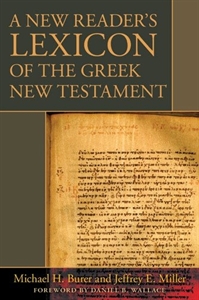
It was time for a new reader’s lexicon. Enter Michael Burer and Jeff Miller, two former students of mine. In 2008 Kregel published their A New Reader’s Lexicon of the Greek New Testament. It was a significant improvement over Kubo. Not only is it indexed to the glosses in BDAG, it also is keyed especially to the contextually-sensitive glosses. Further, it gives a threefold word-count for the entries: book, author, and NT. For a long time I wanted to see at a glance the favored lexical stock of a particular author, not only in terms of the book I was studying but also his other contributions to the canon. As well, issues related to authorship (as far as vocabulary can give us insights) have needed a ready table of information. The New Reader’s Lexicon supplies this information at a glance by listing the frequency of words according to the traditional authorship of New Testament books. Thus, for example, the corpus Paulinum includes all thirteen letters to which his name is attached.

Any tool that can simultaneously function well on multiple levels—pedagogical, reference, translation, and exegesis—is rare indeed. What Kubo did for one generation, Burer and Miller’s New Reader’s Lexicon should do for the next.

However, I have been tracking both Kubo and Burer-Miller on Amazon recently and noticed that Kubo continues to outsell Burer-Miller, even five years after the latter’s publication. Perhaps it is because it is only 2/3 the price, perhaps because Kregel is a small publishing house compared to Zondervan. But even with the higher price of Burer-Miller it is well worth the cost. It is long past the time to bid Kubo a fond farewell for the years of service it has given students of the New Testament, and say hello to Burer-Miller.

Postscript

When Burer-Miller was in the press, Kregel asked me to write the Foreword, which I was happy to do. And they asked me to be the senior editor of a new series of reader’s lexica. After nearly six years of work, the second volume in this series was published (earlier this month). The design of Burer-Miller was so good that Brittany Burnette, Terri Moore (both former interns of mine), and I adopted it when we edited the second reader’s lexicon in the series (A Reader’s Lexicon of the Apostolic Fathers). We even included word-frequencies for Ignatius’s seven letters so that one could see at a glance what words were important to that church father. We are now wrestling with what the third volume should be. Contenders are the Septuagint (four volumes—the Law, the Psalms [including all poetic and other books], the Prophets, and the Apocrypha [or, for my Roman Catholic friends, the Deutero-canonical books]), the Apologists, Philo, and Josephus. Have a suggestion? I’m all ears.